roadwise.Open study app

Alaska driving lesson · Turns & Intersections

Signaling & towing

A 3-minute lesson from the Alaska course. Read the rules and examples, follow the handbook page references, and check your understanding before you move on.

Read time
3 minutes
Course unit
Turns & Intersections
Checkpoint questions
6
Source pages
35, 50

Your signal tells everyone around you what you're about to do; the driver behind you can't read your mind. Alaska law says when to signal, how long, and that you must cancel it afterward.

Know the rule

A hand-and-arm or directional signal of your intent to turn or move right or left must be given continuously during the last 100 feet before turning.

Handbook p. 35 ↗
100 feet

Minimum distance you must signal continuously before a turn

Handbook p. 35 ↗

Know the rule

Signal from farther back when traffic conditions or your higher speed warrant it.

Handbook p. 35 ↗

Know the rule

Never stop or suddenly slow down without signaling your intentions.

Handbook p. 35 ↗

Know the rule

Alaska law requires you to cancel your directional signal after using it. A forgotten signal still tells others you're turning and may tempt someone to pull out in front of you.

Handbook p. 35 ↗

Know the rule

Keep turn signals clean and free of dust, dirt, ice and snow.

Handbook p. 35 ↗

Know the rule

Use hand signals when the sun is shining brightly or when a line of cars behind you could hide your turn signal light.

Handbook p. 35 ↗
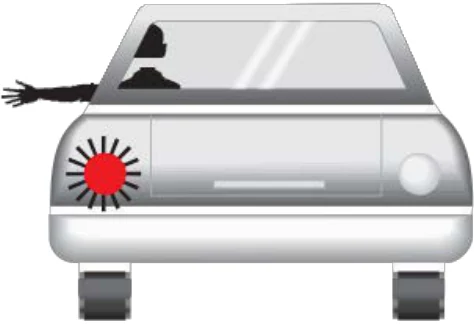
Hand signal left turn
Hand signal: left turn
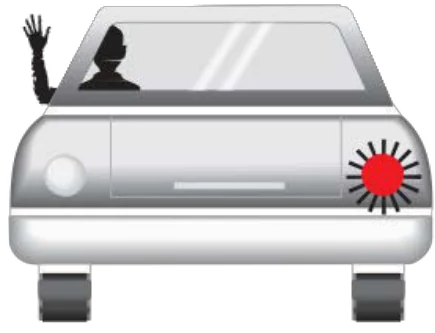
Hand signal right turn
Hand signal: right turn
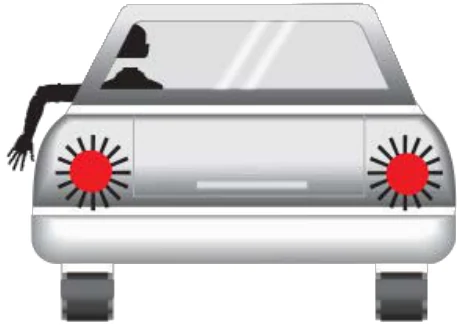
Hand signal stop or slow
Hand signal: stop or slow

Hand signals (left arm out the window)

Hand signals (left arm out the window)
MeaningArm position
Left turnLeft arm fully extended straight out
Right turnLeft arm extended and bent up at the elbow
Stop or slowLeft arm extended and bent down at the elbow
Handbook p. 50 ↗

Know the rule

Bicyclists are also required to use hand signals to signal a turn.

Handbook p. 35 ↗

Know the rule

You may not tow more than one vehicle unless the towing vehicle weighs more than 15,000 pounds, has three or more axles, and has air brakes on both the towing and towed vehicles (13 AAC 04.205(e)).

Handbook p. 35 ↗

Put it into practice

Low evening sun is shining straight onto the back of your car as you prepare to turn left. Your turn signal may be hard to see, so also extend your left arm straight out the window for at least the last 100 feet.

Check your understanding

Read the question, decide on an answer, then open it to check the explanation. These are Roadwise study questions based on the source handbook.

How far in advance must you signal your intention to turn?
  1. At least 100 feet
  2. At least 50 feet
  3. At least 200 feet
  4. At least 25 feet

Answer: At least 100 feet

A turn signal must be given during at least the last 100 feet before turning.
Handbook p. 35 ↗
When must a turn signal be given continuously?
  1. Only at the exact moment of the turn
  2. During the last 100 feet
  3. For the entire block before the turn
  4. Only if other vehicles are visible

Answer: During the last 100 feet

The signal must be given continuously during the last 100 feet traveled before turning.

Handbook p. 35 ↗
What must you do with your turn signal after completing a turn?
  1. Leave it on until your next turn
  2. Leave it on through the next intersection
  3. Cancel it
  4. It cancels automatically on all vehicles

Answer: Cancel it

Alaska law requires you to cancel your directional signal after using it.

Handbook p. 35 ↗
When should you use hand signals instead of your turn signal lights?
  1. Only when your vehicle is stopped
  2. Only at night
  3. Never, hand signals are illegal for cars
  4. When bright sunshine could obscure your signal light

Answer: When bright sunshine could obscure your signal light

Use hand signals when sun glare or a line of following cars could obscure your signal light.

Handbook p. 35 ↗
Are bicyclists required to signal their turns?
  1. Yes, using hand signals
  2. No, bicycles are exempt from signaling
  3. Only if riding with a group
  4. Only on roads with a speed limit over 35 mph

Answer: Yes, using hand signals

Bicyclists are also required to use hand signals to signal a turn.

Handbook p. 35 ↗
What can happen if you fail to cancel your turn signal after turning?
  1. Other drivers will assume you are going straight
  2. Another driver may turn in front of you
  3. It only matters on multi-lane highways
  4. Nothing, since it has no effect on other drivers

Answer: Another driver may turn in front of you

An unintended signal still communicates a turn to other drivers, which can tempt them into your path.

Handbook p. 35 ↗
Take the lesson checkpoint in the app

More in Turns & Intersections