Good turns are planned early: pick the correct lane well ahead, signal at least 100 feet out, yield, and finish in the proper lane. When you need to turn around, choose the safest method, not the quickest.
Left turn, two-way street onto a one-way street:
- Make the proper two-way approach and signal at least 100 feet in advance
- Yield to all road users
- Don't turn before reaching the crosswalk
- Look out the left window for pedestrians and check your turn path
- Turn sharply into the first lane
Left turn, one-way street onto a two-way street:
- Approach in the lane farthest to the left on the one-way street
- Signal at least 100 feet in advance
- Don't start the turn at the crosswalk; drive into the intersection, then turn into the proper lane
Waiting to turn left at a signal:
- Wait for the traffic signal cue to turn
- Wait for oncoming vehicles before entering; don't go past the center of the intersection
- Keep your front wheels straight while waiting
- Look out the left window for pedestrians and check your turn path
Every turn:
- Get into the proper lane well ahead of the turn
- Signal for at least 100 feet
- Yield to oncoming vehicles and to pedestrians
- Turn into the proper lane; don't loop or cut corners
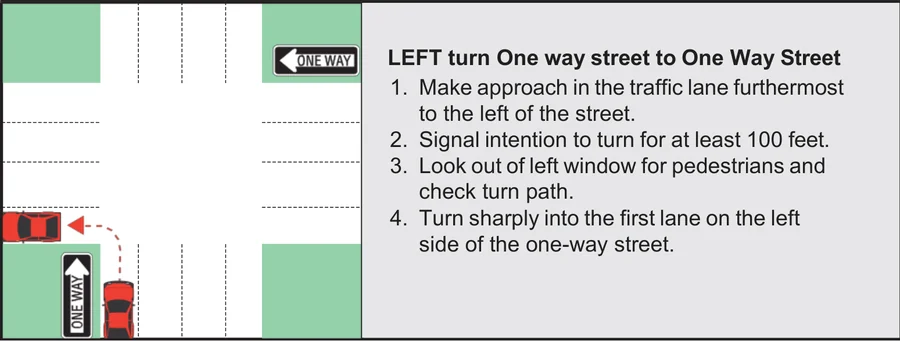
Know the rule
Left turn from one-way onto one-way: approach in the lane farthest left, signal for 100 feet, check for pedestrians, and turn sharply into the first lane on the left side of the new street.
Handbook p. 37 ↗Know the rule
Right turn: signal for 100 feet, get into the proper lane early, look out the right side of the windshield for pedestrians, and watch for vehicles ahead turning right that may stop for pedestrians.
Handbook p. 37 ↗Three-point turn (on a narrow street, unless prohibited):
- Signal right, pull to the far right and stop
- Signal left and check for traffic
- If clear, turn left across the street until pointing at the curb or left shoulder
- Check traffic, turn the wheels fully right, and back to the opposite side
- Stop, check traffic again, and drive forward to finish
Know the rule
During a three-point turn, yield to traffic, bicyclists, and pedestrians from both directions. For extra safety, sound your horn before backing.
Handbook p. 37 ↗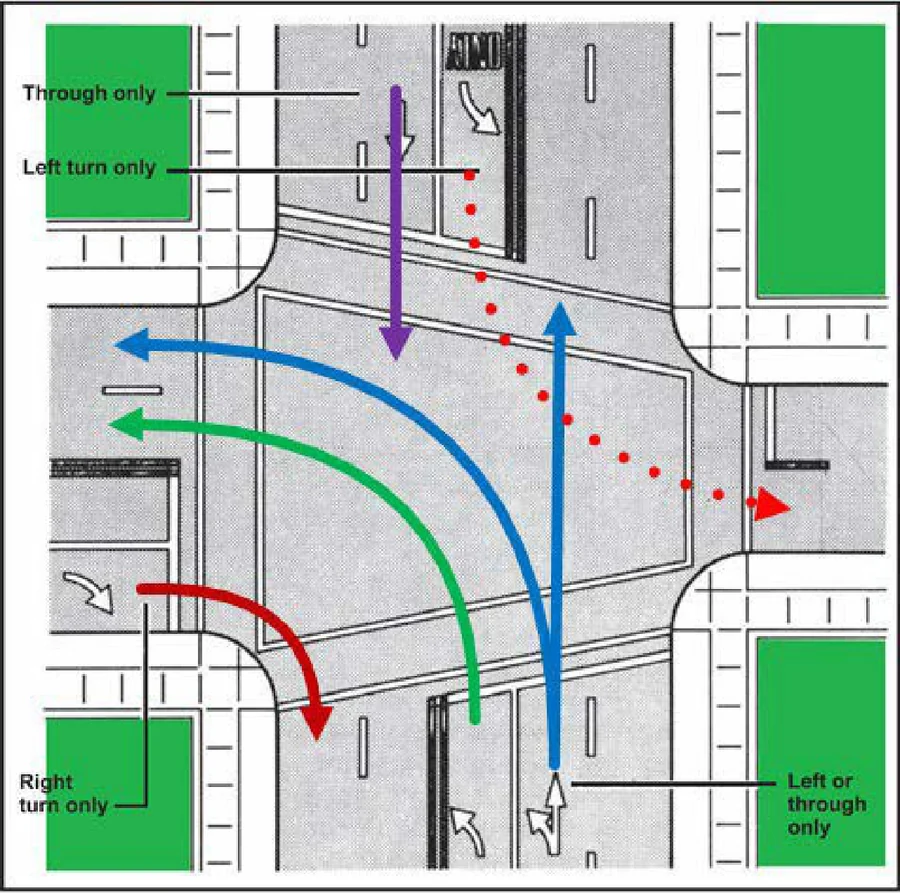
Know the rule
If you're in the wrong lane to turn as you enter an intersection, don't turn or block traffic to get over. Continue around the block, and watch for no "U" turn signs.
Handbook p. 62 ↗Know the rule
On a highway, don't turn around near a curve or hill where you can't see 500 feet or more in each direction. In the city, the safest method is to drive around the block.
Handbook p. 79 ↗Put it into practice
You're waiting in the intersection to turn left while oncoming cars pass. Keep your wheels pointed straight ahead. If you're rear-ended with them turned, you'd be pushed into oncoming traffic.