roadwise.Open study app

Alaska driving lesson · Speed, Following Distance & Highways

Highways: lanes, blind spots & freeways

A 3-minute lesson from the Alaska course. Read the rules and examples, follow the handbook page references, and check your understanding before you move on.

Read time
3 minutes
Course unit
Speed, Following Distance & Highways
Checkpoint questions
3
Source pages
69, 70

On high-speed roads, small mistakes are costly: a missed blind spot, a slow merge, a sudden stop at an exit. The handbook's highway rules keep traffic flowing and prevent rear-end crashes.

Hill crest sightline
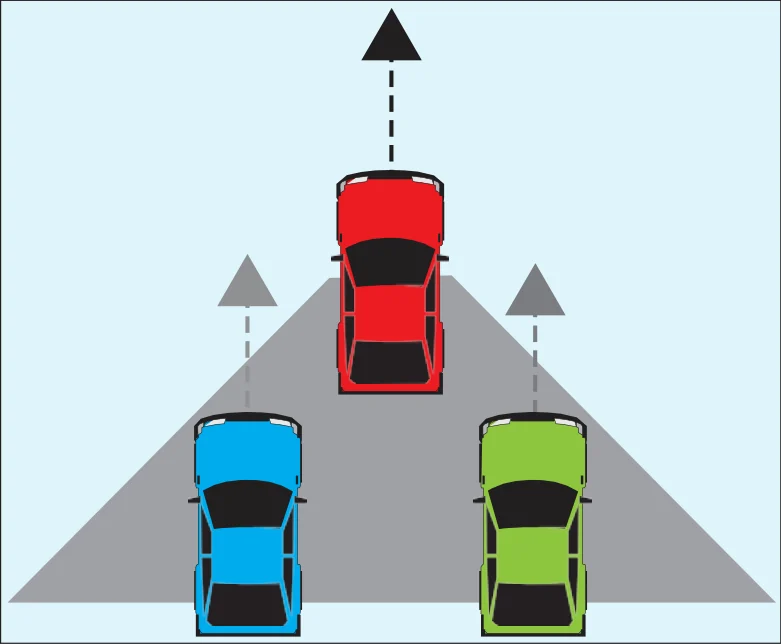
Blind spots: the front driver can't see the two cars behind in the inside mirror

Changing lanes:

  • Use your mirrors
  • Check your blind spots
  • Signal your intentions
  • Check mirrors and blind spots again
  • Change lanes gradually and carefully
Handbook p. 69 ↗

Know the rule

Look over your shoulder toward the rear before changing lanes, and if traffic permits, don't cruise in the blind spot of the vehicle ahead.

Handbook p. 69 ↗

Passing on the highway:

  • Slow-moving vehicles must keep right
  • Safe passing depends on cooperation: don't speed up when being passed
  • Don't cut in too soon; quick movements at high speed can be fatal
  • Mind a truck's "deaf spot": partial vacuum often keeps truck drivers from hearing your horn
Handbook p. 69 ↗
Freeway acceleration/deceleration lanes
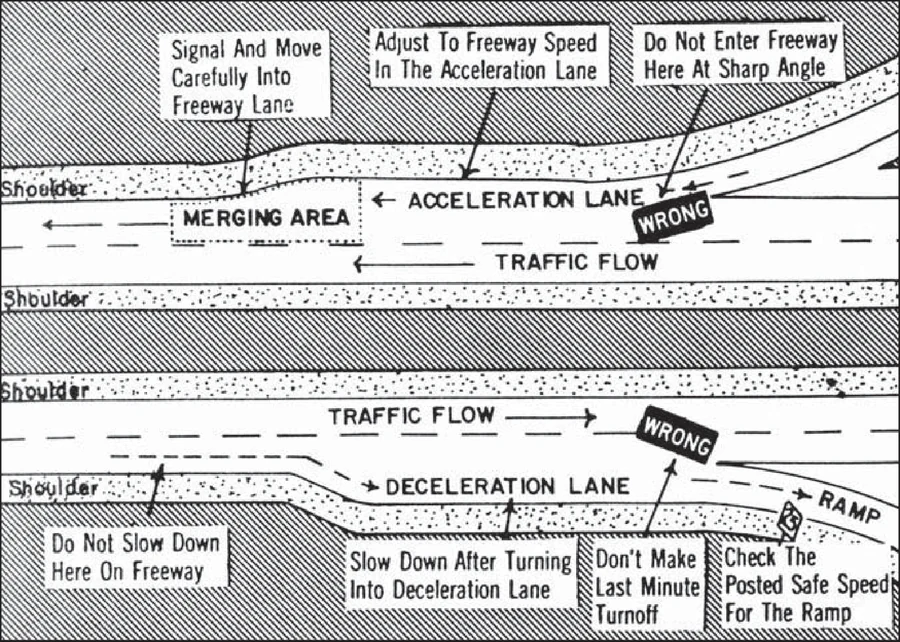
Entering and leaving a freeway: acceleration and deceleration lanes

Know the rule

Entering a freeway: use the acceleration lane to reach cruising speed before merging, and yield to approaching freeway traffic. Stop if necessary, but watch the vehicles behind you.

Handbook p. 70 ↗

Leaving an expressway:

  • Keep moving on the expressway; a stop can cause a serious rear-end crash
  • Move into the deceleration lane, then slow down
  • Plan ahead and watch for exit signs
  • If you miss your exit, don't back up; go to the next exit
  • If you take a wrong exit, don't stop; stops are a primary cause of rear-end crashes
Handbook p. 70 ↗

Know the rule

Except in an emergency, parking is prohibited on the paved portion of the highway, the shoulders, or anywhere within the right-of-way.

Handbook p. 70 ↗

Know the rule

Make only authorized turns on a highway or freeway. Dimming headlights is required on divided highways just like everywhere else.

Handbook p. 70 ↗

Put it into practice

You're heading for an exit but traffic keeps you from getting over and you pass it. Don't stop or back up on the shoulder. Continue to the next exit and turn around from there.

Check your understanding

Read the question, decide on an answer, then open it to check the explanation. These are Roadwise study questions based on the source handbook.

When entering a freeway, what should you use the acceleration lane for?
  1. To reach cruising speed before merging
  2. To drive until the lane ends, then merge
  3. To pass slower cars on the ramp
  4. To slow down before joining traffic

Answer: To reach cruising speed before merging

Use the acceleration lane to get up to cruising speed before attempting to merge into the traffic stream.
Handbook p. 70 ↗
You miss your exit on an expressway. What should you do?
  1. Back up along the shoulder to the exit
  2. Continue on to the next exit
  3. Stop on the shoulder and wait for a gap
  4. Cut across the lane lines to reach the ramp

Answer: Continue on to the next exit

If you miss an exit, don't back up; go to the next exit.

Handbook p. 70 ↗
Before changing lanes, what should you do in addition to using your mirrors?
  1. Tap your brakes to warn drivers behind
  2. Sound your horn to warn nearby drivers
  3. Look over your shoulder to check blind spots
  4. Speed up to open a gap first

Answer: Look over your shoulder to check blind spots

Check mirrors and look over your shoulder toward the rear to check blind spots before changing lanes.

Handbook p. 69 ↗
Take the lesson checkpoint in the app

More in Speed, Following Distance & Highways