roadwise.Open study app

Alabama driving lesson · Traffic Laws

School buses

A 3-minute lesson from the Alabama course. Read the rules and examples, follow the handbook page references, and check your understanding before you move on.

Read time
3 minutes
Course unit
Traffic Laws
Checkpoint questions
6
Source pages
21, 63, 64, 83

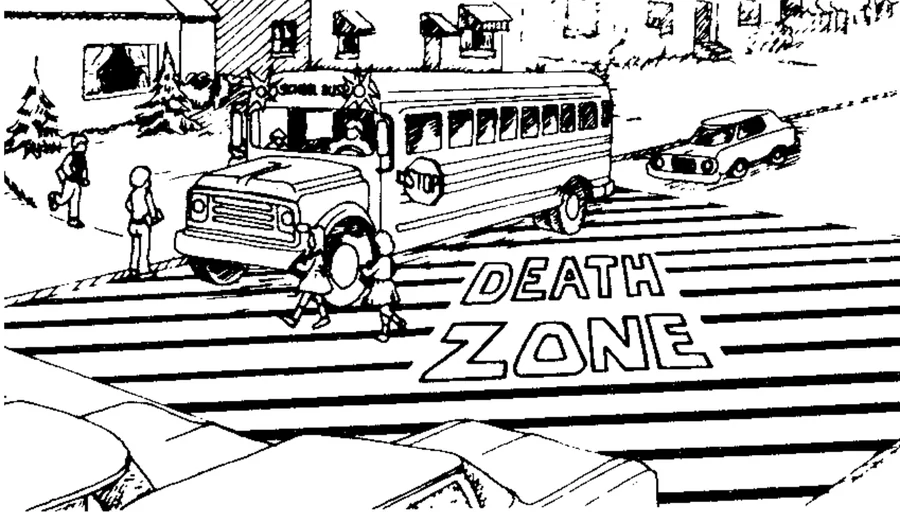
Children getting on and off a bus are at the greatest risk outside the bus. Most are struck by drivers who fail to stop for flashing red lights and the extended stop arm.

Know the rule

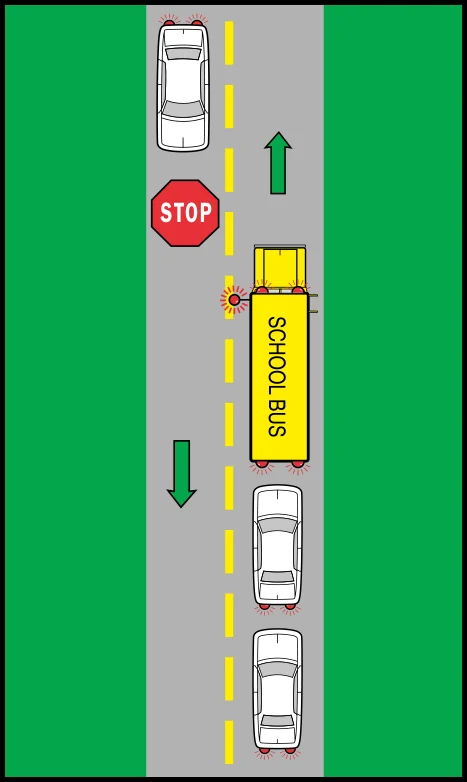
Stop when meeting or following a school or church bus stopped on the road with its stop arm out and red lights flashing. Stay stopped until the arm is retracted and the lights go off.

Handbook p. 63 ↗

Know the rule

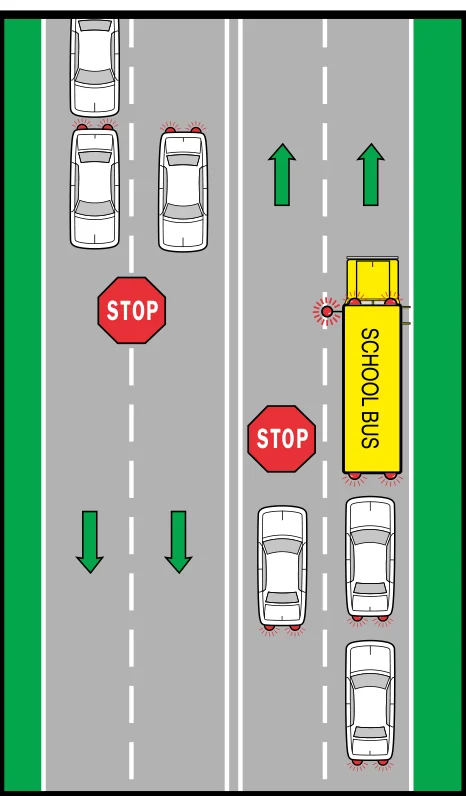
You must also stop when meeting or following a school or church bus stopped on a four-to-six-lane undivided highway.

Handbook p. 63 ↗

Know the rule

No stop is required on a divided highway of four or more lanes (at least two each way) when the bus is in the opposing roadway, or in a loading zone where pedestrians can't cross.

Handbook p. 63 ↗
20 feet

Stop at least this far from a school bus showing its stop signals, coming from either direction

Handbook p. 64 ↗

Flashing amber lights

A pre-warning that the bus is preparing to stop to load or unload children. Flashing red lights and an extended stop arm mean the bus has stopped.

Handbook p. 64 ↗

When a bus turns on amber lights

When a bus turns on amber lights
AreaAt least this far before stopping
Rural areas300 feet
Municipalities100 feet
Handbook p. 64 ↗
School bus stop law (all lanes stop)
Multi-lane undivided road: traffic in both directions stops for the bus
School bus stop law (divided highway)
Two-lane road: traffic in both directions stops for the bus

Death zone

The area around a stopped school bus, where most children hurt or killed in pupil transportation are struck by motorists who fail to stop.

Handbook p. 83 ↗
School bus danger zone
The "death zone" around a stopped school bus
5 points

Passing a stopped school bus

Handbook p. 21 ↗

Put it into practice

On a four-lane undivided road, a school bus stops on the far side with its red lights flashing and stop arm out. You must stop at least 20 feet away, even though you're traveling the other way. On a divided highway with a median, you could keep going.

Check your understanding

Read the question, decide on an answer, then open it to check the explanation. These are Roadwise study questions based on the source handbook.

On a divided highway of four or more lanes, is a stop required when meeting a school bus stopped in the OPPOSING roadway?
  1. Yes, traffic from both directions must stop
  2. No, a stop is not required
  3. Only if children are visible
  4. Only if driving over 45 mph

Answer: No, a stop is not required

A stop is not required on a divided highway with four or more lanes (permitting at least two lanes each direction) when meeting a bus stopped in the opposing roadway.
Handbook p. 63 ↗
How far from a stopped school bus with flashing red lights must you stop?
  1. At least 50 feet
  2. At least 20 feet
  3. At least 10 feet
  4. At least 30 feet

Answer: At least 20 feet

The handbook instructs drivers to stop at least 20 feet from the bus.

Handbook p. 64 ↗
In rural areas, how far before stopping does a school bus typically activate its amber warning lights?
  1. At least 100 feet
  2. At least 50 feet
  3. At least 300 feet
  4. At least 500 feet

Answer: At least 300 feet

In rural areas, amber lights are used at least 300 feet before the bus stops.

Handbook p. 64 ↗
In municipalities, how far before stopping does a school bus typically activate its amber warning lights?
  1. At least 500 feet
  2. At least 20 feet
  3. At least 300 feet
  4. At least 100 feet

Answer: At least 100 feet

In municipalities, amber lights are used at least 100 feet before the bus stops, versus 300 feet in rural areas.

Handbook p. 64 ↗
From which directions must traffic stop for a school bus with flashing red lights and extended stop arm, on a typical two-lane road?
  1. Only oncoming traffic
  2. Coming from either direction
  3. Only from behind the bus
  4. Only traffic in the right lane

Answer: Coming from either direction

The handbook states drivers coming from either direction must stop when they see these signals displayed.

Handbook p. 64 ↗
What is the area around a stopped school bus, where most child pedestrian injuries occur, referred to as?
  1. The Safety Corridor
  2. The Loading Perimeter
  3. The Death Zone
  4. The No-Zone

Answer: The Death Zone

The handbook calls the area around a stopped school bus the “Death Zone,” since most injuries happen outside the bus, not on it.

Handbook p. 83 ↗
Take the lesson checkpoint in the app

More in Traffic Laws