roadwise.Open study app

Alabama driving lesson · Traffic Laws

Passing safely

A 3-minute lesson from the Alabama course. Read the rules and examples, follow the handbook page references, and check your understanding before you move on.

Read time
3 minutes
Course unit
Traffic Laws
Checkpoint questions
6
Source pages
21, 66, 67

Many deaths and serious injuries on two-lane highways come from head-on and sideswipe crashes, mostly caused by improper or careless passing. Passing takes planning and a lot of clear road.

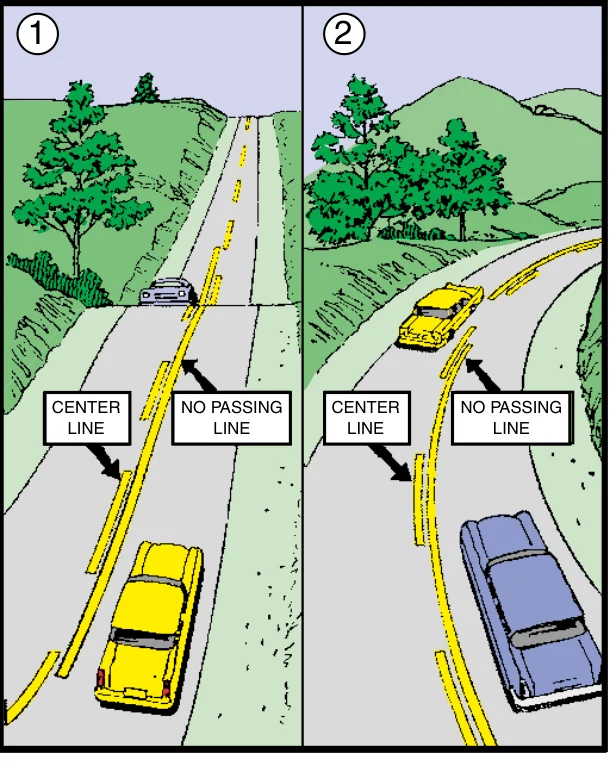
Center line and no-passing line examples
No-passing zones marked by a solid yellow line on your side of the center line

Know the rule

On a two-lane, two-way road, you may pass on the left if you can complete the pass safely without exceeding the speed limit.

Handbook p. 66 ↗

How to pass:

  • Check the road ahead for enough distance and behind for anyone preparing to pass you
  • Signal the driver ahead: a tap of the horn, or a flick of the headlights at night
  • Turn on your left signal before passing
  • Turn on your right signal after passing, before returning to the right lane
  • Return only when you can see the entire front of the passed vehicle in your inside mirror
Handbook p. 66 ↗

Know the rule

When someone is passing you, stay in your lane and don't speed up.

Handbook p. 66 ↗

Know the rule

Use extreme caution when passing at night, in poor visibility, and on roads slippery from rain, snow or ice.

Handbook p. 66 ↗

Know the rule

Passing on the right is allowed on one-way roads and on roads marked for two or more lanes moving in the same direction. Check ahead and behind and signal. A signal alone doesn't give you the right to pass.

Handbook p. 66 ↗

Know the rule

Driving on the shoulder to pass is unlawful, except in an emergency or when traffic authorities direct you to.

Handbook p. 67 ↗

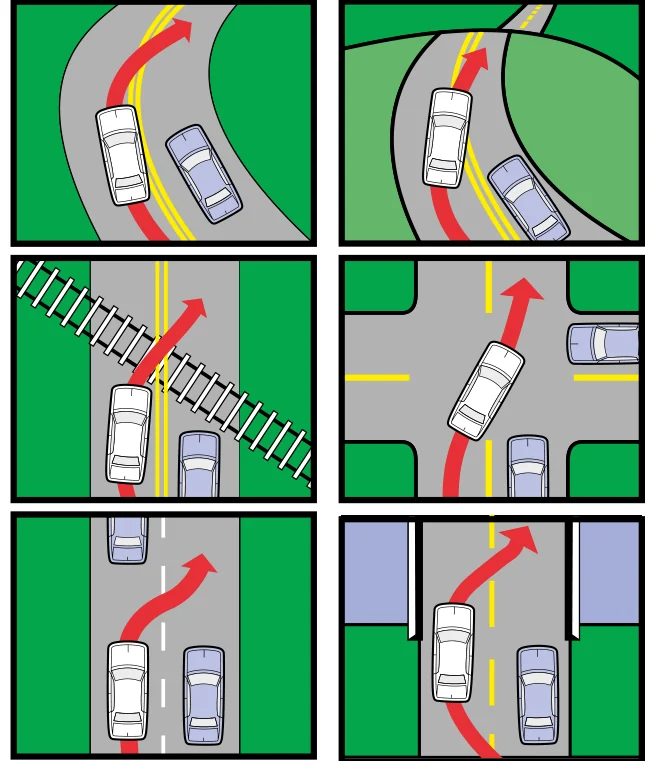
You may not cross the center line to pass:

  • On a curve or hill where you can't see a clear passing distance of at least 500 feet
  • At a highway intersection
  • When meeting an oncoming vehicle
  • Where signs prohibit it, or a solid yellow line is on your side of the center line
  • Across a double solid yellow line (prohibited in both directions)
Handbook p. 67 ↗
500 feet

Minimum clear sight distance needed to pass on a curve or hill

Handbook p. 67 ↗
Lane position through curves
No-passing zones: examples include curves, hills and intersections
4 points

Wrong side of road / illegal passing

Handbook p. 21 ↗

Put it into practice

You're following a slow truck on a two-lane road that curves over a hill, and you can see only about 300 feet ahead. Stay behind it. You need at least 500 feet of clear passing distance, and a solid yellow line on your side would forbid passing anyway.

Check your understanding

Read the question, decide on an answer, then open it to check the explanation. These are Roadwise study questions based on the source handbook.

You may not cross the center line to pass on a curve or hill unless you can see a clear passing distance of at least how far?
  1. 100 feet
  2. 200 feet
  3. 500 feet
  4. 1,000 feet

Answer: 500 feet

You may not pass on a curve or hill unless you can see at least 500 feet of clear passing distance.
Handbook p. 67 ↗
On a one-way street or a road marked for two or more lanes in the same direction, is passing on the right ever legal?
  1. No, passing on the right is always illegal
  2. Only when the driver ahead turns left
  3. Only during emergencies
  4. Yes, it's permissible there

Answer: Yes, it's permissible there

Passing on the right is permitted on one-way roadways and roads marked for two or more lanes of traffic moving the same direction.

Handbook p. 66 ↗
When is it legal to drive on the shoulder to pass another vehicle?
  1. Only during an emergency or when directed by traffic authorities
  2. Only on interstate highways
  3. Whenever traffic is congested
  4. Any time it's safe to do so

Answer: Only during an emergency or when directed by traffic authorities

Driving on the shoulder to pass is unlawful except during an emergency or when directed by traffic authorities.

Handbook p. 67 ↗
At which location are you never allowed to cross the center line to pass?
  1. On a long straightaway
  2. At a highway intersection
  3. On a road with a 55 mph limit
  4. On a four-lane road

Answer: At a highway intersection

You may not cross the center line to pass at a highway intersection.

Handbook p. 67 ↗
After passing a vehicle on a two-lane road, when should you return to the right lane?
  1. As soon as your rear bumper clears its front
  2. Immediately after signaling right
  3. Once you reach the speed limit
  4. When its entire front shows in your inside mirror

Answer: When its entire front shows in your inside mirror

Don't return to the right lane until you can see the entire front of the vehicle you passed in your interior rearview mirror.

Handbook p. 66 ↗
What should you do if another car is trying to pass you?
  1. Keep your lane; don't speed up
  2. Speed up to prevent them from passing
  3. Move toward the center line
  4. Move onto the shoulder immediately

Answer: Keep your lane; don't speed up

When another car is passing you, stay in your lane and don't increase your speed.

Handbook p. 66 ↗
Take the lesson checkpoint in the app

More in Traffic Laws