roadwise.Open study app

Alabama driving lesson · Signs, Signals & Road Markings

Pavement markings

A 3-minute lesson from the Alabama course. Read the rules and examples, follow the handbook page references, and check your understanding before you move on.

Read time
3 minutes
Course unit
Signs, Signals & Road Markings
Checkpoint questions
6
Source pages
54, 55, 56

Lines on the road are traffic controls too. Their color tells you the direction of traffic, and whether they're solid or broken tells you if you may cross.

The four types of pavement markings:

  • Centerline striping
  • Edge striping
  • Crosswalks
  • Pavement messages
Handbook p. 54 ↗

Know the rule

Centerlines separate traffic moving in opposite directions. They are yellow on two-lane highways and white on multi-lane highways and one-way streets.

Handbook p. 54 ↗

What the lines mean

What the lines mean
MarkingMeaning
Broken centerlineNo passing restriction; pass when safe
Solid yellow beside broken line, your sideYou may not pass
Two solid yellow linesNo passing in either direction
Broken white linesLane dividers, same direction; may cross to pass
Solid white edge lineCross only to move to or from the shoulder
Normal solid white lineSame direction both sides; crossing discouraged
Wide solid white lineEmphasis: crossing requires unusual care
Handbook p. 54 ↗

Know the rule

A double solid white line separates lanes going the same direction; crossing it is prohibited.

Handbook p. 55 ↗

Know the rule

Yellow lines are sometimes used as left edge lines on divided roads, and to mark obstructions and islands, which must be passed on the right.

Handbook p. 54 ↗

Know the rule

White solid lines mark crosswalks. With no controlling signals, you must stop at every crosswalk occupied by pedestrians.

Handbook p. 55 ↗

Know the rule

Pavement messages such as SCHOOL ZONE or RR CROSSING warn of conditions ahead and are lettered in white paint.

Handbook p. 55 ↗
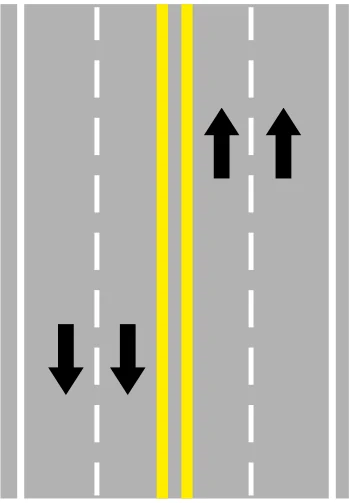
Double solid yellow lines
Two-lane, two-way road: passing permitted
Double solid yellow lines
Two-lane, two-way road: passing prohibited in one direction
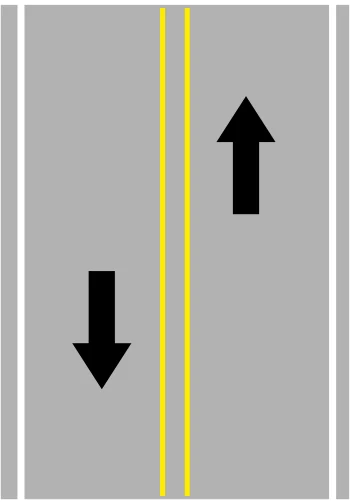
Double solid yellow lines
Double yellow: no passing either way; cross only as part of a left turn
Solid yellow center line
Multi-lane, two-way road: cross the centerline only as part of a left turn
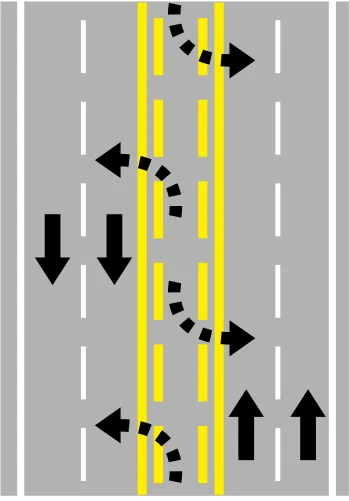
Two-way left turn lane markings
Two-way left-turn lane, reserved for left turns in either direction
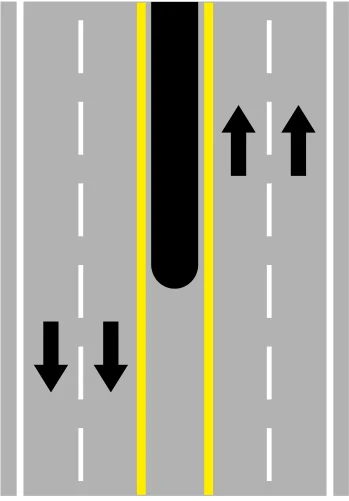
Reversible lane markings
Divided multi-lane roadway with a non-traversable divider

Put it into practice

On a two-lane road, the centerline on your side changes from broken to solid yellow while the other side stays broken. You may not pass here, but drivers coming the other way may.

Check your understanding

Read the question, decide on an answer, then open it to check the explanation. These are Roadwise study questions based on the source handbook.

On a two-lane highway, what color is the centerline that separates opposing traffic?
  1. Orange
  2. White
  3. Red
  4. Yellow

Answer: Yellow

Under the Uniform Code, centerlines are painted yellow on two-lane highways.
Handbook p. 54 ↗
If there is a solid yellow line on your side of the centerline, what does it mean?
  1. Passing is allowed at night only
  2. You may not pass
  3. You may pass only on the right
  4. You may pass if the way is clear

Answer: You may not pass

If a solid yellow line is on your side of the centerline, passing is not permitted for you.

Handbook p. 54 ↗
What do double solid yellow lines on a roadway mean?
  1. The road is one-way
  2. Passing is allowed with extra caution
  3. Neither direction may cross it to pass
  4. Passing is allowed only in daylight

Answer: Neither direction may cross it to pass

Double solid yellow lines prohibit traffic from both directions from crossing the center line to pass.

Handbook p. 54 ↗
Broken white lines between lanes moving in the same direction indicate what?
  1. You may never cross them
  2. They mark the edge of the roadway
  3. They indicate a bike lane
  4. They may be crossed when passing

Answer: They may be crossed when passing

Broken white lane dividers may be crossed when passing or changing lanes.

Handbook p. 54 ↗
A solid white line marking the edge of the traffic lane may be crossed only when doing what?
  1. To or from the shoulder
  2. Making a U-turn
  3. Passing another vehicle
  4. Entering a bike lane

Answer: To or from the shoulder

Edge striping (a solid white line) indicates the outside edge of the travel lane and may be crossed only when moving to or from the shoulder.

Handbook p. 54 ↗
What do double solid white lines between lanes moving in the same direction mean?
  1. The lane is closed ahead
  2. No crossing between lanes
  3. It's a merging area
  4. Crossing is allowed with caution

Answer: No crossing between lanes

Double solid white lines delineate a travel lane where crossing between the lanes is prohibited.

Handbook p. 55 ↗
Take the lesson checkpoint in the app

More in Signs, Signals & Road Markings