roadwise.Open study app

Wyoming driving lesson · Speed & Right-of-Way

Right-of-way at intersections

A 3-minute lesson from the Wyoming course. Read the rules and examples, follow the handbook page references, and check your understanding before you move on.

Read time
3 minutes
Course unit
Speed & Right-of-Way
Checkpoint questions
6
Source pages
42, 43, 47, 92

Right-of-way laws don't give anyone the right to go. They only say who must yield. So even when the other driver should yield, stay ready in case they don't, and do everything you can to avoid a crash.

Right-of-way

Rules for who must yield where vehicles, bicycles or pedestrians can't all go at once. The law never gives the right of way; it only says who must yield it.

Handbook p. 42 ↗

Intersection

The area where highways or streets join or cross each other.

Handbook p. 92 ↗

Know the rule

Bicyclists are classified as vehicles and have the same rights and responsibilities as motor vehicle drivers.

Handbook p. 42 ↗

Know the rule

At an intersection with no signs or signals, yield to any driver coming from your right, no matter who reached and entered the intersection first.

Handbook p. 42 ↗

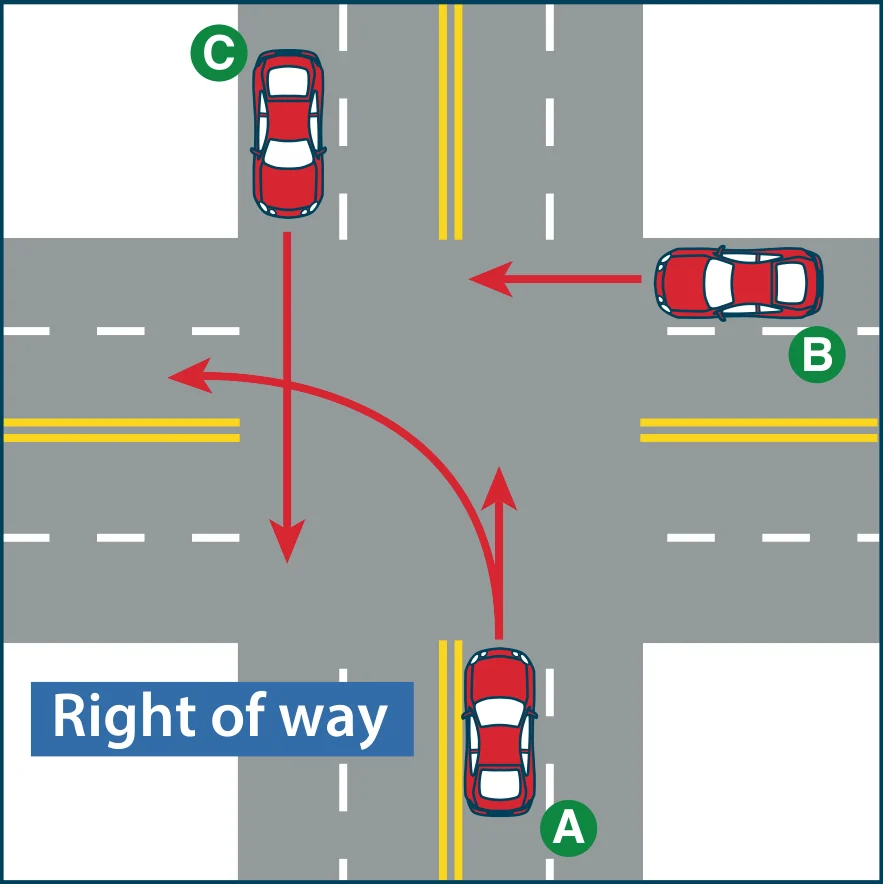
Right of way with no signs (see diagram):

  • Car A, going straight, yields to Car B coming from the right
  • If Car A turns left, it yields to both B and C
  • Car B yields to Car C
Handbook p. 43 ↗
Right-of-way at yield-sign intersection
Right of way at an intersection with no signs or signals

Before crossing anyone's path:

  • Check in front of you
  • Check to the left first, since vehicles from the left reach you first
  • Check for vehicles coming from the right
  • Make another check in both directions
Handbook p. 43 ↗

Know the rule

Don't depend on traffic signs or signals to give you a safe path. Check to the sides wherever others may cross or enter your path.

Handbook p. 43 ↗

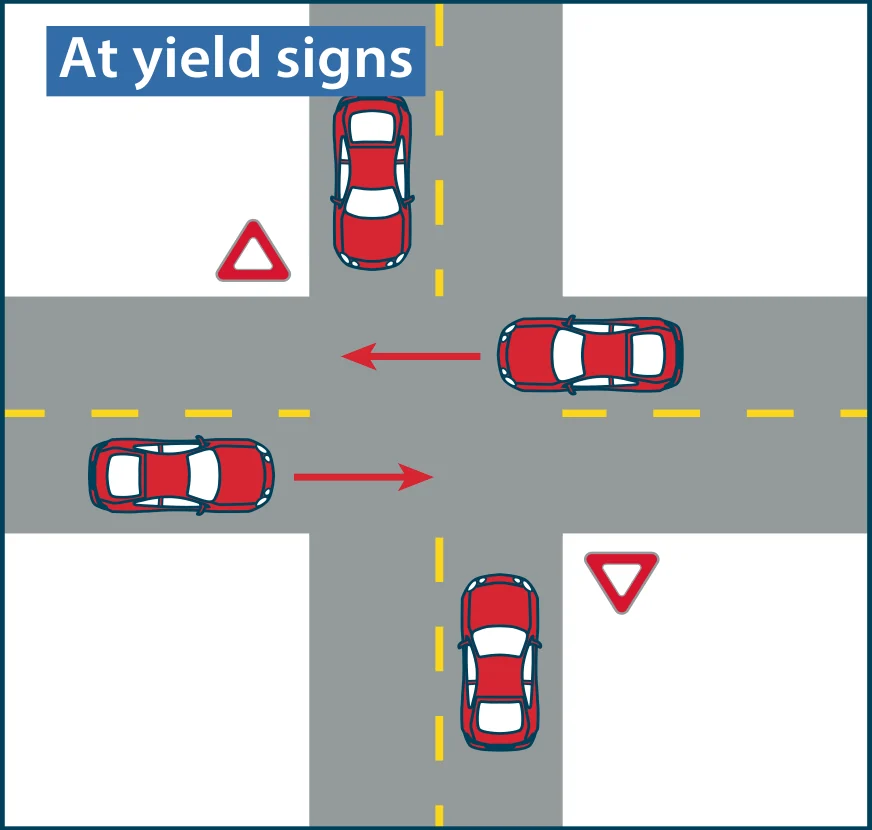
At a YIELD sign:

  • Check for cross traffic before you reach the intersection
  • Yield to cross traffic close enough to be dangerous
  • When turning onto a street or highway, yield to any vehicle close enough to be dangerous
  • Look for a gap, merge and adjust your speed
Handbook p. 43 ↗
Right-of-way at yield signs
Yield signs at an intersection

Put it into practice

You reach an unmarked rural intersection at the same time as a pickup on your right. You're going straight. Yield to the pickup, because it's coming from your right. If you were turning left, you'd also yield to oncoming traffic.

Check your understanding

Read the question, decide on an answer, then open it to check the explanation. These are Roadwise study questions based on the source handbook.

When approaching an intersection with a yield sign in your lane, you must always come to a full stop.
  1. True
  2. False

Answer: False

A yield sign requires you to yield to traffic close enough to be dangerous, not necessarily a full stop every time.

Handbook p. 43 ↗
At an intersection with no signs or signals, what is the right-of-way rule?
  1. The driver who arrives first goes first
  2. Yield to any driver coming from your left
  3. Yield to any driver coming from your right
  4. The driver going straight goes first

Answer: Yield to any driver coming from your right

Where no signs or signals are in place, you must yield the right of way to any driver coming from your right, regardless of who reaches the intersection first.

Handbook p. 42 ↗
At an uncontrolled intersection you plan to turn left. One car approaches from your right and another comes toward you from ahead. Whom must you yield to?
  1. Only the car on your right
  2. Only the oncoming car ahead of you
  3. Neither, if you signaled first
  4. Both the car on your right and the oncoming car

Answer: Both the car on your right and the oncoming car

In the p.43 diagram, Car A turning left yields to both Car B (on its right) and Car C (oncoming from ahead).
Handbook p. 43 ↗
After checking in front of you, which direction should you check next when others may cross your path?
  1. To the left, since you meet traffic from the left first
  2. To the right, since it has the right of way
  3. Behind you, for vehicles following too closely
  4. Straight ahead again, for oncoming traffic

Answer: To the left, since you meet traffic from the left first

Check in front of you, then check to the left first since you will meet vehicles coming from the left first, then check the right.

Handbook p. 43 ↗
At a yield sign, when must you yield to cross traffic?
  1. Only if the cross traffic has already stopped
  2. When it is close enough to be dangerous
  3. Only when there is a stop line painted
  4. Only when the cross traffic is turning

Answer: When it is close enough to be dangerous

If a yield sign is in your lane, you yield the right of way to cross traffic close enough to be dangerous.

Handbook p. 43 ↗
Bicyclists at intersections without signs or signals follow which right-of-way rule?
  1. Bicycles always have the right of way
  2. The same rules as motor vehicles
  3. Bicycles must yield to all motor vehicles
  4. The same rules as pedestrians

Answer: The same rules as motor vehicles

Bicyclists are classified as vehicles and granted the same rights and responsibilities as motor vehicle operators at intersections.

Handbook p. 42 ↗
Take the lesson checkpoint in the app

More in Speed & Right-of-Way