Roadwise States Wyoming Driving lessons Entering and driving the Interstate Wyoming driving lesson · Interstate Driving
Entering and driving the Interstate A 4-minute lesson from the Wyoming course. Read the rules and examples, follow the handbook page references, and check your understanding before you move on.
Read time 4 minutes
Course unit Interstate Driving
Checkpoint questions 6
Source pages 60, 61, 91, 92 Interstate traffic moves fast, so the key skills are merging smoothly, keeping a steady speed and space, and staying alert on long drives. Traffic already on the Interstate has the right of way, not you.
Know the rule
Watch for DO NOT ENTER and WRONG WAY signs; they mean you're about to go the wrong way up an exit ramp.
Handbook p. 60 ↗ Know the rule
If you're going the wrong way on a ramp, pull onto the shoulder, stop, and turn around only when there's no oncoming traffic.
Handbook p. 60 ↗ DO NOT ENTER and WRONG WAY signs Acceleration lane The lane an entrance ramp usually leads to. Its purpose is to let you match your speed to Interstate traffic.
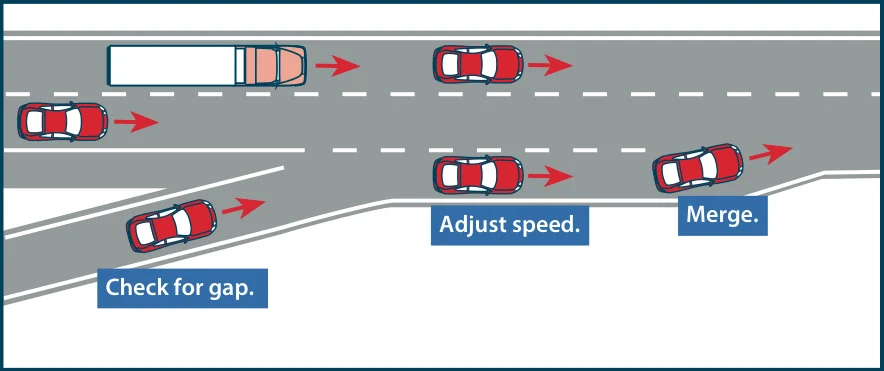
Handbook p. 60 ↗ As you approach the Interstate: CHECK over your shoulder for a gap in the traffic ADJUST your speed to meet that gap, and signal DO NOT STOP unless there is no gap in traffic MERGE at about the same speed as other traffic Handbook p. 60 ↗ Check for a gap, adjust speed, merge Gap in traffic An opening between vehicles in traffic large enough for a vehicle to enter safely.
Handbook p. 91 ↗ Know the rule
Traffic on the Interstate has the right of way. Don't count on others seeing you or moving over, and be ready if a vehicle ahead on the ramp slows or stops without warning.
Handbook p. 60 ↗ Once on the Interstate: MAINTAIN a steady speed, keeping pace with traffic, and OBEY posted limits Leave at least two seconds behind the vehicle ahead; double or triple it in bad weather or on slick pavement WATCH for entering vehicles; move left if safe to give them room Stay in the right lane unless overtaking and passing; avoid needless lane changes SIGNAL lane changes, check blind spots, and see the passed vehicle in your mirror before pulling in If you MISS your exit, go on to the next one; backing up on the Interstate is dangerous DO NOT cross the median Handbook p. 61 ↗ Know the rule
Rear-end collisions are the most frequent type of crash on the Interstate.
Handbook p. 61 ↗ Median A barrier of grass, concrete or other material separating two roadways, like the area between an Interstate's two sides. It's not legal to ride over, across or on it.
Handbook p. 92 ↗ Drowsiness is one of the greatest dangers in driving: To avoid it: open the windows for fresh air, sing along with the radio, keep your eyes moving If you become drowsy, stop and take a break If you're really sleepy, pull off the highway, check into a motel and get some sleep Handbook p. 61 ↗ Put it into practice
You pass your exit near Rawlins. Don't stop, back up or cut across the median. Keep going to the next exit and turn around there.
Check your understanding Read the question, decide on an answer, then open it to check the explanation. These are Roadwise study questions based on the source handbook.
What should you check before merging onto an Interstate from an entrance ramp? Over your shoulder for a gap in Interstate traffic Only your rearview mirror Nothing, since ramp traffic always has the right of way For a signal from drivers already on the Interstate Answer: Over your shoulder for a gap in Interstate traffic
As you approach the Interstate, check over your shoulder for a gap in traffic, adjust your speed, and merge.
Handbook p. 60 ↗ What is the purpose of the acceleration lane on an Interstate entrance ramp? To give exiting traffic room to slow down To let you match your speed to Interstate traffic To let slow trucks climb grades To let slower vehicles stop and wait Answer: To let you match your speed to Interstate traffic
The entrance ramp usually takes you to an acceleration lane, whose purpose is to let you match your speed to that of Interstate traffic.
Handbook p. 60 ↗ If you find yourself going the wrong way on an exit ramp, what should you do? Continue forward to reach the Interstate Back up slowly to the ramp entrance Pull over, stop, then turn around when clear Make a U-turn right away Answer: Pull over, stop, then turn around when clear
If you find yourself going the wrong way on a ramp, pull onto the shoulder, stop, and only turn around when there is no oncoming traffic.
Handbook p. 60 ↗ On the Interstate, what should you do with your following time when the weather is bad or the pavement is slick? Keep it at two seconds Add one extra second Double or triple it Increase it to three seconds Answer: Double or triple it
Always leave at least two seconds on the Interstate; when the weather is bad or the pavement is slick, double or triple your following time.
Handbook p. 61 ↗ What is the most frequent type of crash on the Interstate? Rear-end collisions Head-on collisions Rollovers Side-swipe collisions in construction zones Answer: Rear-end collisions
Rear-end collisions are the most frequent type of crashes on the Interstate, often from following too closely.
Handbook p. 61 ↗ What should you do if you miss your Interstate exit? Back up carefully on the shoulder Go on to the next exit Stop and wait for a gap to reverse Make a U-turn across the median Answer: Go on to the next exit
If you miss your exit, go on to the next exit. Backing up on the Interstate is dangerous.
Handbook p. 61 ↗ Previous lesson Parking rules Next lesson Leaving the Interstate and emergency stops More in Interstate Driving About the source Roadwise’s Wyoming course uses the driver handbook edition supplied with this study pack. This lesson cites source pages 60, 61, 91, 92. The linked PDF is a third-party mirror of the handbook, rather than a government-hosted page.
Open the handbook source PDF · View the source edition
For current application requirements, fees, appointments, and the format that applies to your age or license type, check Wyoming’s WYDOT. Roadwise provides study material and does not issue permits or licenses.