roadwise.Open study app

Vermont driving lesson · Speed, Turns, Right-of-Way & Parking

Right-of-way

A 3-minute lesson from the Vermont course. Read the rules and examples, follow the handbook page references, and check your understanding before you move on.

Read time
3 minutes
Course unit
Speed, Turns, Right-of-Way & Parking
Checkpoint questions
6
Source pages
29

Right-of-way rules decide who goes first when two road users want the same space. Not yielding the right-of-way is one of the poor driver decisions the handbook lists as a cause of crashes, so know exactly when you must wait.

Vermont right-of-way rules:

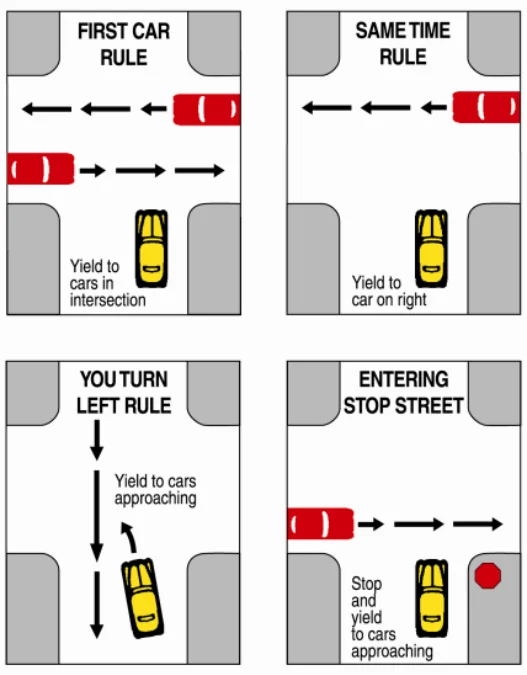
  • Yield to pedestrians, bicyclists and other traffic already in the intersection
  • At a yield sign, slow enough to stop if needed; enter only when the way is clear
  • At a four-way stop, the first vehicle to arrive should go first
  • Arriving at a four-way stop at about the same time: the driver on the left yields to the one on the right
  • Turning left: yield to all oncoming traffic, motor vehicles and bicyclists
  • Entering from a driveway, alley, parking lot or T-intersection: yield to all traffic on the road
  • Before entering any intersection, search in all directions and be sure your path is clear
Handbook p. 29 ↗
Four-way intersection right-of-way rules
Right-of-way: first-car rule, same-time rule, left-turn rule, entering a stop street

Know the rule

When two vehicles reach a four-way stop at about the same time from different directions, the driver on the left yields to the driver on the right.

Handbook p. 29 ↗

Know the rule

If you are turning left, you must yield to all oncoming traffic. Any vehicle coming toward you, including a bicyclist, has the right-of-way.

Handbook p. 29 ↗

Know the rule

A driver coming onto the road from a driveway, alley, parking lot or T-intersection must yield to all traffic on the road.

Handbook p. 29 ↗

Know the rule

Approaching a yield sign, travel slowly enough to stop if necessary, and enter only when the way is clear.

Handbook p. 29 ↗

Put it into practice

You and another car stop at a four-way stop at the same moment. The other car is on your right, so you yield and let it go first. If you had clearly arrived first, you would go first.

Check your understanding

Read the question, decide on an answer, then open it to check the explanation. These are Roadwise study questions based on the source handbook.

At a 4-way stop, who has the right-of-way?
  1. The vehicle on the left
  2. The vehicle turning right
  3. The first vehicle to arrive
  4. The vehicle going straight

Answer: The first vehicle to arrive

At a four-way stop, the first vehicle to arrive should have the right-of-way.
Handbook p. 29 ↗
Two vehicles reach a 4-way stop at approximately the same time from different directions. Who yields?
  1. The driver on the right yields to the driver on the left
  2. Whoever is going faster yields
  3. Neither; both proceed together
  4. The driver on the left yields to the driver on the right

Answer: The driver on the left yields to the driver on the right

When vehicles arrive together, the driver on the left should yield to the driver on the right.

Handbook p. 29 ↗
You're turning left across traffic. Who must you yield to?
  1. All oncoming traffic, including bicyclists
  2. Only oncoming cars, not bicyclists
  3. No one, once your signal is on
  4. Only vehicles that arrived before you

Answer: All oncoming traffic, including bicyclists

A driver turning left must yield to all oncoming traffic, whether a motor vehicle or a bicyclist.

Handbook p. 29 ↗
You're pulling out of a private driveway onto a public road. Who has the right-of-way?
  1. You, if no one is signaling
  2. All traffic already on the road
  3. Whoever is turning right
  4. You, since driveways have priority

Answer: All traffic already on the road

A driver entering from a driveway, alley, parking lot, or T-intersection must yield to all traffic on the road.

Handbook p. 29 ↗
Approaching a yield sign, what speed should you drive at?
  1. The posted speed limit
  2. 10 mph under the posted limit
  3. Slow enough to stop if necessary
  4. A full stop, every time

Answer: Slow enough to stop if necessary

At a yield sign, travel at a speed slow enough to stop if necessary, entering only when clear.

Handbook p. 29 ↗
At an intersection, a bicyclist is already partway through when you arrive in your car. Who has the right-of-way?
  1. The car, since it's larger
  2. The bicyclist
  3. Whoever signals first
  4. The vehicle on the right

Answer: The bicyclist

Drivers must yield the right-of-way to pedestrians, bicyclists, and other traffic already in the intersection.

Handbook p. 29 ↗
Take the lesson checkpoint in the app

More in Speed, Turns, Right-of-Way & Parking