roadwise.Open study app

Vermont driving lesson · Speed, Turns, Right-of-Way & Parking

Passing

A 3-minute lesson from the Vermont course. Read the rules and examples, follow the handbook page references, and check your understanding before you move on.

Read time
3 minutes
Course unit
Speed, Turns, Right-of-Way & Parking
Checkpoint questions
5
Source pages
52, 53

Passing puts you in the path of oncoming traffic, so do it only when you can see enough clear road to finish safely. The rules cover how to pass, how much room to leave, when you may pass on the right, and where passing is never allowed.

To pass:

  • Make sure you have enough distance to pass safely
  • Signal left
  • Check behind you: rearview mirrors, and over your left shoulder for the blind spot
  • Change lanes and pass on the left
Handbook p. 52 ↗

Know the rule

At night, you may blink your headlights from low to high to low beam to warn the driver ahead that you intend to pass.

Handbook p. 52 ↗

Know the rule

When towing a trailer, make sure you are well past the vehicle or bicycle before pulling back into its lane.

Handbook p. 52 ↗
4 feet

Minimum clearance between your vehicle and any vehicle or bicycle you pass

Handbook p. 53 ↗

Know the rule

Before returning, go far enough to see the entire front of the vehicle, or the bicyclist, in your inside rearview mirror. Then signal right, check your right blind spot and return to the right.

Handbook p. 53 ↗

Know the rule

When another vehicle is passing you, slow a little and keep right.

Handbook p. 53 ↗

You may pass on the right only:

  • On a multilane road
  • On a road that isn't multilane, if the vehicle or bicycle is turning or about to turn left and there's room
Handbook p. 53 ↗

Know the rule

You may never pass by driving off the pavement or main traveled part of the road.

Handbook p. 53 ↗

Do not pass at these locations:

  • Hills
  • Curves
  • Railroads
  • Intersections
  • Where you see a "changed path ahead"
Handbook p. 53 ↗
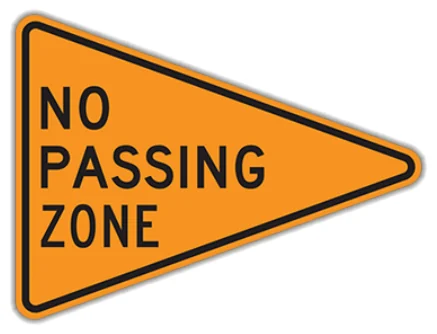
No passing zone
No Passing Zone sign

Put it into practice

On a two-lane road, the car ahead stops with its left signal on. There's a paved lane of room on its right, so you may pass on the right. You may not use the gravel shoulder, since passing off the pavement is never allowed.

Check your understanding

Read the question, decide on an answer, then open it to check the explanation. These are Roadwise study questions based on the source handbook.

When passing, how far beyond the vehicle or bicyclist should you go before returning to the right side of the road?
  1. Until your rear bumper just clears its front bumper
  2. At least one car length past it
  3. Until you can see its entire front in your inside rearview mirror
  4. Until you can see it in your right side mirror

Answer: Until you can see its entire front in your inside rearview mirror

Go far enough beyond the vehicle or bicyclist that you can see its entire front in your inside rearview mirror, then signal right and return.
Handbook p. 53 ↗
On a road that is not multilane, when may you pass another vehicle on the right?
  1. When it is turning or about to turn left and there's room
  2. When the paved shoulder is wide enough
  3. When it is going under the speed limit
  4. When the center line is solid

Answer: When it is turning or about to turn left and there's room

On roads that are not multilane, you may pass on the right of a vehicle turning or preparing to turn left, if there's room.

Handbook p. 53 ↗
Which of these is a place where the handbook says you should not pass?
  1. On a multilane road
  2. On a straight road with a broken center line
  3. On a curve
  4. Beside a vehicle turning left

Answer: On a curve

Do not pass on hills, curves, railroads, intersections, or where you see a "changed path ahead."

Handbook p. 53 ↗
Another vehicle is passing you on a two-lane road. What should you do?
  1. Slow a little and keep right
  2. Hold your speed and lane position
  3. Speed up slightly so it passes quickly
  4. Move left to discourage the pass

Answer: Slow a little and keep right

When you are being passed, slow a little and keep right so the other driver can pass more safely.

Handbook p. 53 ↗
You may pass a slow vehicle by driving on the shoulder if the shoulder is wide enough.
  1. True
  2. False

Answer: False

Under no conditions may a vehicle be passed by driving off the pavement or main traveled part of the road.

Handbook p. 53 ↗
Take the lesson checkpoint in the app

More in Speed, Turns, Right-of-Way & Parking