roadwise.Open study app

Oregon driving lesson · Buses, Railroads & Special Situations

Work Zones and Stopped Vehicles

A 3-minute lesson from the Oregon course. Read the rules and examples, follow the handbook page references, and check your understanding before you move on.

Read time
3 minutes
Course unit
Buses, Railroads & Special Situations
Checkpoint questions
6
Source pages
65, 67, 68

Workers and emergency crews often stand just feet from moving traffic. Oregon requires you to move over for stopped vehicles with flashing lights, doubles fines in work zones, and keeps work zone speed limits in force whether or not you see workers.

Know the rule

On a road with two or more lanes going your direction, if you approach any motor vehicle stopped with lights flashing, change lanes so you don't drive next to it. You may also slow down to at least 5 mph under the posted limit. Give it as much room as safely possible.

Handbook p. 65 ↗

Know the rule

At emergency scenes, slow down and be prepared to stop. Don't drive over fire hoses unless officials at the scene tell you to.

Handbook p. 65 ↗

Work zone

An area defined by orange traffic control devices where workers and construction equipment may be close to traffic. Orange signs warn what's ahead; orange cones guide you away from construction.

Handbook p. 67 ↗

Know the rule

Traffic fines are doubled in all work zones, and you're expected to yield to workers.

Handbook p. 67 ↗

Work zone speed and guidance

  • Expect to be guided by signs, cones, flaggers, lane markings or other devices
  • The temporary posted speed applies at all times, even if no workers are visible
  • The reduced limit lasts until an End Work Zone Speed Limit sign or another posted speed sign
  • On two-lane roads, expect to be stopped by flaggers or automated flagger devices
Handbook p. 67 ↗

Know the rule

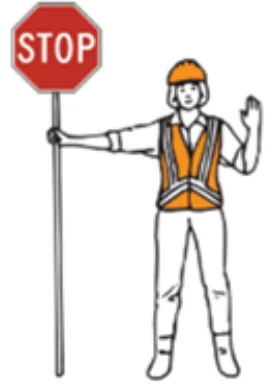
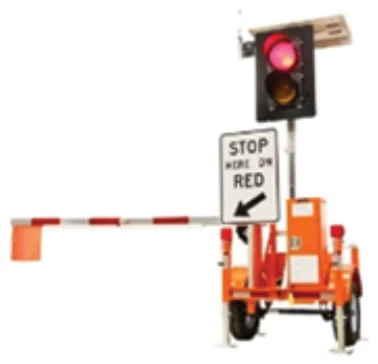
Flaggers use signs and hand signals to tell you which direction to travel, to slow down or to stop. Automated flagger devices have the same duties.

Handbook p. 67 ↗

Automated flagger device

Automated flagger device
SignalWhat you do
Red light on, arm downStop
Yellow light flashing, arm upProceed
Handbook p. 67 ↗
Flagger stop paddle
Flagger
Automated flagger assistance device
Automated flagger device

Freeway work zones

  • You'll usually keep driving through the zone, possibly in fewer, narrow or new lanes
  • Expect to merge and to drive very close to cones, workers and equipment — slow down and pay attention
  • Don't follow construction vehicles in a work zone
  • Construction vehicles may enter the road and cause slowing
Handbook p. 68 ↗

Put it into practice

At 9 p.m. you enter a highway work zone posted at 45 mph. The crews have gone home. The 45 mph limit still applies until you pass an End Work Zone Speed Limit sign or another speed sign — and any ticket fine is doubled.

Check your understanding

Read the question, decide on an answer, then open it to check the explanation. These are Roadwise study questions based on the source handbook.
Traffic fines in work zones are:
  1. Tripled
  2. Doubled
  3. The same as elsewhere
  4. Increased by half

Answer: Doubled

Work zone fines are doubled.

Handbook p. 67 ↗
A temporary speed limit posted in a work zone applies:
  1. Only when workers are actually present
  2. Only during daylight hours
  3. At all times
  4. Only on weekdays

Answer: At all times

The temporary speed applies at all times, not just when workers are visible.

Handbook p. 67 ↗
An automated flagger device shows a red light with the arm down. You should:
  1. Proceed with caution
  2. Drive slowly past the arm
  3. Wait for a hand signal from a worker instead
  4. Stop

Answer: Stop

A red light with arm down means stop.

Handbook p. 67 ↗
On a road with two or more lanes in your direction, if you approach a vehicle stopped with lights flashing, you should:
  1. Maintain your lane and speed
  2. Stop completely in your lane
  3. Move over a lane, away from the stopped vehicle
  4. Stay in your lane and flash your headlights

Answer: Move over a lane, away from the stopped vehicle

Change lanes away from a vehicle stopped with flashing lights.

Handbook p. 65 ↗
Besides changing lanes, the handbook says you may slow down when passing a vehicle stopped with flashing lights. By how much?
  1. At least 10 mph under the posted limit
  2. Down to 20 mph
  3. At least 20 mph under the posted limit
  4. At least 5 mph under the posted limit

Answer: At least 5 mph under the posted limit

You must change lanes away from the stopped vehicle, and you may also slow down by at least 5 mph under the posted speed limit.

Handbook p. 65 ↗
A work zone's reduced speed limit remains in effect until you see:
  1. An End Work Zone sign or a new speed limit sign
  2. The last orange cone and the end of the lane closure
  3. A worker waving you through
  4. The last worker or piece of equipment

Answer: An End Work Zone sign or a new speed limit sign

The reduced limit lasts until you see the ending sign.

Handbook p. 67 ↗
Take the lesson checkpoint in the app

More in Buses, Railroads & Special Situations