roadwise.Open study app

Ohio driving lesson · Be Alert

Vision, fatigue, aggression & distraction

A 2-minute lesson from the Ohio course. Read the rules and examples, follow the handbook page references, and check your understanding before you move on.

Read time
2 minutes
Course unit
Be Alert
Checkpoint questions
6
Source pages
10

Driving safely depends on good health and good decisions. Poor eyesight, tiredness, anger and distraction all shrink the time you have to see a problem and react to it.

Know the rule

If you pass the vision screening with corrective lenses, your license shows a vision restriction and you must always wear your corrective lenses when driving.

Handbook p. 10 ↗

Know the rule

Avoid dark or tinted corrective lenses at night. Have your eyes checked regularly by an eye doctor.

Handbook p. 10 ↗

Fatigue

Physical or mental tiredness caused by physical or mental strain, repetitive tasks, illness, medications, or lack of sleep. It can affect vision and decrease reaction time.

Handbook p. 10 ↗

Aggressive driving

Intentionally committing an action that endangers other persons or property.

Handbook p. 10 ↗

Examples of aggressive driving:

  • Speeding
  • Following too closely
  • Unsafe lane changes
  • Improper signaling
  • Failing to obey traffic signals and warning signs
Handbook p. 10 ↗

Distraction

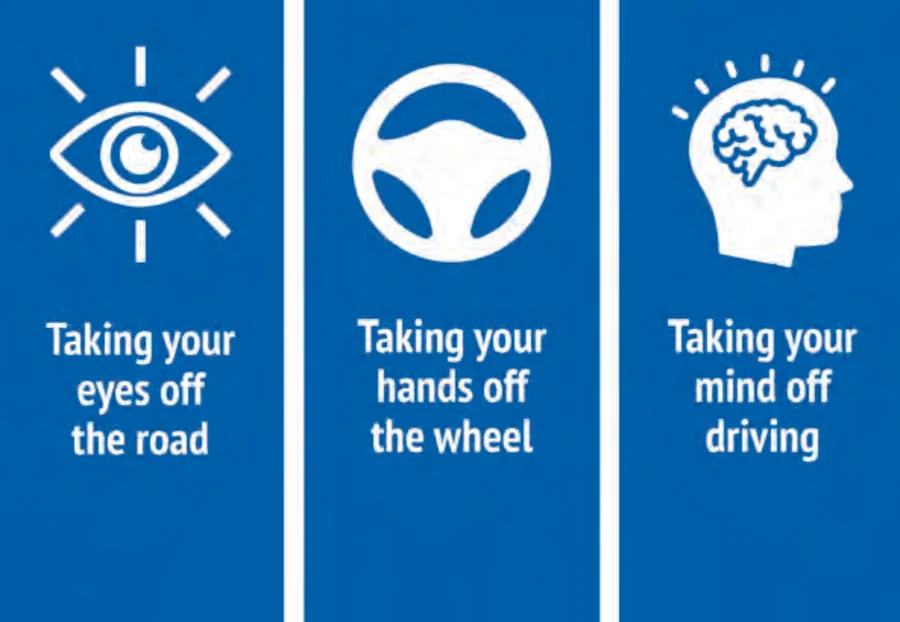
Anything that takes attention away from driving: taking your hands off the wheel, eyes off the road, or mind off driving.

Handbook p. 10 ↗
Three types of driving distraction
The three kinds of distraction: eyes off the road, hands off the wheel, mind off driving

Avoid all types of distraction:

  • Cell phone conversations
  • Text messaging
  • Passengers
  • Eating while driving
  • Unsecured children and pets — secure them properly
Handbook p. 10 ↗

Know the rule

In Ohio, it is illegal to drive distracted, including using an electronic wireless communication device.

Handbook p. 11 ↗

Put it into practice

You're irritated at a slow driver, so you ride their bumper and cut back in front without signaling. Tailgating, an unsafe lane change and improper signaling are all listed forms of aggressive driving.

Check your understanding

Read the question, decide on an answer, then open it to check the explanation. These are Roadwise study questions based on the source handbook.

If your vision screening required corrective lenses, when must you wear them?
  1. Only at night
  2. Only on highways
  3. Only when requested by police
  4. Always, whenever you drive

Answer: Always, whenever you drive

If you completed the vision screening with corrective lenses, you must always wear them when driving.
Handbook p. 10 ↗
What type of corrective lenses should you avoid wearing at night?
  1. Tinted lenses
  2. Bifocal lenses
  3. Anti-glare clear lenses
  4. Contact lenses

Answer: Tinted lenses

Dark or tinted corrective lenses reduce vision at night and should be avoided.

Handbook p. 10 ↗
Which of these counts as aggressive driving, according to the handbook?
  1. Driving the speed limit
  2. Following too closely
  3. Using a turn signal early
  4. Braking gently for a yellow light

Answer: Following too closely

Aggressive driving examples include speeding, following too closely, unsafe lane changes, improper signaling, and ignoring signs.

Handbook p. 10 ↗
What effect does fatigue have on your driving ability?
  1. It has no measurable effect
  2. It only affects nighttime driving
  3. It can affect vision and decrease reaction time
  4. It only affects new drivers

Answer: It can affect vision and decrease reaction time

Fatigue can affect your vision and decrease your reaction time.

Handbook p. 10 ↗
An aggressive driver intentionally does something that endangers people or property. What distinguishes this from ordinary poor driving?
  1. The type of vehicle involved
  2. The time of day it occurs
  3. Whether a crash results
  4. Its intentional nature

Answer: Its intentional nature

Aggressive driving specifically involves intentionally committing an action that endangers other persons or property.

Handbook p. 10 ↗
What is one way fatigue can be caused, according to the handbook?
  1. Repetitive tasks
  2. Only lack of sleep
  3. Only illness
  4. Only medication

Answer: Repetitive tasks

Fatigue can result from physical or mental strain, repetitive tasks, illness, medications, or lack of sleep.

Handbook p. 10 ↗
Take the lesson checkpoint in the app

More in Be Alert