roadwise.Open study app

Ohio driving lesson · Passing, Railroads, School Buses & Parking

Passing safely

A 3-minute lesson from the Ohio course. Read the rules and examples, follow the handbook page references, and check your understanding before you move on.

Read time
3 minutes
Course unit
Passing, Railroads, School Buses & Parking
Checkpoint questions
6
Source pages
23, 24

Passing puts you in the path of oncoming traffic, so the rules focus on seeing far enough ahead and getting back into your lane with room to spare. When someone passes you, your job is to make it easy for them.

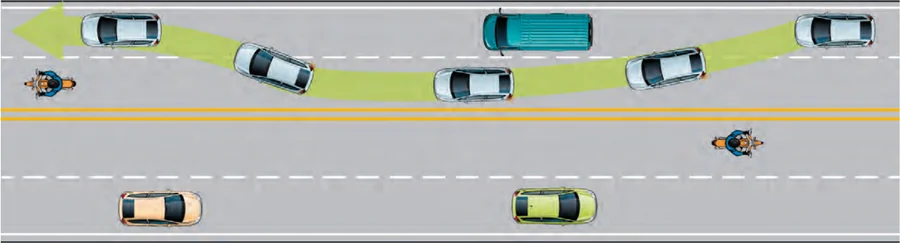
How to pass:

  • Check for oncoming traffic
  • Check mirrors and over your shoulder for vehicles following or passing you
  • Signal when it is safe to pass
  • Steer smoothly into the passing lane; maintain or adjust speed
  • Keep going until both headlights of the passed vehicle show in your rear-view mirror
  • Signal, then steer smoothly back into the lane
Handbook p. 23 ↗
No passing near a railroad crossing
Return to your lane once both headlights of the passed car are in your mirror

Know the rule

When you are being passed, stay in your lane and keep a constant speed so the other driver can pass.

Handbook p. 23 ↗

Do not pass when:

  • An oncoming vehicle is approaching
  • A curve or hill blocks your view
  • You are at an intersection
  • You are before a highway-railroad crossing or a bridge
Handbook p. 23 ↗

Know the rule

Never pass on the shoulder, whether it is paved or not.

Handbook p. 24 ↗

Know the rule

On multi-lane, two-way roads, the left-most lane is for passing slower vehicles when the pass won't interfere with traffic in either direction.

Handbook p. 24 ↗

Know the rule

On a two-lane road with a solid double yellow line, passing is prohibited from both directions. You may cross the center line only to turn left into a driveway or to pass a slow-moving vehicle (like a bicycle or a vehicle with a slow-moving vehicle sign) when safe.

Handbook p. 24 ↗

Know the rule

In a passing zone, you may pass only when the broken yellow line is on your side. Passing is prohibited when the solid yellow line is in your lane.

Handbook p. 24 ↗

Know the rule

A center two-way left turn lane is only for left-turning vehicles from either direction — never for passing, merging into traffic, or traveling.

Handbook p. 24 ↗

Put it into practice

You're behind a slow truck on a two-lane road and the line on your side is broken, but a hill hides the road ahead. Don't pass: a hill blocking your view is on the do-not-pass list, whatever the paint says.

Check your understanding

Read the question, decide on an answer, then open it to check the explanation. These are Roadwise study questions based on the source handbook.

When passing another vehicle, when should you return to your lane?
  1. As soon as you're alongside the vehicle
  2. Immediately after signaling
  3. After both headlights of the passed vehicle are visible in your rearview mirror
  4. When the passed driver flashes their lights

Answer: After both headlights of the passed vehicle are visible in your rearview mirror

Continue passing until both headlights of the passed vehicle are visible in your rearview mirror before returning to your lane.
Handbook p. 23 ↗
Where is passing prohibited, according to the handbook?
  1. On any road with a speed limit above 45 mph
  2. On any road with a broken yellow center line
  3. On roads without shoulders
  4. Before a highway-railroad crossing or bridge

Answer: Before a highway-railroad crossing or bridge

You should not attempt to pass before a highway-railroad crossing or bridge, at intersections, on curves, or on hills with blocked view.

Handbook p. 23 ↗
You're in a lane where the solid yellow line is on your side. Can you legally pass?
  1. Yes, if there's no oncoming traffic
  2. No — passing is prohibited when the solid line is in your lane
  3. Yes, if you signal first
  4. Only on a two-lane road

Answer: No — passing is prohibited when the solid line is in your lane

Passing is prohibited when the solid yellow line is in your lane; you may only pass when the broken line is in your lane.

Handbook p. 24 ↗
Where is passing never allowed, regardless of lines or signs?
  1. In the left lane of a four-lane highway
  2. On a two-lane road with a broken yellow line
  3. On the shoulder, paved or not
  4. When the vehicle ahead signals a turn

Answer: On the shoulder, paved or not

The handbook states you should never pass on the shoulder, whether it's paved or not.

Handbook p. 24 ↗
On a multi-lane, two-way road, what is the leftmost lane generally intended for?
  1. General through traffic at all times
  2. Slow-moving vehicles only
  3. Left turns exclusively
  4. Passing slower vehicles when safe

Answer: Passing slower vehicles when safe

On multi-lane roads, the leftmost lane is intended for passing slower vehicles when it can be done without interfering with traffic.

Handbook p. 24 ↗
You want to pass a cyclist on a two-lane road with a solid yellow line on your side. Is this legal?
  1. No, never across a solid yellow line
  2. Only if the cyclist waves you by
  3. Yes, when safe; a bicycle counts as a slow-moving vehicle
  4. No, you must wait for a broken yellow line

Answer: Yes, when safe; a bicycle counts as a slow-moving vehicle

Crossing the center line is permitted to pass a slow-moving vehicle, such as a bicycle, when it is safe to do so.

Handbook p. 24 ↗
Take the lesson checkpoint in the app

More in Passing, Railroads, School Buses & Parking