A 3-minute lesson from the North Dakota course. Read the rules and examples, follow the handbook page references, and check your understanding before you move on.
Trucks are not large cars. A loaded tractor-trailer needs far more room to stop, swings wide on turns, and has big blind spots where your car can disappear. Knowing those limits keeps you out of trouble.
400+ feet
Stopping distance on dry pavement for a fully loaded tractor-trailer, more than a football field
On any turning vehicle, the rear wheels follow a shorter path than the front wheels, and the longer the vehicle, the bigger the difference. That's why tractor-trailers often swing out to the left first to make a right turn.
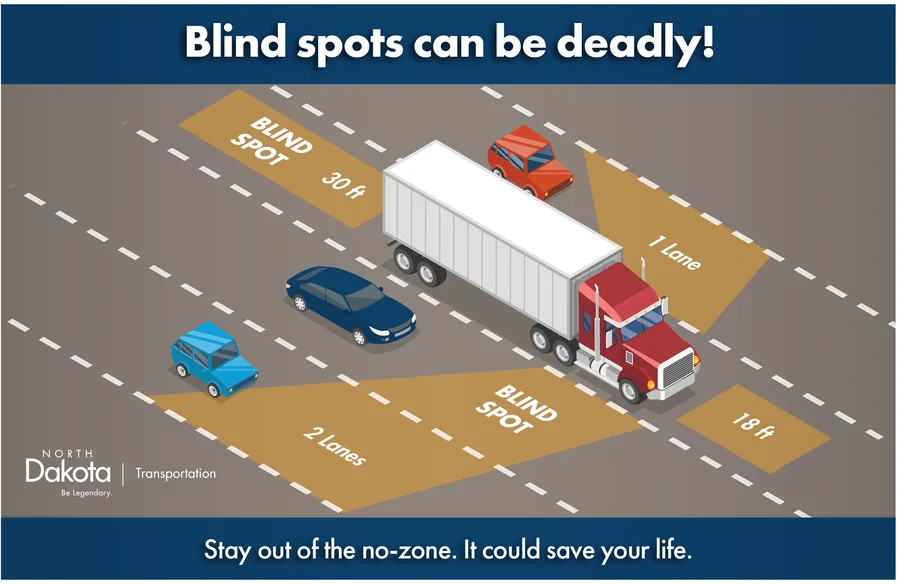
A truck's blind spots, where a car can disappear from the trucker's view: in front of the cab, along either side (especially beside the cab), and behind the trailer.
Truckers sit about twice as high as car drivers and have bigger mirrors, but they still have serious blind spots. Lingering beside or behind a truck limits the trucker's ability to avoid danger.
You're close behind a semi and can't see its side mirrors. The driver can't see you either. Drop back until you can see the mirrors; the extra space also gives you room to stop.
Check your understanding
Read the question, decide on an answer, then open it to check the explanation. These are Roadwise study questions based on the source handbook.
About how far can a fully-loaded tractor-trailer take to stop on dry pavement at highway speed?
About 500 feet
About 200 feet
More than 400 feet
About 100 feet
Answer: More than 400 feet
A fully-loaded tractor-trailer may take more than 400 feet on dry pavement to stop, more than the length of a football field.