North Dakota driving lesson · Right-of-Way & Speed
Pedestrians, driveways & U-turns
A 3-minute lesson from the North Dakota course. Read the rules and examples, follow the handbook page references, and check your understanding before you move on.
Pedestrians in crosswalks come first, and people who are blind need extra space and patience. Pulling out of driveways and alleys, and turning around on hills and curves, have their own rules.
Know the rule
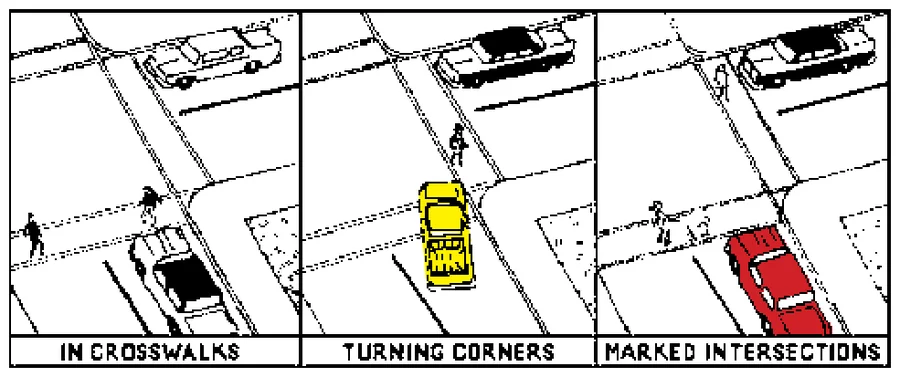
Pedestrians in marked or unmarked crosswalks have the right of way. Drivers must yield when pedestrians are in the driver's lane of travel.
Yield to pedestrians in crosswalks, when turning corners, and at marked intersections
Know the rule
A pedestrian carrying a white cane or using a guide dog is blind or has greatly reduced vision. As with any pedestrian, you must yield or stop for anyone who may have begun crossing.
When stopping at an intersection, stop behind the crosswalk so a visually impaired traveler has an unobstructed path. The person may choose to wait for better traffic conditions.
In a business or residential district, a vehicle coming out of a driveway, alley, private road or building must stop completely just before the sidewalk area. If there's no sidewalk, stop before entering the roadway.
You're leaving a store parking lot onto a downtown street. Stop completely before crossing the sidewalk and check for walkers. Then yield to all oncoming traffic before you pull into the road.
Check your understanding
Read the question, decide on an answer, then open it to check the explanation. These are Roadwise study questions based on the source handbook.
Who has the right of way in a marked or unmarked crosswalk?
Whichever arrives first
Vehicles turning right
Vehicles turning left
Pedestrians
Answer: Pedestrians
Pedestrians in marked or unmarked crosswalks have the right of way, and drivers must yield to them.