roadwise.Open study app

North Dakota driving lesson · Passing, Lane Changes & Following Distance

Passing safely

A 3-minute lesson from the North Dakota course. Read the rules and examples, follow the handbook page references, and check your understanding before you move on.

Read time
3 minutes
Course unit
Passing, Lane Changes & Following Distance
Checkpoint questions
6
Source pages
25

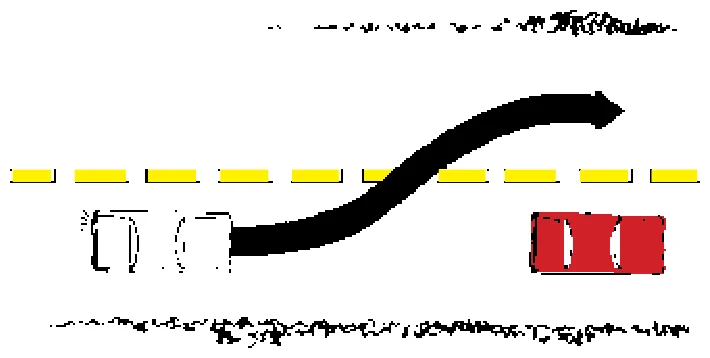
On a two-way road you drive on the right. When you pass, you're driving against the flow of oncoming traffic, and many head-on collisions happen during a pass. Pass only when it's needed, legal, and you can clearly see enough room.

Before you pass, ask yourself:

  • Is the pass necessary?
  • Am I in or approaching a no passing zone?
  • Can I return to my lane before meeting an approaching vehicle?
  • Can I see the road ahead clearly?
Handbook p. 25 ↗

Know the rule

Whenever there's a hill or a curve ahead, treat it as if there is oncoming traffic just beyond it.

Handbook p. 25 ↗
200 feet

Get back in your lane at least this far before meeting an approaching vehicle

Handbook p. 25 ↗

Know the rule

Don't return to your lane until you can see the entire front of the vehicle you passed in your inside rear-view mirror.

Handbook p. 25 ↗
Lane change back to proper lane (200 ft before oncoming vehicle)
Passing and returning to the lane with room to spare

Passing guidelines:

  • Give yourself enough time to get completely past the other vehicle
  • Never leave the main-traveled roadway when passing
  • When you're being passed, do not speed up
  • Do not follow too closely
  • Obey all regulatory and warning signs
Handbook p. 25 ↗

Never pass:

  • While approaching the top of a hill or a curve
  • Within 100 feet of an intersection, a railroad crossing, or a tunnel
  • Where any pavement marking or sign indicates NO PASSING
  • When fog, snow or rain reduces or blocks your view of the road
Handbook p. 25 ↗

Know the rule

Even in the left lane of a four-lane highway, be aware that you might collide with a vehicle going the wrong way.

Handbook p. 25 ↗

Put it into practice

You're behind a slow truck on a clear two-lane road, but a railroad crossing is about 80 feet ahead. Stay behind it. Passing is not allowed within 100 feet of an intersection, a railroad crossing or a tunnel.

Check your understanding

Read the question, decide on an answer, then open it to check the explanation. These are Roadwise study questions based on the source handbook.

Within how many feet of an intersection, railroad crossing, or tunnel is passing prohibited?
  1. 25 feet
  2. 100 feet
  3. 50 feet
  4. 200 feet

Answer: 100 feet

You must never pass within 100 feet of an intersection, a railroad crossing, or a tunnel.
Handbook p. 25 ↗
How far before meeting an approaching vehicle should you return to your lane after passing?
  1. At least 200 feet
  2. At least 100 feet
  3. At least 50 feet
  4. At least 500 feet

Answer: At least 200 feet

Return to your proper lane at least 200 feet before meeting an approaching vehicle.

Handbook p. 25 ↗
Before returning to your lane after passing, what should you be able to see?
  1. The passed vehicle's driver beside your window
  2. Only the passed vehicle's headlights
  3. The entire front of the passed vehicle in your inside rear-view mirror
  4. The rear bumper of the passed vehicle in your side mirror

Answer: The entire front of the passed vehicle in your inside rear-view mirror

Do not return to your lane until you can see the entire front of the passed vehicle in your inside rear-view mirror.

Handbook p. 25 ↗
What should you do if you are being passed by another vehicle?
  1. Move onto the shoulder
  2. Do not speed up
  3. Flash your headlights repeatedly
  4. Speed up to help them pass faster

Answer: Do not speed up

When being passed, you should not speed up, since that makes the pass more dangerous.

Handbook p. 25 ↗
You may pass another vehicle when you see a pavement marking or sign indicating no passing.
  1. True
  2. False

Answer: False

You must never pass when a pavement marking or sign indicates no passing.

Handbook p. 25 ↗
You may legally pass another vehicle if you are within 100 feet of an intersection as long as no cars are visible.
  1. True
  2. False

Answer: False

You may never pass within 100 feet of an intersection, a railroad crossing, or a tunnel, regardless of visible traffic.

Handbook p. 25 ↗
Take the lesson checkpoint in the app

More in Passing, Lane Changes & Following Distance