roadwise.Open study app

North Dakota driving lesson · Passing, Lane Changes & Following Distance

Following & stopping distance

A 3-minute lesson from the North Dakota course. Read the rules and examples, follow the handbook page references, and check your understanding before you move on.

Read time
3 minutes
Course unit
Passing, Lane Changes & Following Distance
Checkpoint questions
6
Source pages
25, 26, 32, 46

If you drive too fast or follow too closely, you won't have time to stop in an emergency. The three-second rule gives you a safety cushion, and some situations call for even more space.

300 feet

Approximate stopping distance at 55 mph on dry pavement, about one city block

Handbook p. 25 ↗

Know the rule

Leave enough room behind the vehicle ahead for a passing vehicle to move into that space safely. If the vehicle ahead stops suddenly, you should be far enough back to stop safely.

Handbook p. 25 ↗
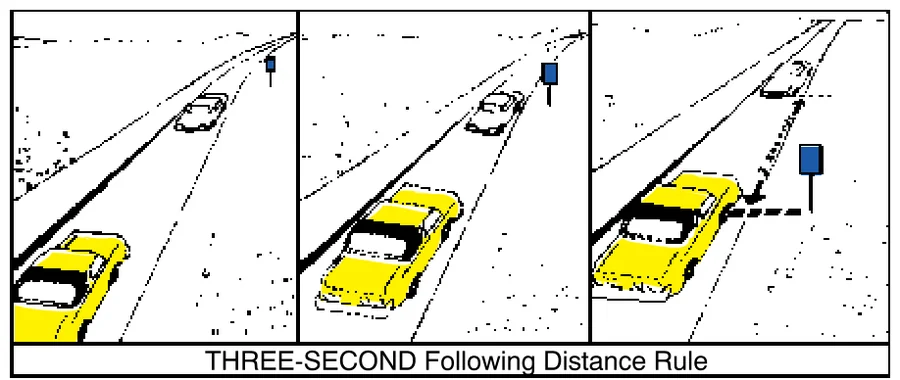
Three-second following distance rule (illustrated)
The three-second following distance rule

How the three-second rule works:

  • Pick a shadow, mark, or object on or near the road ahead
  • When the rear bumper of the vehicle ahead passes it, start counting
  • Count one-thousand-and-one, one-thousand-and-two, one-thousand-and-three
  • If you reach the mark before you finish counting, you're following too closely
Handbook p. 26 ↗

Use four seconds or more when:

  • The roads are slippery
  • You're following motorcycles
  • You have a heavy load or are pulling a trailer
  • You're following large vehicles that block your view ahead
  • The driver behind you wants to pass
  • You're following drivers whose view to the rear is blocked
Handbook p. 26 ↗

Know the rule

Speed increases braking distance: doubling your speed quadruples your braking distance.

Handbook p. 46 ↗

Know the rule

Weight increases braking distance: doubling your vehicle's weight doubles your braking distance. A large vehicle or a trailer takes longer to stop.

Handbook p. 46 ↗

Know the rule

In winter, even with snow tires or tire chains, double your following distance.

Handbook p. 32 ↗

Put it into practice

You're pulling a boat trailer at 55 mph. Three seconds isn't enough here. Leave four seconds or more, because the extra weight lengthens the distance you need to stop.

Check your understanding

Read the question, decide on an answer, then open it to check the explanation. These are Roadwise study questions based on the source handbook.

At 55 miles per hour on dry pavement, about how far does it take to stop?
  1. 500 feet
  2. 100 feet
  3. 300 feet
  4. 150 feet

Answer: 300 feet

At 55 mph, it takes approximately 300 feet, or about one city block, to stop on dry pavement.

Handbook p. 25 ↗
According to the three-second rule, what should you do when the vehicle ahead passes a fixed point?
  1. Immediately brake to slow down
  2. Speed up to close the gap
  3. Check your speedometer
  4. Start counting seconds until you reach that same point

Answer: Start counting seconds until you reach that same point

Pick a mark on the road, and when the vehicle ahead passes it, count the seconds until you reach the same spot.

Handbook p. 26 ↗
Under the three-second rule, you are following too closely if you reach the mark before counting to what?
  1. 1
  2. 3
  3. 2
  4. 5

Answer: 3

If you reach the mark before finishing 'one-thousand-and-three,' you are following too closely.

Handbook p. 26 ↗
When should you increase your following distance to four seconds or more?
  1. Only in heavy traffic
  2. Only on the Interstate
  3. Only in city traffic
  4. When the roads are slippery or you are following a motorcycle

Answer: When the roads are slippery or you are following a motorcycle

You need more following distance, four or more seconds, on slippery roads, following motorcycles, hauling a heavy load, or behind vehicles that block your view.
Handbook p. 26 ↗
How does doubling your speed affect your vehicle's braking distance?
  1. It reduces the braking distance instead
  2. It has no measurable effect
  3. It quadruples the braking distance
  4. It doubles the braking distance

Answer: It quadruples the braking distance

Speed increases braking distance disproportionately: doubling your speed will quadruple your braking distance.

Handbook p. 46 ↗
How does doubling your vehicle's weight affect its braking distance?
  1. It doubles the braking distance
  2. It reduces the braking distance by half
  3. It quadruples the braking distance
  4. It has no effect on braking distance

Answer: It doubles the braking distance

Doubling your vehicle's weight will double your braking distance, which matters for large vehicles or towing.

Handbook p. 46 ↗
Take the lesson checkpoint in the app

More in Passing, Lane Changes & Following Distance