roadwise.Open study app

North Dakota driving lesson · Turning, Roundabouts & Highway Driving

Night driving & headlights

A 3-minute lesson from the North Dakota course. Read the rules and examples, follow the handbook page references, and check your understanding before you move on.

Read time
3 minutes
Course unit
Turning, Roundabouts & Highway Driving
Checkpoint questions
6
Source pages
28, 29

At night you can see only as far as your headlights reach, which cuts your time to react. Don't overdrive your headlights: keep your speed low enough to stop within the distance they light up.

Know the rule

Use your headlights from sunset to sunrise, and at any other time they're needed for safe driving.

Handbook p. 28 ↗
1,000 feet

Use headlights when rain, snow, sleet, hail, smoke or fog cuts visibility below this

Handbook p. 28 ↗

Know the rule

Slow down. You should be able to stop within the distance your headlights cover, even if you come upon a vehicle without taillights.

Handbook p. 28 ↗

Know the rule

Clean your windshield inside and out to reduce glare from oncoming vehicles. Clean your headlights so they give more light.

Handbook p. 28 ↗

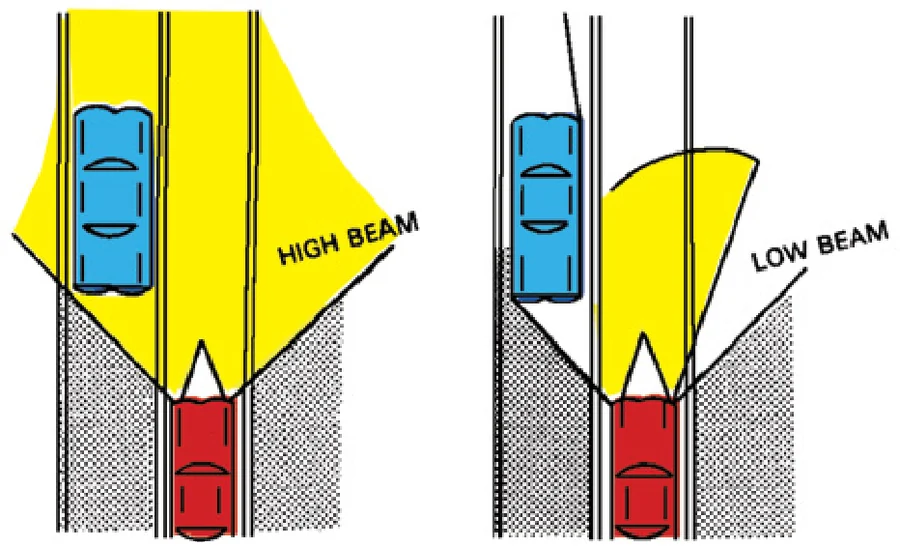
When to dim your high beams

When to dim your high beams
SituationDim
Meeting oncoming trafficAt least 500 feet before meeting
Following another vehicleWithin 300 feet
Handbook p. 29 ↗
High beam vs low beam headlight range
High beams reach farther than low beams and can blind an approaching driver

Know the rule

If an oncoming driver doesn't dim their lights, look to the right edge of the road to avoid being blinded. Your eyes need time to adjust after meeting a vehicle at night.

Handbook p. 29 ↗

Know the rule

Staring at the spot lit by your headlights can cause eyestrain, fatigue and lack of concentration. Keep your eyes moving, and scan for animals, pedestrians and bicycle riders.

Handbook p. 29 ↗

Know the rule

Watch closely for animals at dawn and dusk, especially deer, and drive slower where deer crossing signs are posted. Don't swerve to avoid an animal: you could hit a tree or another vehicle, or roll over.

Handbook p. 29 ↗

Also at night:

  • Check to the sides for lights of vehicles crossing or entering the road ahead
  • Watch the taillights ahead for changes in speed or lane position
  • Watch carefully for pedestrians; dark clothing makes them hard to see
  • Stop and rest if you are tired
Handbook p. 29 ↗

Put it into practice

A deer steps into your headlights on a two-lane highway. Brake and stay in your lane. Swerving could send you into a tree or another vehicle, or roll you over, which can be a more serious crash.

Check your understanding

Read the question, decide on an answer, then open it to check the explanation. These are Roadwise study questions based on the source handbook.

Between what hours must you use headlights, at minimum?
  1. From sunset to sunrise
  2. From 6 p.m. to 6 a.m. only
  3. Only when it is raining
  4. Only on rural highways

Answer: From sunset to sunrise

You should use your headlights from sunset to sunrise, and at any other time necessary for safe driving.
Handbook p. 28 ↗
When must you use headlights during the day due to weather?
  1. Only during a declared state of emergency
  2. When visibility is less than 1,000 feet due to rain, snow, or fog
  3. When visibility is less than 5,000 feet
  4. Headlights are never required during the day

Answer: When visibility is less than 1,000 feet due to rain, snow, or fog

You must use headlights when visibility is less than 1,000 feet due to rain, snow, sleet, hail, smoke, or fog.

Handbook p. 28 ↗
How far before meeting oncoming traffic must you dim your headlights?
  1. At least 1,000 feet
  2. At least 100 feet
  3. At least 500 feet
  4. At least 50 feet

Answer: At least 500 feet

Dim your headlights at least 500 feet before meeting oncoming traffic.

Handbook p. 29 ↗
How close may you follow another vehicle before you must dim your headlights?
  1. Within 500 feet
  2. Within 1,000 feet
  3. Within 300 feet
  4. Within 100 feet

Answer: Within 300 feet

Dim your headlights within 300 feet when following another vehicle.

Handbook p. 29 ↗
What should you do if you meet a vehicle at night that does not dim its high beams?
  1. Look toward the right edge of the road
  2. Flash your high beams repeatedly at them
  3. Stop your vehicle until they pass
  4. Look directly at their headlights

Answer: Look toward the right edge of the road

If a vehicle does not dim its lights, look to the right edge of the road to avoid being blinded.

Handbook p. 29 ↗
Why should you clean your windshield and headlights before driving at night?
  1. To help the defroster work faster
  2. It has no effect on night driving safety
  3. To reduce glare and help you see hazards
  4. To prevent the wipers from freezing

Answer: To reduce glare and help you see hazards

Cleaning your windshield inside and out reduces glare from oncoming vehicles, and clean headlights help you see night hazards better.

Handbook p. 29 ↗
Take the lesson checkpoint in the app

More in Turning, Roundabouts & Highway Driving