A 3-minute lesson from the New York course. Read the rules and examples, follow the handbook page references, and check your understanding before you move on.
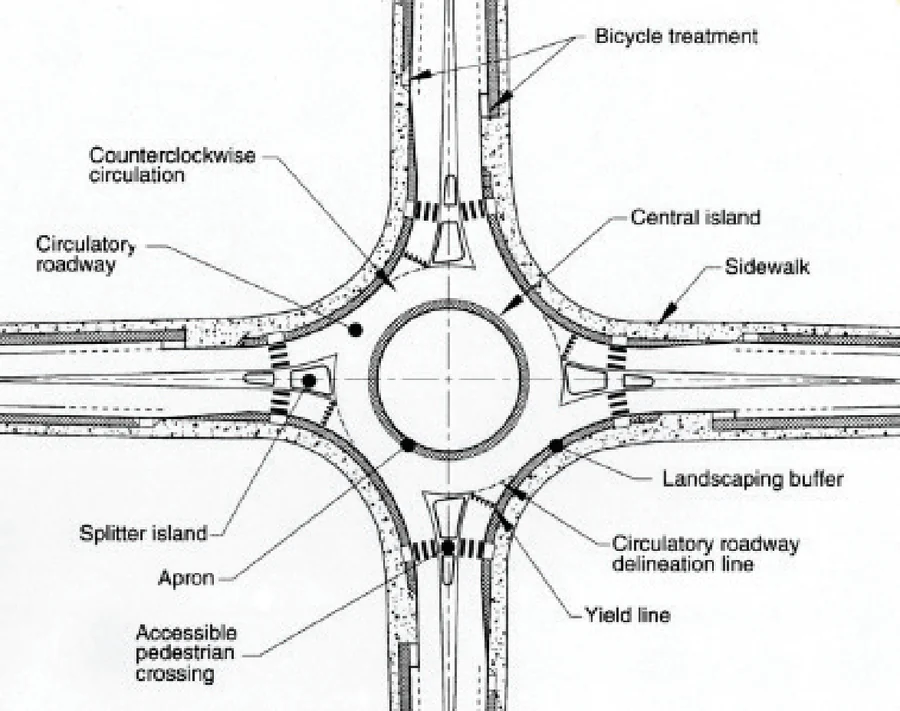
A modern roundabout is a circular intersection where traffic moves counterclockwise around a central island and entering traffic yields. Low speeds and curved entrances make roundabouts safer than many ordinary intersections, as long as everyone follows the yield-at-entry rule.
A common roundabout design: central island, splitter islands, crosswalks and yield lines
Modern roundabout
A circular intersection with yield control of entering traffic, where traffic moves counterclockwise around a central island.
You approach a single-lane roundabout. A car is circling toward you from the left and a pedestrian is in the crosswalk. Yield to both, then enter when there's a gap. Signal right as you near your exit and yield again to anyone in the exit crosswalk.
Check your understanding
Read the question, decide on an answer, then open it to check the explanation. These are Roadwise study questions based on the source handbook.
What is the maximum design speed for vehicles circulating inside a modern roundabout?
30 mph or less
45 mph or less
15 mph or less
There is no design speed limit
Answer: 30 mph or less
Roundabouts are designed so vehicle speed is restricted to 30 mph or less within the circle.