Roadwise States New Mexico Driving lessons Large trucks, RVs & the No Zone New Mexico driving lesson · Sharing the Road
Large trucks, RVs & the No Zone A 3-minute lesson from the New Mexico course. Read the rules and examples, follow the handbook page references, and check your understanding before you move on.
Read time 3 minutes
Course unit Sharing the Road
Checkpoint questions 6
Source pages 30 Big rigs and RVs can't stop, turn or see the way a car can. Knowing their limits keeps you out of situations where the driver can't avoid you.
Know the rule
Don't pull in front of a big rig and suddenly slow down or stop; the driver may not be able to stop in time.
Handbook p. 30 ↗ Know the rule
Big trucks and RVs need more room to turn and often swing wide to turn right. Check a truck's turn signals before passing; if it seems to be turning left, wait and check again, as it may be turning right.
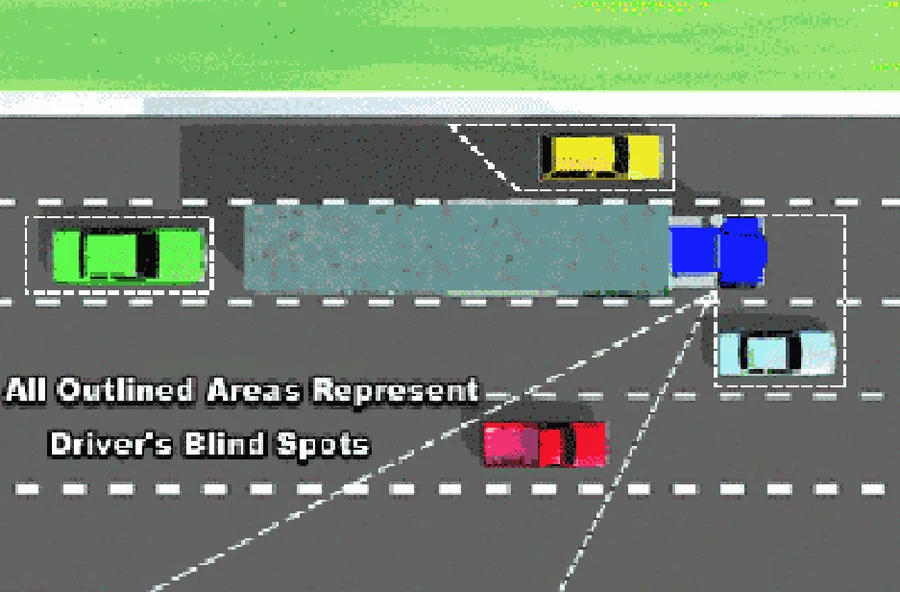
Handbook p. 30 ↗ No Zone A truck's or RV's blind spots: large areas the driver can't see despite sitting high with big mirrors. Don't drive in them.
Handbook p. 30 ↗ Outlined areas show a truck driver's blind spots Know the rule
If you can't see the driver in the truck's side mirror, the driver can't see you.
Handbook p. 30 ↗ Avoid these mistakes around trucks and RVs: Cutting in front of one in traffic to reach your exit or turn Driving beside one: it may not be able to swerve around a hazard Staying in the driver's blind spot after passing Following too closely: the driver may not know you're there Handbook p. 30 ↗ Know the rule
Always pass a large truck or RV on the left side, then move ahead of it.
Handbook p. 30 ↗ Know the rule
A big truck or RV may look like it's going more slowly than it really is.
Handbook p. 30 ↗ Put it into practice
A semi ahead has its right signal on and is drifting left at an intersection. It's likely swinging wide to turn right. Don't squeeze into the gap on its right; wait for it to finish the turn.
Check your understanding Read the question, decide on an answer, then open it to check the explanation. These are Roadwise study questions based on the source handbook.
About how far does a car going 55 mph take to stop, compared to a large truck at the same speed? They take about the same distance A truck always stops faster due to its weight About 400 ft for a car, 800 ft for a truck A car takes about 800 feet; a truck takes about 400 feet Answer: About 400 ft for a car, 800 ft for a truck
A car going 55 mph can stop in about 400 feet, but a large truck could take almost 800 feet.
Handbook p. 30 ↗ How can you tell if you're in a trucker's blind spot? You can see the truck's rear lights You're driving faster than the truck You can't see the driver in their side mirror You're within one car length of the truck Answer: You can't see the driver in their side mirror
In general, if you can't see the driver in the side mirror, the driver can't see you.
Handbook p. 30 ↗ On which side should you always pass a large truck or RV? On the right, if it is turning left The left side The right side Either side, whichever is open Answer: The left side
Always pass a large truck or RV on the left side, and move ahead of it after passing.
Handbook p. 30 ↗ Why shouldn't you cut in front of a truck in traffic to reach your exit? The truck may not be able to stop in time Trucks must keep that space empty by law It's only illegal on interstate highways It makes the truck's brakes overheat Answer: The truck may not be able to stop in time
Cutting into the open space in front of a truck is dangerous; trucks take much longer to stop than cars.
Handbook p. 30 ↗ Why do big trucks often swing wide to make a right turn? To let cars pass them on the right They need more room to make turns To stay out of the bike lane They are avoiding their own blind spot Answer: They need more room to make turns
Big trucks and RVs need more room to make turns and often swing wide to make a right turn.
Handbook p. 30 ↗ It's safe to drive alongside a large truck for an extended period, as long as you keep your speed steady. True False Answer: False
Don't drive beside a large truck or RV — they may not be able to swerve around a hazard without hitting you.
Handbook p. 30 ↗ Previous lesson Bicyclist duties & sharrows Next lesson Vision & fatigue About the source Roadwise’s New Mexico course uses the driver handbook edition supplied with this study pack. This lesson cites source pages 30. The linked PDF is a third-party mirror of the handbook, rather than a government-hosted page.
Open the handbook source PDF · View the source edition
For current application requirements, fees, appointments, and the format that applies to your age or license type, check New Mexico’s MVD. Roadwise provides study material and does not issue permits or licenses.