roadwise.Open study app

New Jersey driving lesson · Sharing the Road

Trucks, buses, and no-zones

A 3-minute lesson from the New Jersey course. Read the rules and examples, follow the handbook page references, and check your understanding before you move on.

Read time
3 minutes
Course unit
Sharing the Road
Checkpoint questions
6
Source pages
149, 150, 151, 152

Big vehicles see less, stop slower and need more room to turn. Large blind spots called no-zones surround them. Stay out of those zones, pass decisively, and never cut in front of a truck.

Know the rule

In bad weather a truck, tractor-trailer or bus can take as much as 25 percent longer to stop.

Handbook p. 149 ↗

No-zone

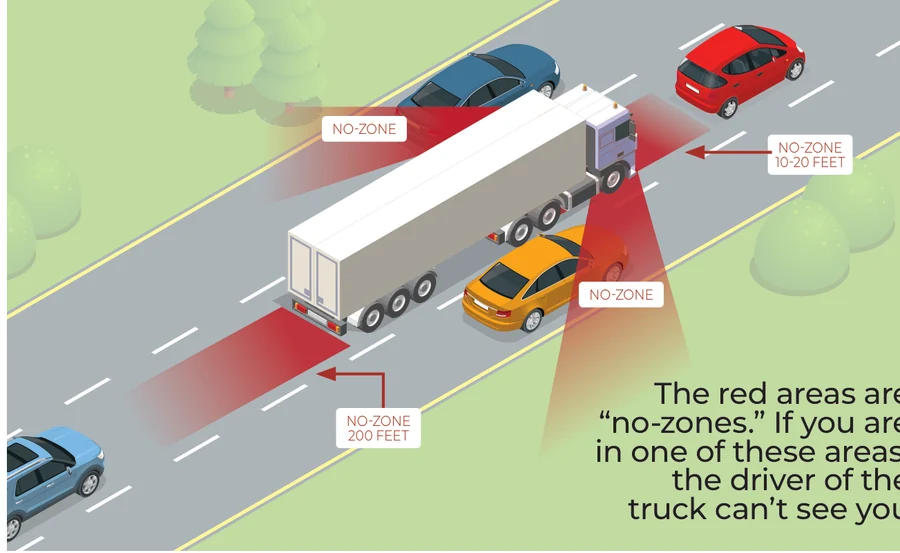
A blind spot around a truck, tractor-trailer or bus. If you can't see the driver in their mirrors, the driver can't see you: you're in a no-zone.

Handbook p. 149 ↗
Truck no-zones (blind spots)
The red areas are no-zones where the truck driver can't see you

Know the rule

Rear no-zone: stay far behind a truck that is backing up or getting ready to, and never pass close behind it. Its width hides objects between it and a loading area.

Handbook p. 150 ↗

Know the rule

Increase following distance so the driver can see you in the mirrors. Never tailgate or ride sandwiched between large vehicles; keep a big space cushion.

Handbook p. 151 ↗

Know the rule

When stopped behind a truck or bus, especially uphill, leave space: large vehicles may roll back slightly when starting.

Handbook p. 151 ↗

Know the rule

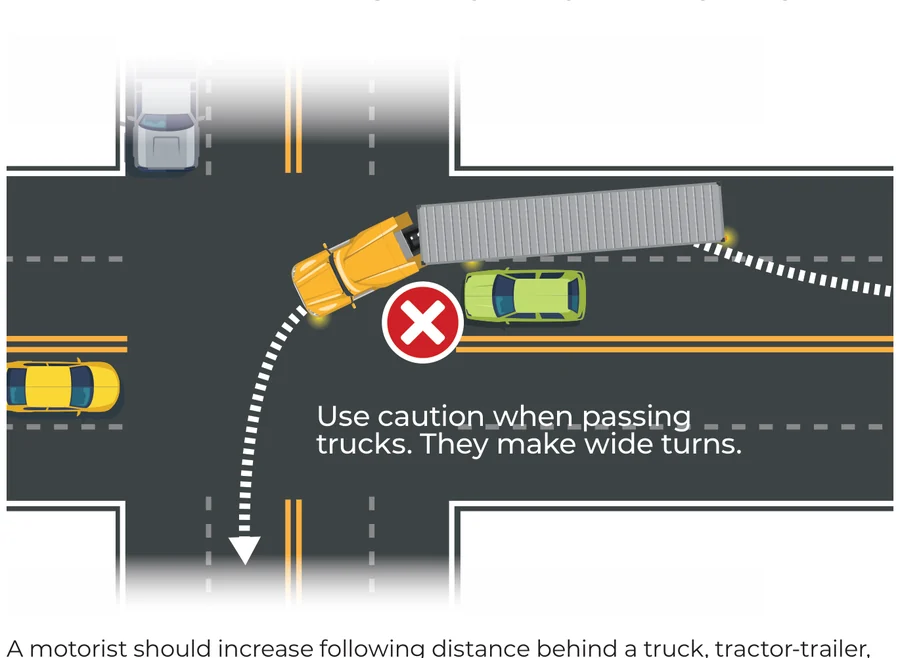
Trucks make wide turns and may swing wide to the left to make a right turn. Give them room, and don't slip in beside them.

Handbook p. 151 ↗
Truck wide turns caution
Use caution when passing trucks. They make wide turns.

Know the rule

Front no-zone: pass at a steady speed and don't pull in front until you can see the whole front of the truck in your rearview mirror. Always signal, and never pass a truck on the right.

Handbook p. 151 ↗

Know the rule

Side no-zone: don't linger alongside a truck when passing. If it must change lanes or swerve, you'll be in the way.

Handbook p. 152 ↗

Know the rule

Head-on no-zone: when a large vehicle approaches from the opposite direction, bear right to reduce wind turbulence and avoid a sideswipe.

Handbook p. 152 ↗

Know the rule

All non-emergency vehicles must yield to buses re-entering traffic after picking up or dropping off passengers. Once a bus is back in traffic you needn't yield to it for lane changes. Violations: $50 to $200, up to 15 days in jail, or both.

Handbook p. 152 ↗

Put it into practice

You're passing a tractor-trailer on the highway. Keep a steady speed, don't hang beside its cab, and move back into its lane only when you can see its entire front end in your rearview mirror.

Check your understanding

Read the question, decide on an answer, then open it to check the explanation. These are Roadwise study questions based on the source handbook.

In bad weather, a truck, tractor-trailer, or bus can take how much longer to stop compared to normal conditions?
  1. As much as 25 percent longer
  2. About 5 percent longer
  3. About 50 percent longer
  4. Twice as long

Answer: As much as 25 percent longer

During bad weather, larger vehicles like trucks and buses can take up to 25 percent longer to stop.
Handbook p. 149 ↗
When passing a large truck, when is it safe to pull back in front of it?
  1. As soon as your rear bumper clears its front
  2. Immediately after signaling
  3. When the truck's whole front shows in your mirror
  4. Only after the truck flashes its lights

Answer: When the truck's whole front shows in your mirror

A motorist should not pull in front of a truck when passing until the whole front of the truck can be seen in the rearview mirror.

Handbook p. 151 ↗
Why should a motorist never pass close behind a truck that is backing up?
  1. Trucks back up at high speed
  2. The area behind it is a no-zone for both drivers
  3. Truck exhaust blocks your view
  4. Backup lights can blind you

Answer: The area behind it is a no-zone for both drivers

The area behind a truck preparing to back up is a no-zone (blind spot) that can hide objects from both drivers.

Handbook p. 150 ↗
A large truck is coming toward you from the opposite direction (the head-on no-zone). What should you do?
  1. Move toward the center line
  2. Bear to the right
  3. Speed up to pass it sooner
  4. Flash your headlights at it

Answer: Bear to the right

Bear right when a large vehicle approaches from the opposite direction; this reduces wind turbulence and may prevent a sideswipe.

Handbook p. 152 ↗
What fine applies to a motorist who fails to yield the right-of-way to a bus re-entering traffic?
  1. A flat $500 fine
  2. $25 to $75
  3. $1,000 minimum
  4. $50 to $200

Answer: $50 to $200

Failing to yield to a bus re-entering traffic carries a fine of not less than $50 or more than $200, up to 15 days in jail, or both.

Handbook p. 152 ↗
A motorist should increase following distance behind a truck so its driver can see the motorist's vehicle in the mirrors.
  1. True
  2. False

Answer: True

Increasing following distance behind large vehicles helps the truck driver spot the motorist's vehicle in their mirrors.

Handbook p. 151 ↗
Take the lesson checkpoint in the app

More in Sharing the Road