Roadwise States New Hampshire Driving lessons Visual search New Hampshire driving lesson · Visual Search and Space Management
Visual search A 2-minute lesson from the New Hampshire course. Read the rules and examples, follow the handbook page references, and check your understanding before you move on.
Read time 2 minutes
Course unit Visual Search and Space Management
Checkpoint questions 6
Source pages 37 Safe drivers see trouble early. Keep your eyes moving ahead, to the sides and behind, using the same search pattern every time, so you have time to change speed or position before a problem reaches you.
Know the rule
Look ahead, to the sides and behind your vehicle, and develop a searching pattern you use every time.
Handbook p. 37 ↗ Searching Keeping your eyes moving to spot situations that could cause a problem, giving you time to change speed and/or road position.
Handbook p. 37 ↗ Know the rule
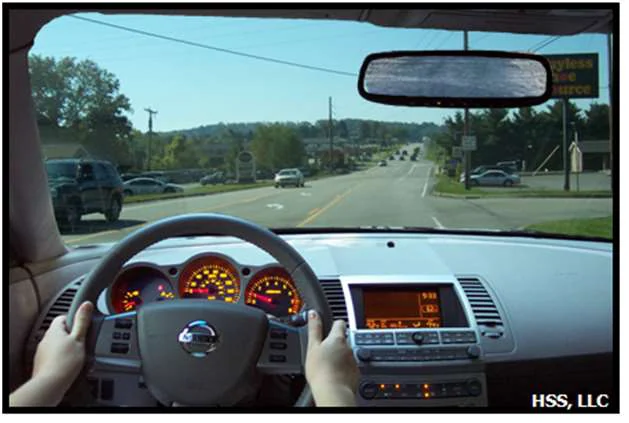
Looking ahead: look down the road, past the vehicles in front of you, and keep checking your mirrors.
Handbook p. 37 ↗ Know the rule
Avoid situations that limit how far you can see, like following too close to a larger vehicle. Behind a large vehicle, adjust your speed and road position.
Handbook p. 37 ↗ Know the rule
Look to the sides to make sure other road users won't cross your path.
Handbook p. 37 ↗ Know the rule
Look to the rear: check your mirrors continually before slowing down, stopping, turning or changing lanes.
Handbook p. 37 ↗ Look well down the road, past the vehicle ahead Search in every direction: Ahead: down the road and past the vehicles in front Sides: for anyone who might cross your path Rear: mirrors before slowing, stopping, turning, changing lanes Handbook p. 37 ↗ Put it into practice
You're stuck close behind a box truck and can't see the road ahead. Drop back and adjust your lane position so you can see past it.
A useful reminder Head first, then hands: turn your head before you turn the wheel.
Check your understanding Read the question, decide on an answer, then open it to check the explanation. These are Roadwise study questions based on the source handbook.
What memory hook does the manual give for visual search before turning? Trust your mirrors completely Signal first, then look Turn your head before you turn the wheel Look once, then commit to the turn Answer: Turn your head before you turn the wheel
The manual's tip is to turn your head before you turn the wheel.
Handbook p. 37 ↗ What should drivers avoid to prevent limiting how far down the road they can see? Checking mirrors too often Following too closely behind a large vehicle Looking far down the road Keeping their eyes moving Answer: Following too closely behind a large vehicle
Following too close to a larger vehicle limits how far ahead a driver can see.
Handbook p. 37 ↗ What is the purpose of 'searching' while driving, according to the manual? To keep a steady eye on the car directly ahead To confirm you are keeping up with traffic To spot problems early and have time to react To read every sign along the route Answer: To spot problems early and have time to react
Searching helps drivers spot problems early and adjust speed or position.
Handbook p. 37 ↗ When should drivers check their mirrors, according to the manual's guidance on looking to the rear? Continually, especially before slowing or turning Only once per trip, at the start Only when merging onto a highway Only after hearing a horn behind them Answer: Continually, especially before slowing or turning
Drivers should check mirrors continually before these key maneuvers.
Handbook p. 37 ↗ Drivers only need to search to the sides when driving on multi-lane highways. True False Answer: False
Searching to the sides is recommended generally, not just on multi-lane highways.
Handbook p. 37 ↗ What should drivers develop to consistently check for problems around their vehicle? A once-per-trip visual check A reliance on passenger lookout duties A habit of checking mirrors only at stoplights A searching pattern used every time Answer: A searching pattern used every time
Drivers should develop a consistent searching pattern they use every time they drive.
Handbook p. 37 ↗ Previous lesson Angle, perpendicular, and parallel parking Next lesson Following distance More in Visual Search and Space Management About the source Roadwise’s New Hampshire course uses the driver handbook edition supplied with this study pack. This lesson cites source pages 37. The linked PDF is a third-party mirror of the handbook, rather than a government-hosted page.
Open the handbook source PDF · View the source edition
For current application requirements, fees, appointments, and the format that applies to your age or license type, check New Hampshire’s DMV. Roadwise provides study material and does not issue permits or licenses.