New Hampshire driving lesson · Visual Search and Space Management
Space to the sides and behind
A 2-minute lesson from the New Hampshire course. Read the rules and examples, follow the handbook page references, and check your understanding before you move on.
Space on your sides gives you an escape route if something goes wrong, and managing the space behind you keeps you from being rear-ended. Both depend on where you place your car and how predictably you drive.
Space to the side:
Don't drive next to other vehicles for long; you may be in their blind spot and lose escape room
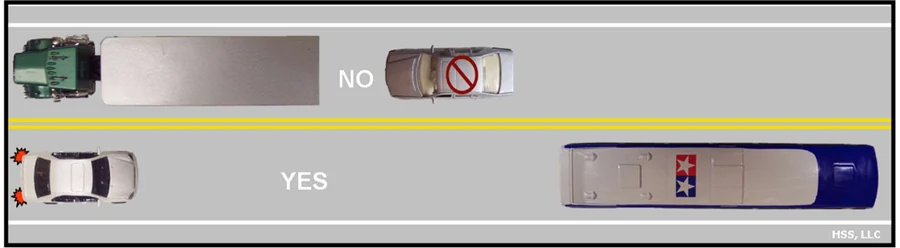
Don't crowd the center line; keep space between you and oncoming traffic
Make room for vehicles entering a multi-lane or limited access road: move over a lane or adjust speed
Leave stopping space for pedestrians in crosswalks
Leave room for bicyclists, children playing, joggers and pedestrians along the road
A car is merging from an on-ramp into your lane. If the left lane is clear, move over a lane; if not, adjust your speed so the driver has room to merge.
Check your understanding
Read the question, decide on an answer, then open it to check the explanation. These are Roadwise study questions based on the source handbook.
Why should drivers avoid driving next to other vehicles for long periods?
It may sit in a blind spot, cutting crash-avoidance space
It increases wind resistance for both vehicles
It wastes fuel compared to following behind
It is illegal on all New Hampshire roads
Answer: It may sit in a blind spot, cutting crash-avoidance space
Driving alongside another vehicle for long periods puts it in a blind spot and limits space to avoid a crash.