roadwise.Open study app

Nevada driving lesson · Special Driving Conditions

Work zones & stopped emergency vehicles

A 3-minute lesson from the Nevada course. Read the rules and examples, follow the handbook page references, and check your understanding before you move on.

Read time
3 minutes
Course unit
Special Driving Conditions
Checkpoint questions
4
Source pages
60, 61

Work zones narrow the lanes and put workers on foot beside traffic, so Nevada doubles speeding fines there. On any road, slowing and moving over for stopped emergency and service vehicles protects the people working beside them.

Know the rule

Work zones are marked by orange signs, cones and barrels. Expect narrow lanes, rough pavement, flaggers, pilot cars and cars stopped ahead.

Handbook p. 60 ↗
Double

Speeding fines in highway work zones

Handbook p. 60 ↗

Work zone speed signs

Work zone speed signs
SignMeaning
Black and white speed limitRegulatory — the legal limit
Orange speed limitAdvisory — a slower, safer speed
Handbook p. 60 ↗

Know the rule

Moving barriers or signs to cross a road closed to traffic is illegal and brings double work-zone penalties.

Handbook p. 60 ↗

In a work zone:

  • Whenever you see orange signs, slow down and watch for equipment and workers
  • Follow flaggers' instructions
  • Merge carefully and cooperatively
  • Stay alert — visibility may be reduced, especially at night; don't drive tired
  • Short on time? Take another route or leave earlier
Handbook p. 60 ↗
Traffic cone (channelizing device)
Traffic cones mark a work zone

Know the rule

These rules cover stopped emergency, utility and service vehicles — any law enforcement vehicle, tow truck, NDOT vehicle, garbage truck, or vehicle showing non-flashing blue lights in certain cases — and anyone repairing a vehicle (NRS 484B.607).

Handbook p. 61 ↗

Approaching them, unless a peace officer directs otherwise:

  • Slow to a reasonable and proper speed below the posted limit
  • Proceed with caution and be prepared to stop
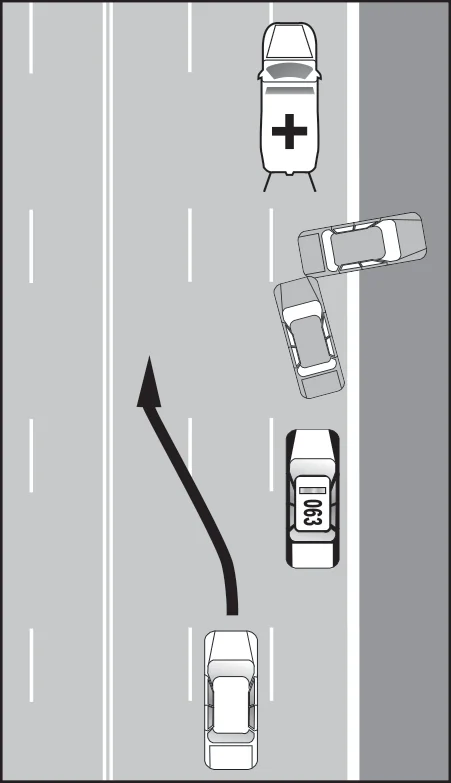
  • If possible, drive in a lane not next to the stopped vehicle — unless unsafe or impossible
Handbook p. 61 ↗
Move over for stopped emergency vehicles
Move out of the lane next to vehicles stopped on the shoulder

Know the rule

Where signs authorize it, certain emergency vehicles may drive on a paved shoulder. Other drivers may not stop on a shoulder marked for emergency use.

Handbook p. 61 ↗

Vehicles that may use a marked shoulder (from January 1, 2024):

  • Authorized emergency vehicles — law enforcement, fire engines, ambulances
  • Traffic incident management vehicles
  • Tow cars
  • Coroner vehicles
  • Public transit buses
Handbook p. 61 ↗

Put it into practice

On I-15 a tow truck is loading a car on the right shoulder. Slow to below the posted limit and, if the lane to your left is clear, move over so you're not in the lane next to the tow truck.

Check your understanding

Read the question, decide on an answer, then open it to check the explanation. These are Roadwise study questions based on the source handbook.
Fines for speeding in highway work zones:
  1. Stay the same as normal fines
  2. Double
  3. Triple
  4. Only apply to commercial trucks

Answer: Double

Fines for speeding double in work zones.

Handbook p. 60 ↗
Orange speed limit signs in a work zone are:
  1. Regulatory and must be strictly obeyed like black-and-white signs
  2. Minimum speeds for the work zone
  3. Advisory, indicating slower, safer speeds
  4. Only used at night

Answer: Advisory, indicating slower, safer speeds

Orange speed limit signs are advisory, while black-and-white signs are regulatory.

Handbook p. 60 ↗
When approaching a stopped emergency vehicle with flashing lights, drivers must:
  1. Maintain the posted speed limit
  2. Speed up to pass quickly
  3. Stop completely, even if not required
  4. Decrease speed and be prepared to stop

Answer: Decrease speed and be prepared to stop

Drivers must decrease speed, proceed with caution, and be prepared to stop.

Handbook p. 61 ↗
Effective January 1, 2024, which type of vehicle may use a paved highway shoulder if authorized by signage?
  1. Public transit buses
  2. Personal passenger vehicles avoiding traffic
  3. Motorcycles at any time
  4. School buses picking up students

Answer: Public transit buses

Public transit buses are among the emergency-related vehicles that may use a signed paved shoulder.

Handbook p. 61 ↗
Take the lesson checkpoint in the app

More in Special Driving Conditions