Roadwise States Nevada Driving lessons School buses & bicycles Nevada driving lesson · Sharing the Road
School buses & bicycles A 4-minute lesson from the Nevada course. Read the rules and examples, follow the handbook page references, and check your understanding before you move on.
Read time 4 minutes
Course unit Sharing the Road
Checkpoint questions 6
Source pages 64, 65 A school bus with flashing red lights means children may be crossing — stop wherever you are. Bicyclists are legal traffic too, and Nevada requires at least 3 feet of space when you pass one.
Know the rule
You must stop at any location for a school bus showing a flashing red signal, and you may not pass it until the driver turns off the flashing red lights (NRS 484B.353).
Handbook p. 64 ↗ Know the rule
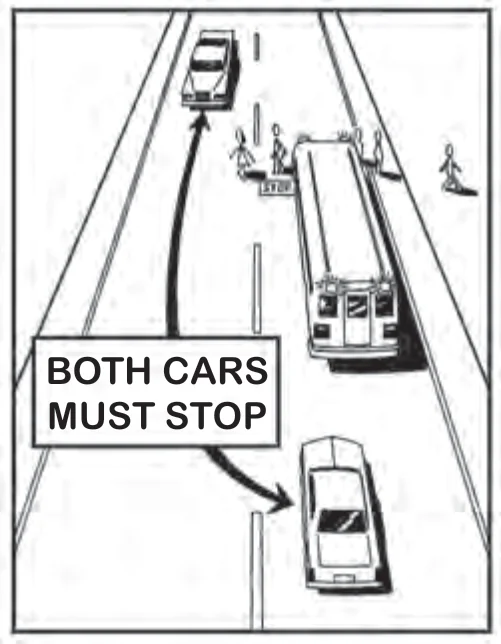
The one exception: on a divided highway, you must stop only if you're traveling in the same direction as the bus.
Handbook p. 64 ↗ On an undivided road, both directions must stop Know the rule
School bus drivers may report violators to the school district and the DMV; the vehicle's registered owner is sent a warning letter.
Handbook p. 64 ↗ Know the rule
A motorist who causes even a minor collision with a bicycle, or intentionally interferes with one, may be charged with reckless driving — penalties include license suspension. Cyclists may not intentionally interfere with vehicles either.
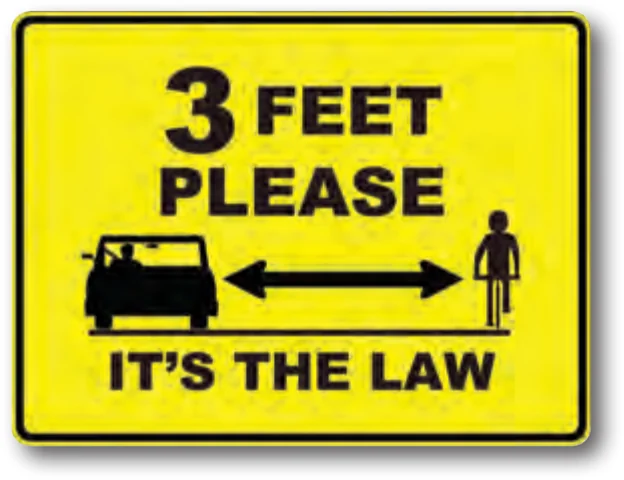
Handbook p. 65 ↗ Bicyclists must: Ride as far right as practicable, except when preparing to turn or passing Obey all traffic signs and signals Dismount and cross as a pedestrian if they choose to use a crosswalk Give a hand signal once (unless in a turn lane or both hands are needed); right arm may signal a right Handbook p. 65 ↗ Motorists and bicycles: At intersections, yield to cyclists as you would to other vehicles and pedestrians Passing: move to the left lane if one is available and it's reasonably safe No adjacent lane? Pass at least 3 feet away and don't move back until safely clear Yield to cyclists on a bicycle path or in a bike lane Don't stop, park or drive in a bike lane except for a driveway/alley, official duty, police order or emergency Handbook p. 65 ↗ 3 feet please — it's the law Be especially cautious: When turning at an intersection or driveway, check both ways for cyclists Never speed up to pass a cyclist just before you turn Parked on the street? Check for cyclists behind you before opening your door Check both ways for cyclists when backing out of a driveway or parking lot Handbook p. 65 ↗ Cyclists should — and should not: Should obey the law, wear a helmet and bright clothing, and keep bikes in good repair Should not ride on the wrong side of the road Should not wear a headset (headphones, phone earpiece) while riding Should not ride at night without required lights and reflectors Handbook p. 65 ↗ Know the rule
Give inexperienced riders, especially children, special courtesy and care — they may not follow the rules, so expect the unexpected.
Handbook p. 65 ↗ Put it into practice
On a two-lane road with no room to change lanes, you come up behind a cyclist. Wait until you can pass with at least 3 feet of space, and don't move back right until you're safely clear of the bike.
A useful reminder Divided highway: only traffic going the bus's direction stops. Otherwise, everyone stops.
Check your understanding Read the question, decide on an answer, then open it to check the explanation. These are Roadwise study questions based on the source handbook.
You must stop for a school bus displaying: A flashing red signal Only a flashing yellow signal Hazard lights alone A stop sign, regardless of lights Answer: A flashing red signal
NRS 484B.353 requires drivers to stop for a school bus displaying a flashing red signal.
Handbook p. 64 ↗ On a divided highway, when must you stop for a school bus with flashing red lights? Always, regardless of direction Only if going the same direction as the bus Never, on any divided highway Only if children are visible Answer: Only if going the same direction as the bus
On divided highways, you only need to stop if traveling the same direction as the bus.
Handbook p. 64 ↗ Cyclists must generally ride: In the center of the lane at all times On the sidewalk when available As far to the right as practicable Against the flow of traffic Answer: As far to the right as practicable
Cyclists may ride in a traffic lane, staying as far right as practicable.
Handbook p. 65 ↗ When passing a cyclist and more than one lane exists in your direction, you should: Move left if it's reasonably safe Stay in your lane and slow down only Honk before passing in the same lane Pass only if the cyclist waves you by Answer: Move left if it's reasonably safe
Move into the lane to the left when more than one lane exists and it's reasonably safe.
Handbook p. 65 ↗ A motorist who causes even a minor collision with a bicyclist may be charged with: Failure to yield Careless driving Reckless driving No charge if the cyclist wasn't wearing a helmet Answer: Reckless driving
Motorists causing even a minor collision with a bicyclist may be charged with reckless driving.
Handbook p. 65 ↗ Motorists must yield the right-of-way to a cyclist riding in a bike lane. True False Answer: True
Motorists must yield the right-of-way to a cyclist on a bicycle path or in a bike lane.
Handbook p. 65 ↗ Previous lesson Motorcycles & mopeds Next lesson Pedestrians & truck-bed riders About the source Roadwise’s Nevada course uses the driver handbook edition supplied with this study pack. This lesson cites source pages 64, 65. The linked PDF is a third-party mirror of the handbook, rather than a government-hosted page.
Open the handbook source PDF · View the source edition
For current application requirements, fees, appointments, and the format that applies to your age or license type, check Nevada’s DMV. Roadwise provides study material and does not issue permits or licenses.