roadwise.Open study app

Nevada driving lesson · Right-of-Way & Speed

Right-of-way rules

A 3-minute lesson from the Nevada course. Read the rules and examples, follow the handbook page references, and check your understanding before you move on.

Read time
3 minutes
Course unit
Right-of-Way & Speed
Checkpoint questions
6
Source pages
34

Nevada law never gives anyone the right-of-way — it only says who must yield. Failing to yield is the leading cause of crashes in Nevada, and even when others should yield to you, you must do everything possible to avoid a crash.

Right-of-way

Generally, the right of one vehicle to go before another. The term also applies to pedestrians and bicycle riders.

Handbook p. 34 ↗

Who goes first at intersections:

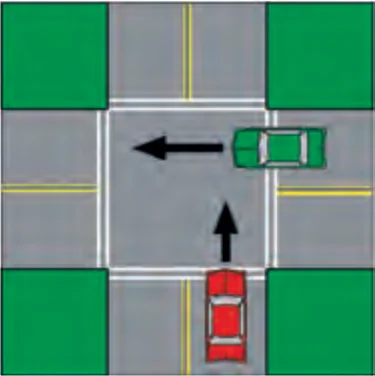
  • No signs or signals: the vehicle on your right should usually go first
  • A vehicle already in the intersection goes before others just getting there
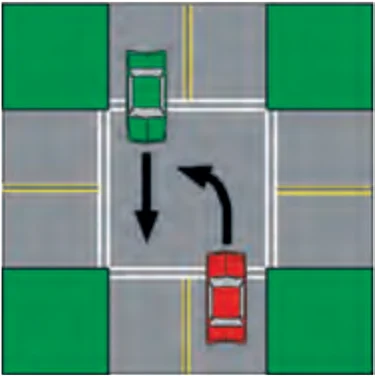
  • A vehicle going straight that's already in the intersection goes before one turning left
  • After yielding and properly signaling, the left-turning vehicle then has the right-of-way
  • At a four-way stop, the driver who reaches it first goes first, after stopping completely
Handbook p. 34 ↗
Pedestrian and vehicle right-of-way at intersection
The left-turning car yields to oncoming straight-through traffic
Right-of-way at an uncontrolled intersection
No signs or signals: the vehicle on the right usually goes first

You must also yield:

  • To all main-road traffic and pedestrians when entering from a minor road, private road or driveway
  • To traffic already on the freeway when you enter — merge only when it's safe
  • To bicyclists riding on a bike path or lane
  • To funeral processions — let the vehicles with headlights on pass as a group
Handbook p. 34 ↗

Know the rule

Emergency vehicles sounding a siren or using flashing lights, from any direction: immediately drive to the right side of the road, clear of any intersection, and stop until they pass.

Handbook p. 34 ↗

Know the rule

If you have the right-of-way and others yield it to you, proceed through the intersection with caution.

Handbook p. 34 ↗

Put it into practice

You reach an intersection with no signs at the same moment as a pickup approaching from your right. The pickup should usually go first. Let it through, then proceed carefully.

Check your understanding

Read the question, decide on an answer, then open it to check the explanation. These are Roadwise study questions based on the source handbook.

At an intersection with no signs or signals, which vehicle should generally go first?
  1. The vehicle on the left
  2. The larger vehicle
  3. The vehicle on the right
  4. The vehicle going straight

Answer: The vehicle on the right

At an uncontrolled intersection, the vehicle on your right should usually go first.
Handbook p. 34 ↗
A vehicle is already in the intersection going straight, and another vehicle is turning left. Who has the right-of-way?
  1. The vehicle turning left, always
  2. Whichever vehicle arrived first
  3. Neither; both must stop and wait
  4. The vehicle going straight

Answer: The vehicle going straight

A vehicle going straight that is already in the intersection has the right-of-way over one turning left.

Handbook p. 34 ↗
You are entering a main road from a private driveway. What must you do?
  1. Proceed if no vehicle is within 300 feet
  2. Yield to traffic on the main road and pedestrians
  3. Only yield to vehicles coming from the left
  4. Have the right-of-way over traffic already on the road

Answer: Yield to traffic on the main road and pedestrians

Vehicles entering from a driveway must yield to all traffic on the main road and to pedestrians.

Handbook p. 34 ↗
According to Nevada law, right-of-way is:
  1. Automatically granted to the larger vehicle
  2. Always given to the vehicle on the left
  3. Never given; the law only states who must yield
  4. Determined by which driver signals first

Answer: Never given; the law only states who must yield

Nevada law does not give anyone the right-of-way; it only says who must yield.

Handbook p. 34 ↗
What is the leading cause of crashes in Nevada, according to the handbook?
  1. Not yielding right-of-way
  2. Speeding
  3. Distracted driving
  4. Driving under the influence

Answer: Not yielding right-of-way

Failure to yield the right-of-way is the leading cause of crashes in Nevada.

Handbook p. 34 ↗
Even when you legally have the right-of-way, you must still do everything possible to avoid a crash.
  1. True
  2. False

Answer: True

The handbook states you must do everything possible to avoid a crash even when you have the right-of-way.

Handbook p. 34 ↗
Take the lesson checkpoint in the app

More in Right-of-Way & Speed