A 3-minute lesson from the Nevada course. Read the rules and examples, follow the handbook page references, and check your understanding before you move on.
Defensive drivers buy themselves time. Looking far ahead lets you spot trouble early, a gap in front gives you room to stop, and good lane position leaves you an escape route.
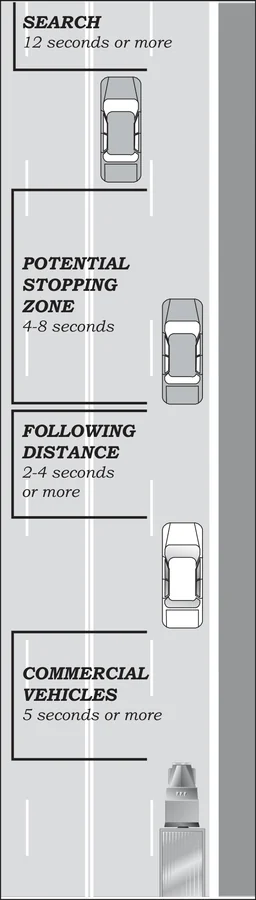
12 seconds
Minimum distance to look ahead — to where your vehicle will be 12 seconds from now
To check: pick a fixed object ahead and count "one thousand one, one thousand two…" until your front bumper passes it. If you didn't reach "one thousand twelve," look farther ahead. At 30 mph, 12 seconds is a little over a block.
To measure following distance, start counting when the rear of the vehicle ahead passes a fixed point, such as a sign. Reach the sign before "one thousand two" and you're following too closely.
The two-second rule is only a minimum. At 55 mph you'd need almost seven seconds to stop with perfect brakes and ideal conditions, so leave more room at highway speeds and whenever roads are slippery or visibility is reduced.
On a 40 mph boulevard, the car ahead passes a sign and you reach it at "one thousand one." You're too close — ease off until you count at least to "one thousand two," ideally four.
Check your understanding
Read the question, decide on an answer, then open it to check the explanation. These are Roadwise study questions based on the source handbook.
What is the minimum recommended following distance if you're driving 40 mph or less?
Two seconds
One second
Three seconds
Half a second
Answer: Two seconds
Stay at least two seconds behind the vehicle ahead when driving 40 mph or less.