Roadwise States Nebraska Driving lessons White lines, stop lines and crosswalks Nebraska driving lesson · Pavement Markings
White lines, stop lines and crosswalks A 2-minute lesson from the Nebraska course. Read the rules and examples, follow the handbook page references, and check your understanding before you move on.
Read time 2 minutes
Course unit Pavement Markings
Checkpoint questions 6
Source pages 53, 54 White lines separate lanes going the same way and show you where to stop. They also mark crosswalks, where pedestrians have the right-of-way.
Know the rule
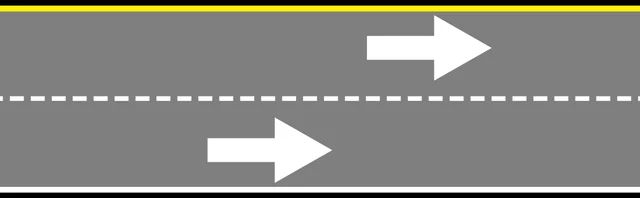
White lines separate lanes of traffic going in the same direction.
Handbook p. 53 ↗ Broken white lane line Know the rule
Broken white lines separate same-direction lanes and may be crossed with care.
Handbook p. 53 ↗ Know the rule
Solid white lines mark turn lanes and discourage lane changes near intersections.
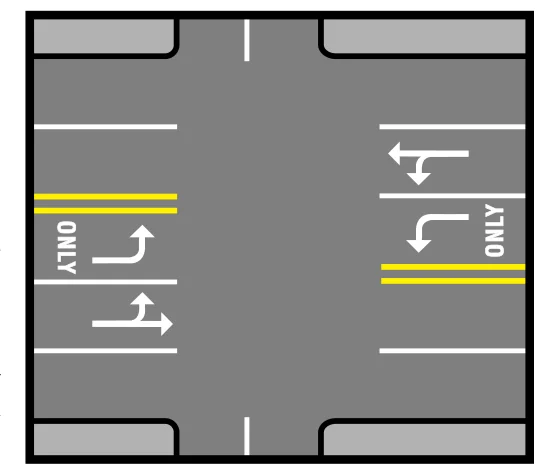
Handbook p. 53 ↗ Lane-use arrows at an intersection Know the rule
A lane marked with a curved arrow and the word ONLY means you must turn in the arrow's direction. A lane with both a curved and a straight arrow lets you turn or go straight.
Handbook p. 53 ↗ Stop line A white line painted across the pavement at an intersection showing where to stop. In urban areas it is usually about four feet before a crosswalk.
Handbook p. 54 ↗ Know the rule
When a stop line is present, you must stop at the line, not at the stop sign or traffic signal.
Handbook p. 54 ↗ Know the rule
Pedestrians have the right-of-way when they're in a crosswalk. Crosswalks may be midblock in residential and school areas, and may be unpainted.
Handbook p. 54 ↗ Put it into practice
Your lane has a curved left arrow and the word ONLY. Even if you meant to go straight, you must turn left from this lane, so plan your lane change earlier, before the solid white line.
Check your understanding Read the question, decide on an answer, then open it to check the explanation. These are Roadwise study questions based on the source handbook.
White lines on a roadway generally separate: Lanes of traffic traveling in the same direction Lanes of opposing traffic Reversible lanes during rush hour Shared center left-turn lanes Answer: Lanes of traffic traveling in the same direction
White lines separate same-direction lanes.
Handbook p. 53 ↗ Broken white lines separating same-direction lanes may be: Never crossed under any circumstance Crossed with care Crossed only by emergency vehicles Crossed only when turning right Answer: Crossed with care
Broken white lines may be crossed with care.
Handbook p. 53 ↗ Solid white lines near intersections are used to: Mark the center of a two-way road Indicate a reversible lane Discourage lane changes near the intersection Show where parking is allowed Answer: Discourage lane changes near the intersection
Solid white lines discourage lane changes approaching intersections.
Handbook p. 53 ↗ In urban areas, a painted stop line is usually located about how far before a crosswalk? One foot Ten feet Twenty feet Four feet Answer: Four feet
Stop lines are typically about four feet before the crosswalk.
Handbook p. 54 ↗ When both a stop sign and a painted stop line are present, drivers must stop: At the line, not at the sign At the sign, ignoring the line Wherever gives the clearest view, ignoring both Halfway between the sign and the line Answer: At the line, not at the sign
Drivers must stop at the painted line, not the sign.
Handbook p. 54 ↗ In a marked crosswalk, right-of-way belongs to: Whichever vehicle arrives first Pedestrians Vehicles turning right on red Vehicles that have a green light Answer: Pedestrians
Pedestrians have the right-of-way in marked crosswalks.
Handbook p. 54 ↗ Previous lesson Yellow center lines Next lesson Bike lanes, rumble strips and special markings More in Pavement Markings About the source Roadwise’s Nebraska course uses the driver handbook edition supplied with this study pack. This lesson cites source pages 53, 54. The linked PDF is a third-party mirror of the handbook, rather than a government-hosted page.
Open the handbook source PDF · View the source edition
For current application requirements, fees, appointments, and the format that applies to your age or license type, check Nebraska’s DMV. Roadwise provides study material and does not issue permits or licenses.