roadwise.Open study app

Nebraska driving lesson · Safety Equipment & Wellness

Air bags, children, pets and deer

A 3-minute lesson from the Nebraska course. Read the rules and examples, follow the handbook page references, and check your understanding before you move on.

Read time
3 minutes
Course unit
Safety Equipment & Wellness
Checkpoint questions
6
Source pages
33, 34, 47

Air bags protect you best when you're buckled up, but they deploy with great force. Where people sit and how you hold the wheel matter. Deer are another serious hazard on Nebraska roads.

Know the rule

Air bags are an added safety feature and do not replace wearing a seat belt. Combined with seat belts, they give improved crash protection.

Handbook p. 33 ↗
9 and 3

Recommended hand positions (o'clock) on a steering wheel with an air bag

Handbook p. 33 ↗
10 inches

Minimum space between you and an air-bag steering wheel

Handbook p. 34 ↗

Air bag safety:

  • Even in a low-speed crash, a deploying air bag can injure children, elderly people and short-statured adults
  • Children age 12 and younger should ride in the rear seat
  • Never put a rear-facing infant seat in the front passenger seat of an air-bag vehicle
  • Forward-facing child seat in an air-bag seat? Slide the vehicle seat as far back as possible
Handbook p. 33 ↗

Know the rule

Never, under any circumstance, leave children unattended or unsupervised in a motor vehicle.

Handbook p. 34 ↗

Know the rule

Don't leave pets in a vehicle: an animal can suffer heatstroke and die in a few minutes, even when it's relatively mild outside.

Handbook p. 34 ↗

Know the rule

About to hit a deer? BRAKE firmly, STEER to maintain control, and STOP as safely as possible. In a passenger vehicle, swerving puts you at more risk of death or injury.

Handbook p. 34 ↗

Lower your risk of a deer crash:

  • Don't veer off the road, out of control, or into oncoming traffic
  • Slow down in marked deer caution zones
  • Drive within the range of your headlights
  • Watch from dusk to dawn, in spring and fall, near waterways and wooded areas
  • Deer travel in groups: if you see one, watch for more
Handbook p. 34 ↗
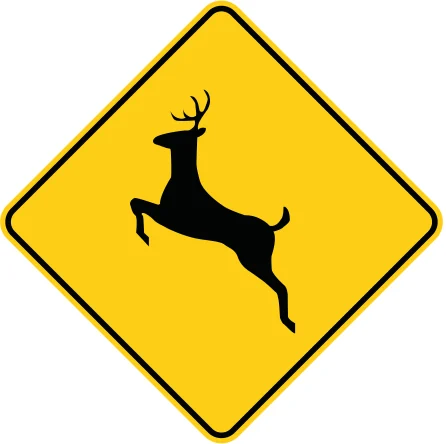
Deer crossing
Deer Crossing warning sign

Put it into practice

At dusk a deer jumps onto the highway ahead. Brake firmly and steer to keep control, but don't swerve into the ditch or the oncoming lane. Then watch for a second deer following the first.

Check your understanding

Read the question, decide on an answer, then open it to check the explanation. These are Roadwise study questions based on the source handbook.

The recommended hand position on a steering wheel equipped with an air bag is:
  1. 10 o'clock and 2 o'clock
  2. 8 o'clock and 4 o'clock
  3. 12 o'clock and 6 o'clock
  4. 9 o'clock and 3 o'clock

Answer: 9 o'clock and 3 o'clock

The recommended hand position for airbag-equipped wheels is 9 and 3 o'clock.

Handbook p. 33 ↗
For maximum safety, children age 12 and younger should ride:
  1. In the rear seat
  2. In the front seat with airbag off
  3. Anywhere, as long as buckled up
  4. Behind the driver only

Answer: In the rear seat

Children 12 and younger should ride in the rear seat for maximum safety.

Handbook p. 33 ↗
Never place a rear-facing infant safety seat:
  1. In the rear seat of any vehicle
  2. In the front passenger seat of an air-bag equipped vehicle
  3. On the driver's side rear seat
  4. In a vehicle without a passenger air bag

Answer: In the front passenger seat of an air-bag equipped vehicle

Rear-facing infant seats must never go in a front seat with an airbag.

Handbook p. 33 ↗
Drivers of air bag-equipped vehicles should allow at least how much space between themselves and the steering wheel?
  1. 5 inches
  2. 15 inches
  3. 10 inches
  4. 20 inches

Answer: 10 inches

At least 10 inches of space is recommended from the steering wheel.

Handbook p. 34 ↗
If your vehicle is about to hit a deer, the safest response is to:
  1. Swerve immediately to avoid the deer
  2. Steer onto the shoulder around it
  3. Flash your high beams and coast
  4. Brake firmly

Answer: Brake firmly

If you are about to hit a deer, the safest action is to brake firmly, steer to maintain control and stop; swerving raises your risk of death or injury.
Handbook p. 34 ↗
According to the handbook, when should you especially watch for deer?
  1. From dusk to dawn
  2. At midday, year-round
  3. Only during winter storms
  4. Only on interstate highways

Answer: From dusk to dawn

The handbook says to watch for deer from dusk to dawn, in spring and fall, near waterways and near wooded areas.

Handbook p. 34 ↗
Take the lesson checkpoint in the app

More in Safety Equipment & Wellness