roadwise.Open study app

Mississippi driving lesson · Speed, Signaling & Following Distance

Turn signals & arm signals

A 3-minute lesson from the Mississippi course. Read the rules and examples, follow the handbook page references, and check your understanding before you move on.

Read time
3 minutes
Course unit
Speed, Signaling & Following Distance
Checkpoint questions
6
Source pages
42

Signals are how you talk to other drivers. Use your blinkers well ahead of every turn, lane change, pass or parallel-parking move, and use them only to announce what YOU are doing.

Know the rule

Use your signal lights each time you intend to turn, change lanes, pass, or enter or exit a parallel parking space. The best way to notify other drivers is to signal well in advance.

Handbook p. 42 ↗

Know the rule

If the vehicle ahead signals a turn, turn on your signal ONLY IF YOU ALSO INTEND TO TURN. Don't signal to warn others that the vehicle in front of you is turning.

Handbook p. 42 ↗

Know the rule

Don't use your left signal to tell the driver behind you it's safe to pass. The driver behind you is responsible for deciding whether it's safe to pass.

Handbook p. 42 ↗

Know the rule

Arm signals are used by bicyclists, motorists whose signal lights are malfunctioning, and drivers of some antique vehicles and farm equipment.

Handbook p. 42 ↗
100 feet

With your arm fully extended, signal continuously for at least this distance before you slow, turn, stop or change lanes

Handbook p. 42 ↗

Arm signals

Arm signals
Arm positionMeansAlso used for
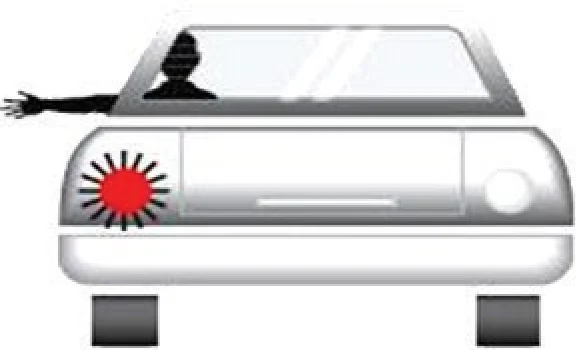
Straight outLeft turnRight-to-left lane change; leaving a parallel spot
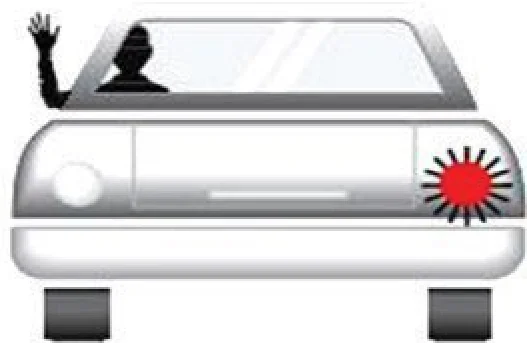
Upward, bent at the elbowRight turnLeft-to-right lane change; entering a parallel space
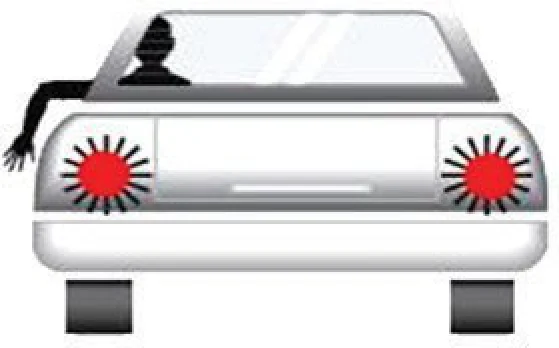
Downward, palm facing the rearSlow down or stopNo other use listed
Handbook p. 42 ↗
Hand signal left turn
Left turn: arm straight out
Hand signal right turn
Right turn: arm up, bent at the elbow
Hand signal stop or slow
Slow down or stop: arm down, palm to the rear

Put it into practice

Your turn signals stop working on the way home. Use arm signals: arm straight out for a left turn, arm up and bent at the elbow for a right turn, arm down with palm back to slow or stop, held for at least 100 feet before you act.

Check your understanding

Read the question, decide on an answer, then open it to check the explanation. These are Roadwise study questions based on the source handbook.

Should you signal simply because the vehicle ahead of you activated its turn signal?
  1. Yes, always signal to warn others
  2. Only if you're following a large truck
  3. Yes, but only on two-lane roads
  4. Only signal if you also intend to turn

Answer: Only signal if you also intend to turn

You should activate your signal only if you also intend to turn, not just because the car ahead did.
Handbook p. 42 ↗
Using arm signals, how must you signal a right turn?
  1. Extend your arm and hand straight out
  2. Extend your arm and hand upward, bent at the elbow
  3. Wave your arm in a circular motion
  4. Extend your arm and hand downward, palm to the rear

Answer: Extend your arm and hand upward, bent at the elbow

A right turn arm signal is made by extending the arm and hand upward with the arm bent at the elbow.

Handbook p. 42 ↗
For how many feet must an arm signal be extended and held before you slow, turn, stop, or change lanes?
  1. At least 25 feet
  2. At least 200 feet
  3. At least 100 feet
  4. At least 50 feet

Answer: At least 100 feet

Arm signals must be extended fully and signaled continuously for at least one hundred feet.

Handbook p. 42 ↗
How should you signal to slow down or stop using arm signals?
  1. Extend your arm upward, bent at the elbow
  2. Extend your arm and hand downward
  3. Wave your arm rapidly up and down
  4. Extend your arm straight out to the side

Answer: Extend your arm and hand downward

The slow-down-or-stop arm signal is made by extending the arm and hand downward with the palm facing the rear.

Handbook p. 42 ↗
What does extending your arm straight out signal?
  1. A left turn
  2. A right turn
  3. A stop
  4. Slowing down

Answer: A left turn

Extending the arm and hand straight out signals a left turn.

Handbook p. 42 ↗
You may use your left turn signal to let the driver behind you know it's safe for them to pass.
  1. True
  2. False

Answer: False

You should not use your signal for this purpose; the driver behind is responsible for judging whether it's safe to pass.

Handbook p. 42 ↗
Take the lesson checkpoint in the app

More in Speed, Signaling & Following Distance