roadwise.Open study app

Massachusetts driving lesson · Sharing the Road

Trucks, Buses & School Buses

A 4-minute lesson from the Massachusetts course. Read the rules and examples, follow the handbook page references, and check your understanding before you move on.

Read time
4 minutes
Course unit
Sharing the Road
Checkpoint questions
6
Source pages
113, 114, 115

Large vehicles need more room to stop and turn and have big blind spots. Many crashes happen because a smaller vehicle was hidden, followed too closely, or cut in too soon. School buses bring their own strict law.

Know the rule

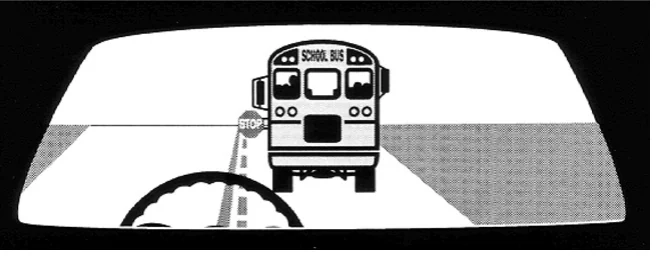
Yellow school buses have flashing red lights and a stop sign that folds out from the driver's side; pupil transport vans and cars have flashing red lights and SCHOOL BUS signs. Stop for them from either side of the road, and stay stopped until the lights stop flashing or the stop sign folds back.

Handbook p. 113 ↗
School bus ahead (driver's view illustration)
Obey school bus signals from either direction
$250

Fine for a first school bus violation, which can also cause a license suspension

Handbook p. 113 ↗

Know the rule

The only exception: a school bus stopped on the other side of a divided highway with a barrier between directions. After the warning signals stop, proceed slowly and keep looking for children.

Handbook p. 113 ↗

Know the rule

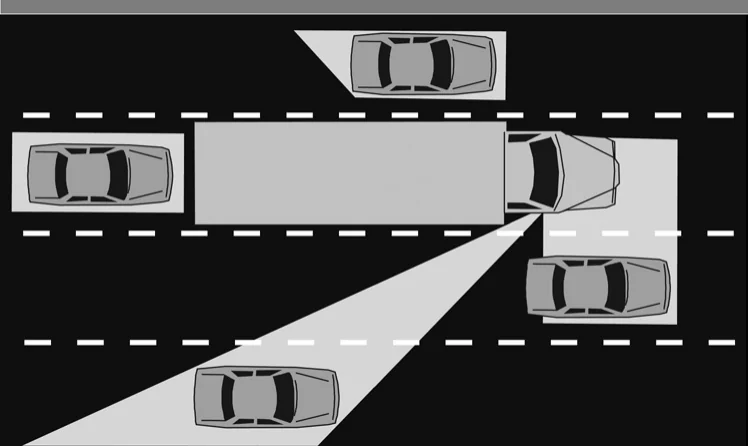
Don't follow closely behind a truck or bus, and know the driver's blind spots on the right, left, front and behind. If you can't see a truck's rearview mirrors, you are tailgating.

Handbook p. 114 ↗
Truck blind spot / following distance (diagram)
A tractor-trailer's blind spots

Know the rule

Don't pull in front of a large vehicle and then slow or stop suddenly. A large truck may need twice the distance to stop as a car or motorcycle, especially on wet or icy roads, and could hit you or jackknife.

Handbook p. 114 ↗

Know the rule

On a multiple-lane highway, trucks and buses may only use the two right-hand lanes: the far right for travel and the second for passing. In the second lane, keep up with traffic, never below the minimum speed, and move over to let a truck or bus pass when safe.

Handbook p. 114 ↗

Know the rule

Passing a tractor-trailer or bus takes longer; it may pull more than one trailer, and large vehicles go slower uphill and faster downhill. Avoid passing on the right: they may swing left before a wide right turn.

Handbook p. 114 ↗

Know the rule

When a truck or bus approaches on an undivided road, stay to the right to avoid a sideswipe or air turbulence. At intersections, judge its speed carefully and don't cut in front of it to turn.

Handbook p. 115 ↗

Buses and trolleys:

  • Let signaling buses pull away from bus stops
  • Watch for passengers getting on or off buses and trolleys
  • Stay at least eight feet from a trolley's passenger step while it loads or unloads
  • Look for oncoming trolleys before crossing tracks, and don't turn in front of one
  • Keep a safe distance: a trolley is limited to its tracks and can't swerve
Handbook p. 115 ↗

Put it into practice

On a two-lane road, a school bus stops across from you with red lights flashing. You must stop even though it's in the opposite lane, stay stopped until the lights stop, then go slowly and watch for children.

Check your understanding

Read the question, decide on an answer, then open it to check the explanation. These are Roadwise study questions based on the source handbook.

What must you do when a school bus stops with its red lights flashing on a two-way street?
  1. Stop only if you're behind the bus
  2. Stop, from either direction
  3. Slow down but you may pass carefully
  4. Stop only if children are visible outside

Answer: Stop, from either direction

You must stop for a school bus with flashing red lights from either direction, no matter which side of the road you're on.
Handbook p. 113 ↗
What is the fine for a first violation of the school bus stopping law?
  1. $100
  2. $500
  3. $250
  4. $50

Answer: $250

A first violation of the school bus stopping law carries a $250 fine plus possible license suspension.

Handbook p. 113 ↗
What is the one exception to the school bus stopping law?
  1. A bus stopped fewer than 100 feet away
  2. A bus without a stop sign extended
  3. There is no exception; you must always stop
  4. A bus across a divided, barriered highway

Answer: A bus across a divided, barriered highway

The only exception is a school bus stopped across a divided highway with a physical barrier between directions.

Handbook p. 113 ↗
How can you tell if you're following a truck too closely?
  1. If you can't see the truck's rearview mirrors
  2. If you're within 100 feet
  3. If you're in the left lane
  4. If you are within three seconds of it

Answer: If you can't see the truck's rearview mirrors

If you cannot see a truck's rearview mirrors, you are tailgating.

Handbook p. 114 ↗
How close may you drive to a trolley passenger step while it's letting passengers on or off?
  1. No closer than eight feet
  2. No closer than three feet
  3. No closer than 20 feet
  4. No closer than one foot

Answer: No closer than eight feet

You must not drive closer than eight feet of a trolley passenger step during loading.

Handbook p. 115 ↗
Trucks and buses are restricted to the two right-hand lanes on a multi-lane highway.
  1. True
  2. False

Answer: True

Trucks and buses can only drive in the two right-hand lanes of a multi-lane highway.

Handbook p. 114 ↗
Take the lesson checkpoint in the app

More in Sharing the Road