roadwise.Open study app

Kentucky driving lesson · General Driving Maneuvers

Parking

A 4-minute lesson from the Kentucky course. Read the rules and examples, follow the handbook page references, and check your understanding before you move on.

Read time
4 minutes
Course unit
General Driving Maneuvers
Checkpoint questions
6
Source pages
50, 51, 52

A parked car must never become a hazard. Park only in designated areas, as far from traffic as possible, and make sure the vehicle can't move once you walk away. Watch for signs and painted curbs that prohibit or limit parking.

Know the rule

When parking along a roadway, park as far from traffic as possible. If there's a curb, park as close to it as you can.

Handbook p. 50 ↗

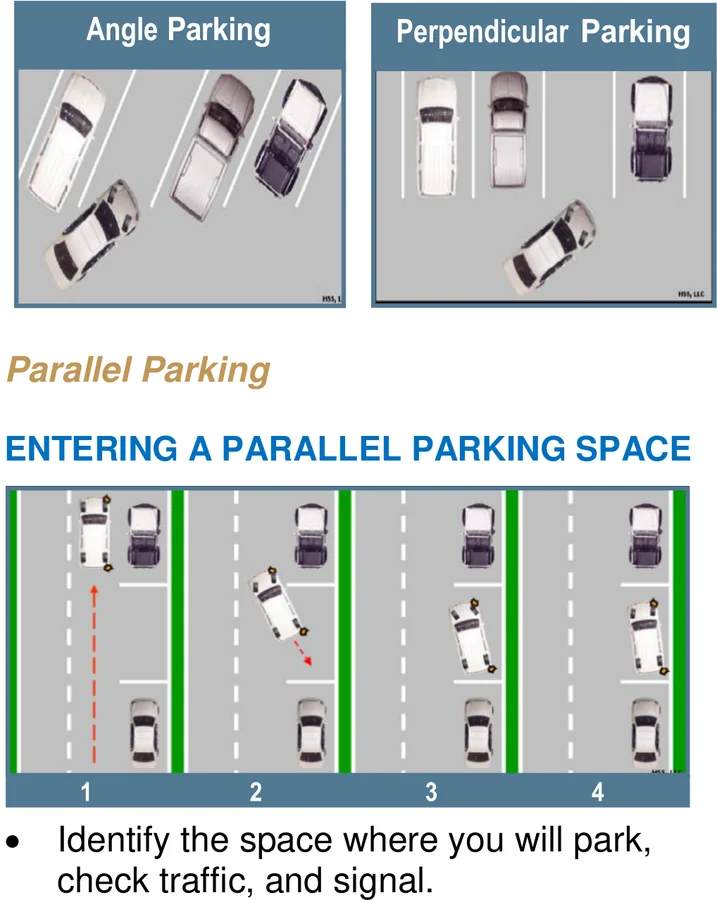
Entering an angle or perpendicular space:

  • Identify the space and check traffic
  • Signal your intentions
  • Move forward slowly, turning the wheel, until the car reaches the middle of the space
  • Center the vehicle; move to the front of the space, stop and secure it
Handbook p. 50 ↗

Leaving an angle or perpendicular space:

  • Check for traffic in all directions
  • Back straight until your front bumper clears the car beside you
  • Turn the wheel sharply the way the rear should move
  • When clear of the space, stop and shift to drive; accelerate smoothly, straightening the wheels
Handbook p. 51 ↗
Angle/perpendicular/parallel parking (composite)
Angle, perpendicular and parallel parking

Parallel parking—entering:

  • Identify the space, check traffic and signal
  • Shift to reverse and look toward the rear where you'll move
  • Back slowly, turning quickly, until your front bumper lines up with the rear bumper of the car ahead
  • Keep backing slowly, turning the wheel quickly to center the car
  • Stop before touching the car behind; shift to drive and adjust
  • Set the parking brake and shift to park (reverse in a manual)
Handbook p. 51 ↗

Parallel parking—leaving:

  • Check traffic, brake, shift to reverse and back close to the car behind
  • Check traffic and signal; shift to drive and move slowly, steering into the lane
  • Make sure your front bumper will clear the car ahead—if not, reverse and correct
  • Enter the lane when your door post passes the rear bumper of the car ahead
Handbook p. 51 ↗

Know the rule

The law requires you to turn off the engine and remove the key when you leave a vehicle. Always lock it, even for a short time. Get out on the curb side; if you must use the street side, check traffic first.

Handbook p. 51 ↗

Parking on a hill

Parking on a hill
SituationTurn your wheels so the car…
There's a curbTouches the curb if it starts to roll
No curbGoes off the road if it rolls
Handbook p. 52 ↗

Know the rule

Unauthorized parking in a handicapped space is unlawful and punishable by a fine. Those spaces are only for vehicles showing an official permit and carrying a disabled person; decals and plates come from the County Clerk.

Handbook p. 52 ↗

Put it into practice

You parallel park facing downhill on a street with a curb. Turn your front wheels so the car would roll into the curb, set the parking brake, shift to park, turn off the engine, take the key and lock up.

Check your understanding

Read the question, decide on an answer, then open it to check the explanation. These are Roadwise study questions based on the source handbook.

When parking along the roadway near a curb, you should:
  1. Angle your vehicle away from the curb
  2. Park at least 3 feet from the curb
  3. Park as close to the curb as possible
  4. Park facing traffic

Answer: Park as close to the curb as possible

When there is a curb, park your vehicle as close to it as possible, as far from the flow of traffic as you can.
Handbook p. 50 ↗
When exiting a parallel parking space, you should first:
  1. Pull straight forward immediately
  2. Signal, then pull forward into the lane
  3. Check traffic, shift to reverse, and back toward the vehicle behind you
  4. Turn the wheel toward the street first

Answer: Check traffic, shift to reverse, and back toward the vehicle behind you

Check traffic in all directions, shift to reverse, and back as much as possible toward the vehicle parked behind you before pulling out.

Handbook p. 51 ↗
If you are parked on a hill with a curb, you should turn your wheels so that:
  1. It will roll toward the car parked behind
  2. The wheels point straight regardless of grade
  3. The vehicle will roll into the travel lane
  4. It will touch the curb if it rolls

Answer: It will touch the curb if it rolls

Turn your wheels so the vehicle will touch the curb if it starts to move.

Handbook p. 52 ↗
If there is no curb, when parked on a hill you should turn your wheels so that:
  1. The wheels remain perfectly straight
  2. They point toward the center of the road
  3. The vehicle rolls back into traffic
  4. It will roll off the road

Answer: It will roll off the road

With no curb present, turn the wheels so the vehicle would roll off the road rather than into traffic.

Handbook p. 52 ↗
Kentucky law requires that when you leave your vehicle, you must:
  1. Turn off the engine and remove the key
  2. Set the parking brake only
  3. Leave the vehicle unlocked in case of emergency
  4. Lock the doors; the engine may idle

Answer: Turn off the engine and remove the key

The law requires drivers to turn off the engine and remove the key when leaving a vehicle.

Handbook p. 51 ↗
Unauthorized parking in a designated handicapped space is:
  1. Only a warning on the first offense
  2. Allowed for less than 15 minutes
  3. Unlawful and punishable by a fine
  4. Legal if no handicapped person is nearby

Answer: Unlawful and punishable by a fine

Unauthorized parking in a handicapped space is unlawful and punishable by a fine.

Handbook p. 52 ↗
Take the lesson checkpoint in the app

More in General Driving Maneuvers