roadwise.Open study app

Kansas driving lesson · Avoiding Collisions & Emergencies

Vision limitations: night, weather and glare

A 3-minute lesson from the Kansas course. Read the rules and examples, follow the handbook page references, and check your understanding before you move on.

Read time
3 minutes
Course unit
Avoiding Collisions & Emergencies
Checkpoint questions
6
Source pages
77

You must never drive faster than you can see. At night your headlights set the limit, and fog, rain, snow or glare can shrink it further. Match your speed to the distance you can see and stop within.

Know the rule

At night you must be closer to an object to see it, and you must be able to stop within the distance your headlights let you see.

Handbook p. 77 ↗

Headlight range

Headlight range
HeadlightsSee clearlySpeed to stop within it
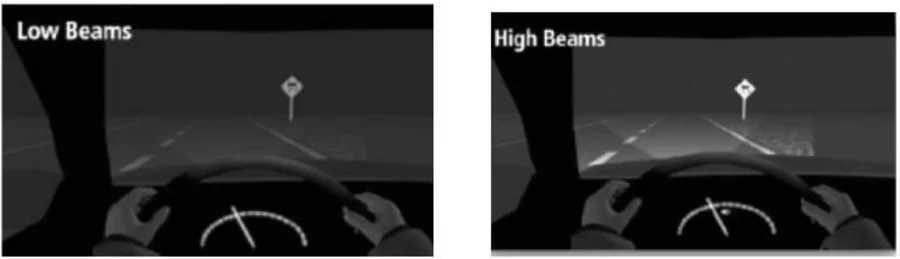
Low beamsAbout 150 to 200 feetAbout 45 mph
High beamsAbout 350 to 400 feetAbout 65 mph
Handbook p. 77 ↗
Low beams vs high beams (headlight patterns)
View with low beams versus high beams

Know the rule

At night add at least one second to your following distance, and at least two seconds on unfamiliar roads at night.

Handbook p. 77 ↗
30 mph

Top safe speed when you can't see farther than 100 feet due to rain, snow, blowing dust, smoke or thick fog

Handbook p. 77 ↗

Know the rule

If weather limits visibility so much you can't see well enough to drive, pull off the road in a safe place and wait until it clears.

Handbook p. 77 ↗

Know the rule

In fog, snow or heavy rain, use low beams and fog lights, even during the day, and watch for drivers who forgot their headlights.

Handbook p. 77 ↗

Know the rule

Sun glare in early morning or late afternoon: wear sunglasses, keep windows clean and use your sun visors. With the sun behind you, oncoming drivers may not see your signals or car.

Handbook p. 77 ↗

Know the rule

Near hills and curves where you can't see what's beyond, adjust speed so you can stop or steer around a stalled vehicle.

Handbook p. 77 ↗

Know the rule

Parked vehicles can hide people about to get out or step from between cars. Give parked vehicles as much room as the lane allows.

Handbook p. 77 ↗

Know the rule

Use at least a 3-second following interval, adding a second for any unusual weather or traffic condition, and reduce speed or adjust position for traffic congestion, hills and curves, and weather.

Handbook p. 77 ↗

Put it into practice

You're on a dark two-lane highway at 60 mph with oncoming traffic, so you're on low beams. Low beams show about 150 to 200 feet, which matches about 45 mph. Slow down so you can stop within what you can see.

Check your understanding

Read the question, decide on an answer, then open it to check the explanation. These are Roadwise study questions based on the source handbook.

Low-beam headlights let you see clearly about how far ahead?
  1. 500 to 600 feet
  2. 350 to 400 feet
  3. 150 to 200 feet
  4. 50 to 75 feet

Answer: 150 to 200 feet

Low beams illuminate about 150-200 feet ahead, while high beams reach about 350-400 feet.
Handbook p. 77 ↗
High-beam headlights let you see clearly about how far ahead?
  1. 350 to 400 feet
  2. 150 to 200 feet
  3. 600 to 700 feet
  4. 50 to 100 feet

Answer: 350 to 400 feet

High beams let you see about twice as far as low beams, roughly 350-400 feet.

Handbook p. 77 ↗
Driving at a speed that lets you stop within your low-beam visibility distance is about:
  1. 30 mph
  2. 65 mph
  3. 80 mph
  4. 45 mph

Answer: 45 mph

Given a roughly 150-200 foot low-beam range, 45 mph is about the speed that allows stopping within that visible distance.

Handbook p. 77 ↗
Driving at a speed that lets you stop within your high-beam visibility distance is about:
  1. 65 mph
  2. 30 mph
  3. 90 mph
  4. 45 mph

Answer: 65 mph

With a high-beam range of about 350-400 feet, roughly 65 mph is the speed that allows stopping within that distance.

Handbook p. 77 ↗
When visibility is reduced to 100 feet or less due to rain, snow, dust, or fog, you should not drive faster than:
  1. 45 mph
  2. 30 mph
  3. 20 mph
  4. 50 mph

Answer: 30 mph

When you cannot see farther than 100 feet due to poor conditions, the handbook says you cannot safely drive faster than 30 mph.

Handbook p. 77 ↗
How much extra following distance should you add for night driving conditions?
  1. No additional distance is needed
  2. Half your normal following distance
  3. Double your normal following distance
  4. At least one additional second

Answer: At least one additional second

Night driving conditions call for adding at least one extra second of following distance, and two extra seconds on unfamiliar roads at night.

Handbook p. 77 ↗
Take the lesson checkpoint in the app

More in Avoiding Collisions & Emergencies