roadwise.Open study app

Kansas driving lesson · Avoiding Collisions & Emergencies

Skids and rollovers

A 3-minute lesson from the Kansas course. Read the rules and examples, follow the handbook page references, and check your understanding before you move on.

Read time
3 minutes
Course unit
Avoiding Collisions & Emergencies
Checkpoint questions
6
Source pages
74, 76, 77

A skid happens when your tires can't grip the road, usually because you're too fast for conditions or stop too suddenly. You can't control a skidding car well, so the best defense is not to start one. Rollovers are rarer but far deadlier.

Know the rule

Skids are caused by traveling too fast for conditions, stopping too suddenly, or tires that can no longer grip the road.

Handbook p. 74 ↗

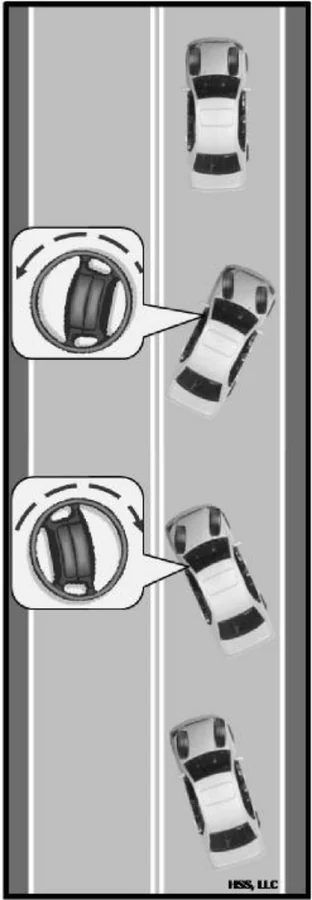
If your vehicle begins to lose traction:

  • Look for open space where the car can go; don't fixate on the hazard
  • Lift off the pedals to tell whether the front or rear tires are losing traction
  • Car keeps going straight while you steer: front traction is lost
  • Car moves sideways without more steering: rear traction is lost
  • Front lost: ease off the brakes, then reapply without skidding; with ABS, brake fully
  • Rear lost: steer toward your intended path; steer and counter-steer until straight
Handbook p. 74 ↗

Know the rule

Keep looking where you want to go, not into the oncoming lane. With traction technology, keep steering toward your path to help it work.

Handbook p. 74 ↗
Space cushion around your vehicle (diagram)
Front-wheel and rear-wheel skids

Rollover facts

Rollover facts
FactNumber
Vehicles in police-reported crashes that rollAbout one of every forty
Passenger vehicle occupant deaths in rolloversOne of every three
Rollovers with no other vehicle involvedMore than 80%
Handbook p. 76 ↗

Know the rule

Most rollovers happen in ordinary driving: a sudden swerve or veering off the road lets a curb, guardrail, tree stump or soft uneven ground 'trip' a sliding vehicle.

Handbook p. 76 ↗

Know the rule

SUVs, vans, pickups and small trucks roll over more often because of their higher center of gravity. Extra cargo and passengers also increase the chance of a rollover.

Handbook p. 76 ↗

Reducing rollover risk:

  • Obey the speed limit and take extra care in bad weather
  • Don't overcorrect; if you leave the pavement, slow gradually and don't jerk the wheel
  • Always wear your safety belt, the most effective protection
  • Side air bags triggered by rollover sensors help prevent ejection
Handbook p. 76 ↗

Know the rule

Without safety belts, occupants of a rolling vehicle can be thrown out, greatly increasing the risk of serious injury or death.

Handbook p. 76 ↗

Put it into practice

On an icy curve your car keeps going straight even as you turn the wheel. The front tires have lost traction. Ease off the brake to regain grip, then reapply without skidding (or brake fully if you have ABS) and steer where you want to go.

Check your understanding

Read the question, decide on an answer, then open it to check the explanation. These are Roadwise study questions based on the source handbook.

If your vehicle's front tires lose traction in a skid, what should you do?
  1. Ease off the brakes to regain traction, then reapply
  2. Pull the parking brake
  3. Accelerate to regain grip
  4. Turn the wheel sharply the other way

Answer: Ease off the brakes to regain traction, then reapply

Easing off the brakes helps the front tires regain traction; if equipped with ABS, you can apply the brakes fully for steering control.
Handbook p. 74 ↗
If your vehicle's rear tires lose traction and begin to slide sideways, you should:
  1. Hold the wheel still and wait
  2. Steer away from your intended path
  3. Brake hard immediately
  4. Steer in the direction of your intended path of travel

Answer: Steer in the direction of your intended path of travel

For rear traction loss, steer toward where you want to go and continue to steer and counter-steer until the vehicle straightens.

Handbook p. 74 ↗
About how many vehicles involved in a police-reported crash actually roll over, according to the handbook?
  1. About one of every four
  2. About one of every ten
  3. About one of every forty
  4. About one of every twenty-five

Answer: About one of every forty

The handbook states roughly one in forty crash-involved vehicles rolls over, yet rollovers cause a disproportionate share of fatalities.

Handbook p. 76 ↗
What fraction of passenger vehicle occupant deaths occur in rollover crashes, per the handbook?
  1. About one of every twenty
  2. About one of every three
  3. About one of every ten
  4. About one of every forty

Answer: About one of every three

Despite being relatively rare crashes, rollovers account for about one in three passenger vehicle occupant deaths.

Handbook p. 76 ↗
What percentage of all rollovers involve no other vehicle besides the one that rolls over?
  1. More than 80%
  2. About 20%
  3. About 50%
  4. Less than 10%

Answer: More than 80%

More than 80% of rollovers are single-vehicle events, often triggered when a driver overcorrects or a tire catches an edge or curb.

Handbook p. 76 ↗
What is the single most effective way to reduce the risk of injury or death in a rollover?
  1. Holding the steering wheel tightly
  2. Braking hard before impact
  3. Wearing your safety belt
  4. Leaning toward the center of the vehicle

Answer: Wearing your safety belt

The handbook identifies safety belt use as the most effective way to reduce rollover injury or death, since it prevents occupant ejection.

Handbook p. 76 ↗
Take the lesson checkpoint in the app

More in Avoiding Collisions & Emergencies