Parking in the wrong spot can get your car towed and ticketed, and parking the wrong way on a hill can send it rolling. Learn Hawaii's no-parking list, the key distances, and the parallel and hill parking steps.
Never park:
- Where your vehicle is a hazard to traffic (it will be towed)
- On a sidewalk or sidewalk area
- Blocking a public or private driveway
- In or so close to an intersection that you interfere with traffic
- In front of or so close to a fire hydrant that you could block its use
- On or so close to a crosswalk that you block drivers' view of pedestrians
- Where official signs or markings prohibit standing or parking
- On a bridge, elevated structure or in a tunnel
- Double parked beside a car stopped at the road edge, even if you stay in the car
- In a passenger or freight loading zone
Also never park:
- More than 12 inches from the curb
- Where less than 10 feet of street width is left for traffic
- On a public road to repair (except emergency), wash or display a vehicle for sale
- Outside a marked space, unless your vehicle is larger than the space
- On a public street for more than 24 hours continuously
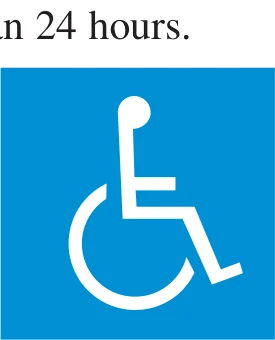
- In an accessible space without the placard or plate issued to the disabled person you're transporting
- In the access aisle beside an accessible space
Know the rule
The access aisle must stay clear so a wheelchair lift or ramp and other mobility devices can be deployed.
Handbook p. 29 ↗Know the rule
In a posted tow-away zone, don't park or stop even momentarily during the posted hours unless blocked by traffic. Police will tow your vehicle; contact them to recover it.
Handbook p. 29 ↗Know the rule
Where angle parking isn't designated, park parallel to the curb facing the direction of traffic, with curbside wheels within 12 inches of the curb or completely within the marked stall.
Handbook p. 73 ↗Know the rule
Park where you're clear of traffic and readily visible. Avoid hidden spots just beyond a curve or the crest of a hill.
Handbook p. 71 ↗Know the rule
On any hill, uphill or downhill, turn the front wheels toward the curb, set the hand brake, and shift to PARK (or reverse or low gear).
Handbook p. 71 ↗Parallel parked, bumpers no closer than this to other vehicles unless the street is marked otherwise
Handbook p. 72 ↗Parallel parking steps:
- 1. Signal, stop even with the front car about 18 inches away, rear bumpers even
- 2. Back slowly, turning sharp right until at about a 45-degree angle, then straighten and back slowly
- 3. When your front bumper passes its back bumper, turn sharply left and back to the rear car without touching
- 4. Turn sharply right, pull forward slowly and center the car
Know the rule
Angle parking: keep safe clearance and drive forward into the space, leaving equal space on each side between the lines.
Handbook p. 72 ↗Put it into practice
You find a spot on a steep downhill street. Turn your front wheels toward the curb, set the parking brake and shift to PARK. If the brakes slip, all four wheels must climb the curb before the car rolls into traffic.