Roadwise States Hawaii Driving lessons Keeping right, passing on the right, and signaling Hawaii driving lesson · Rules of the Road & Right-of-Way
Keeping right, passing on the right, and signaling A 4-minute lesson from the Hawaii course. Read the rules and examples, follow the handbook page references, and check your understanding before you move on.
Read time 4 minutes
Course unit Rules of the Road & Right-of-Way
Checkpoint questions 6
Source pages 26, 27, 73, 74 Hawaii traffic law starts simple: obey police, signs and markings, and keep right. The details, such as when you may use the left half of the road or pass on the right, and how far ahead to signal, are favorite test questions.
Know the rule
Obey all traffic laws, all lawful orders of a police officer, and all traffic signs, signals and pavement markings.
Handbook p. 26 ↗ Know the rule
Drive on the right half of the roadway and pass oncoming vehicles on the right. On narrow roads, give oncoming vehicles at least one-half of the main traveled portion.
Handbook p. 26 ↗ You MAY drive on the left half of the road when: Passing on a road with two or three lanes of moving traffic and no oncoming traffic An obstruction blocks your side and oncoming vehicles aren't using the left half Driving on a one-way street or road Handbook p. 26 ↗ You must NOT drive on the left half when: The road has four or more lanes for moving traffic (unless signs direct otherwise) Approaching the top of a hill or on a curve Within 100 feet of, or in, an intersection or railroad crossing Within 100 feet of a bridge or tunnel when you can't see oncoming vehicles Handbook p. 26 ↗ You may pass on the right: When the vehicle ahead is about to turn left – but never by driving off the pavement On a paved road with two or more marked lanes in each direction On a one-way street with two or more marked lanes Handbook p. 26 ↗ Know the rule
On marked lanes, drive entirely within your lane and don't change lanes until it can be done safely. On a divided highway, cross the barrier or unpaved space only at an opening or paved crossing where signs allow.
Handbook p. 27 ↗ 100 feet Minimum signaling distance before you change lanes, turn or stop (about five car lengths)
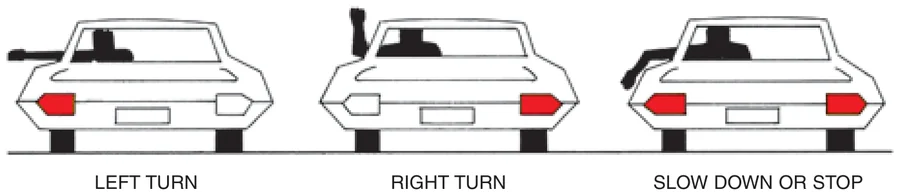
Handbook p. 27 ↗ Signaling rules: Signal every time, even when no other vehicles are in sight Signal for a greater distance at higher speeds Use hand signals when turn signals aren't working A signal doesn't give you the right to move – check it's safe first Don't rest your foot on the brake pedal; it flashes a false stop signal Handbook p. 27 ↗ Hand signals: left turn, right turn, slow down or stop Know the rule
If you must slow before a turn or lane change, begin signaling before you slow down.
Handbook p. 74 ↗ Common signaling errors: Not signaling while stopped at an intersection until the light changes Signaling too briefly, or only after the move has started Not signaling a right turn Not signaling in a lane that requires you to turn Not signaling because no one seems to be watching Handbook p. 74 ↗ Hazard warning signals (4-way flash) Warn others that a vehicle is in a hazardous position on the roadway. Never use them while the vehicle is moving. There is no hand signal for this.
Handbook p. 73 ↗ Why hand signals are harder to use: Hard to tell apart from other arm motions Hard to see in darkness and bad weather Not readily visible to drivers on your right The driver's window must be open You steer with one hand while signaling Handbook p. 73 ↗ Put it into practice
You're on a narrow two-lane road near Hana and a truck approaches. You must give it at least half of the main traveled portion of the road, even if that means squeezing close to the right edge.
A useful reminder 100 feet appears everywhere: signal distance, no left-half driving near intersections, bridges and tunnels.
Check your understanding Read the question, decide on an answer, then open it to check the explanation. These are Roadwise study questions based on the source handbook.
You must drive: in the lane with the least traffic on the right half of the roadway in the left lane unless turning right near the center line for visibility Answer: on the right half of the roadway
Hawaii law requires driving on the right half of the roadway.
Handbook p. 26 ↗ On a narrow road, you must allow an oncoming vehicle: the right-of-way if it is larger at least half the main traveled portion the full road while you pull off and stop at least one-third of the roadway Answer: at least half the main traveled portion
On narrow roads, oncoming traffic must be given at least half of the main traveled surface.
Handbook p. 26 ↗ You may legally drive on the left half of the roadway when: passing through a busy intersection within 100 feet of a bridge you can't see past approaching the top of a blind hill passing on a 2- or 3-lane road with no oncoming traffic Answer: passing on a 2- or 3-lane road with no oncoming traffic
You may use the left half to overtake on a road with two or three lanes of moving traffic when no traffic is coming from the opposite direction.
Handbook p. 26 ↗ You must NOT drive on the left half of the roadway when: driving on a marked one-way street the road has 4+ lanes, unless signs allow passing on a two-lane road with clear sight there's an obstruction blocking your lane Answer: the road has 4+ lanes, unless signs allow
Driving on the left half is prohibited on four-or-more-lane roads unless signs allow it.
Handbook p. 26 ↗ You may lawfully pass another vehicle on the right when: traffic ahead is heavy and slow it is about to make a left turn you're on a narrow one-lane road it is about to make a right turn Answer: it is about to make a left turn
Passing on the right is allowed when the vehicle ahead is about to turn left.
Handbook p. 26 ↗ Signals for turning, changing lanes, or stopping must be given for at least: 25 feet before the maneuver 200 feet before the maneuver 50 feet before the maneuver 100 feet before the maneuver Answer: 100 feet before the maneuver
Signals must be given at least 100 feet before the maneuver, about five car lengths.
Handbook p. 27 ↗ Previous lesson You, your attitude and crash risk Next lesson Speed limits, following distance and railroad crossings More in Rules of the Road & Right-of-Way About the source Roadwise’s Hawaii course uses the driver handbook edition supplied with this study pack. This lesson cites source pages 26, 27, 73, 74. The linked PDF is a third-party mirror of the handbook, rather than a government-hosted page.
Open the handbook source PDF · View the source edition
For current application requirements, fees, appointments, and the format that applies to your age or license type, check Hawaii’s DMV. Roadwise provides study material and does not issue permits or licenses.