Roadwise States Florida Driving lessons Stop lines, crosswalks, turn and bike lanes Florida driving lesson · Signs and Pavement Markings
Stop lines, crosswalks, turn and bike lanes A 3-minute lesson from the Florida course. Read the rules and examples, follow the handbook page references, and check your understanding before you move on.
Read time 3 minutes
Course unit Signs and Pavement Markings
Checkpoint questions 6
Source pages 53, 54 Pavement words, arrows and symbols tell you where to stop, which way a lane may go, and who a lane belongs to. They are enforced like signs.
Know the rule
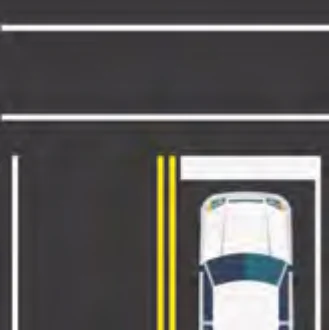
A white stop line shows where you must stop for a stop sign or red light. Stop before any part of your vehicle crosses the line before the crosswalk.
Handbook p. 53 ↗ Know the rule
Marked crosswalks have solid white lines, sometimes filled with diagonal or perpendicular stripes. Always yield to pedestrians in a crosswalk.
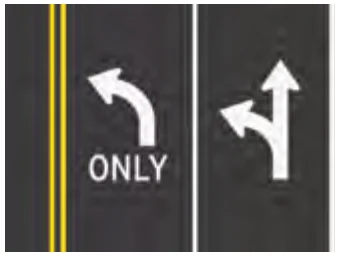
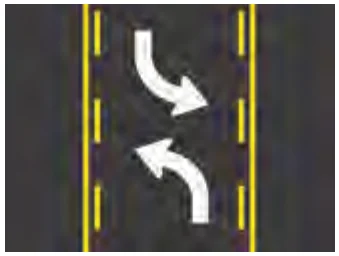
Handbook p. 53 ↗ White stop line before a marked crosswalk Turn lane markings: Curved arrow with the word ONLY: you must turn in the arrow's direction Curved and straight arrow together: you may turn or go straight Center lane on a two-way road: left turns from either direction; never for passing Handbook p. 53 ↗ Turn lane arrows: ONLY lane and turn-or-straight lane Center turn lane shared by both directions Reversible lane A lane whose direction is normally reversed at set times each day to handle rush-hour traffic. It is marked with special pavement markings, lane signals and signs.
Handbook p. 53 ↗ Know the rule
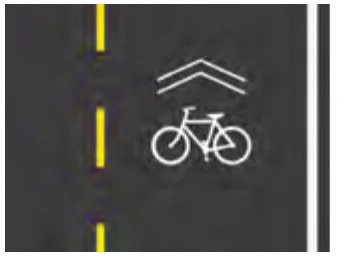
Sharrows also show bicyclists where to ride and discourage riding the wrong way.
Handbook p. 53 ↗ Know the rule
Motor vehicles may not drive in bike lanes. You may cross one to turn at an intersection, but only when no bicyclist is in it.
Handbook p. 53 ↗ Sharrow marking a shared-use lane Other markings: Yellow curbs: no parking, often near fire hydrants or intersections Yellow or white diagonal stripes: fixed obstructions such as medians or no-parking zones Fire lanes and safety zones: illegal to park in or drive through Handbook p. 54 ↗ Put it into practice
You want to turn right at an intersection, and a bike lane runs along the curb. Check your mirror and blind spot. If a bicyclist is in the lane, let them go first and turn behind them. Enter the bike lane only when it is clear.
Check your understanding Read the question, decide on an answer, then open it to check the explanation. These are Roadwise study questions based on the source handbook.
A turn lane marked with a curved arrow and the word 'ONLY' means: You must yield to all traffic You may go straight or turn Turn where the arrow points The lane is for buses only Answer: Turn where the arrow points
A lane marked with a curved arrow and 'ONLY' requires you to turn in the direction shown.
Handbook p. 53 ↗ A lane marked with both a curved and a straight arrow means you may: Only turn Only go straight Only make a U-turn Either turn or go straight Answer: Either turn or go straight
A lane marked with both a curved and straight arrow allows you to either turn or go straight.
Handbook p. 53 ↗ A two-way roadway with a shared center lane allows drivers from either direction to use it for: Left turns only Passing slower traffic U-turns only Parking briefly Answer: Left turns only
Drivers from either direction may use a shared center lane for left turns; it must not be used for passing.
Handbook p. 53 ↗ Pavement markings called 'sharrows' are used to: Mark a school crossing Indicate a reversible lane Mark a shared-use lane and alert motorists that bicyclists may use the full lane Show a fire lane Answer: Mark a shared-use lane and alert motorists that bicyclists may use the full lane
Sharrows mark shared-use lanes, alerting motorists that bicyclists may use the entire lane.
Handbook p. 53 ↗ When may a motor vehicle cross over a bicycle lane? Whenever you need to pass slower traffic Anytime traffic is heavy Never, under any circumstance Only when turning at an intersection and no bicyclists are present Answer: Only when turning at an intersection and no bicyclists are present
Motor vehicles may cross bike lanes when turning at intersections, but only when no bicyclists are present in the lane.
Handbook p. 53 ↗ Yellow curbs typically indicate: Bike lane boundaries No parking zones near fire hydrants or intersections Passing zones Loading zones for trucks Answer: No parking zones near fire hydrants or intersections
Curbs are often marked yellow to indicate no parking zones near fire hydrants or intersections.
Handbook p. 54 ↗ Previous lesson Edge lines and lane lines Next lesson Sign colors, guide signs and stop/yield signs More in Signs and Pavement Markings About the source Roadwise’s Florida course uses the driver handbook edition supplied with this study pack. This lesson cites source pages 53, 54. The linked PDF is a third-party mirror of the handbook, rather than a government-hosted page.
Open the handbook source PDF · View the source edition
For current application requirements, fees, appointments, and the format that applies to your age or license type, check Florida’s FLHSMV. Roadwise provides study material and does not issue permits or licenses.