roadwise.Open study app

Delaware driving lesson · Driving Skills & Safety

Seeing well & scanning

A 3-minute lesson from the Delaware course. Read the rules and examples, follow the handbook page references, and check your understanding before you move on.

Read time
3 minutes
Course unit
Driving Skills & Safety
Checkpoint questions
6
Source pages
113, 114, 115, 116, 117

The single biggest contributor to crashes is failing to see what's happening. Good drivers scan constantly—far ahead, to the sides and behind—so they spot trouble early and avoid last-second moves.

10 sec

How far ahead safer drivers look

Handbook p. 114 ↗

Ten seconds ahead is about…

Ten seconds ahead is about…
WhereDistance
In the cityAbout one block
On the highwayAbout four city blocks, or a quarter mile
Handbook p. 114 ↗

Find out how far ahead you're looking:

  • Pick a fixed object, like a sign or pole, about as far ahead as you're looking
  • Count one-one-thousand, two-one-thousand… until you reach it
  • The number you counted is how many seconds ahead you were looking
Handbook p. 114 ↗

Know the rule

Don't take your eyes off the road for more than a few seconds at a time; pull off safely to look at a map.

Handbook p. 113 ↗

Know the rule

Before entering an intersection, look left and right; if stopped, look again just before moving; and look across to make sure your path is clear all the way through.

Handbook p. 115 ↗

Know the rule

Look left and right even if cross traffic has a red light or stop sign—especially right after your light turns green, when others may rush through.

Handbook p. 115 ↗

Know the rule

If your view of a cross street is blocked, edge forward slowly until you can see. Crossing drivers will see your front bumper first.

Handbook p. 115 ↗

Know the rule

Before turning left, find a safe gap, check the street you're entering for vehicles and pedestrians, and look once more at oncoming traffic. Before turning right, check for traffic from the left, oncoming left-turners and pedestrians.

Handbook p. 115 ↗

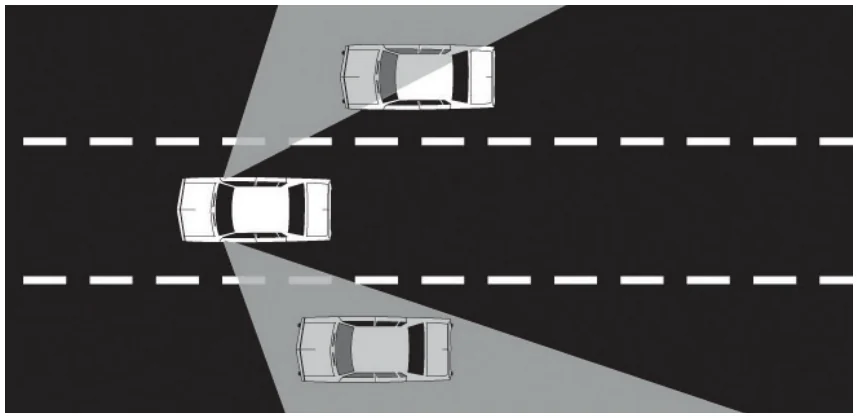
When changing lanes:

  • Signal your intention
  • Check your rearview and side mirrors
  • Look over your shoulder toward your blind spot
  • Check quickly—don't take your eyes off the road ahead for long
  • Check the far lane for anyone moving into the same space
  • Watch for harder-to-see motorcycles, bicycles and pedestrians
Handbook p. 116 ↗
Space cushion between vehicles diagram
Blind spots your mirrors can't show

Know the rule

Check behind you whenever you slow down—especially where following drivers won't expect it, like driveways or parking spaces—and when going down long or steep hills.

Handbook p. 117 ↗

Backing safely:

  • Check behind the vehicle before getting in—children and small objects can't be seen from the seat
  • Put your right arm on the seat back and look directly through the rear window
  • Back slowly; the vehicle is harder to steer in reverse
  • When possible, have someone outside help guide you
Handbook p. 117 ↗

Put it into practice

Your light turns green, but a car on the cross street is approaching fast. Look left and right before moving—drivers often hurry through just as the light changes.

Check your understanding

Read the question, decide on an answer, then open it to check the explanation. These are Roadwise study questions based on the source handbook.

Safer drivers try to look how far ahead of their vehicle while driving?
  1. 2 seconds
  2. 10 seconds
  3. 5 seconds
  4. 20 seconds

Answer: 10 seconds

Safer drivers tend to look at least 10 seconds ahead of their vehicle to spot hazards early.
Handbook p. 114 ↗
On the highway, looking 10 seconds ahead corresponds to about
  1. one city block
  2. one full mile
  3. a quarter of a mile
  4. 100 feet

Answer: a quarter of a mile

On the highway, 10 seconds ahead equals roughly a quarter mile, or about four city blocks.

Handbook p. 114 ↗
Before changing lanes, in addition to checking your mirrors you must
  1. only glance at the rearview mirror
  2. slow down by about 10 mph
  3. rely on the side mirror alone
  4. look over your shoulder to check your blind spot

Answer: look over your shoulder to check your blind spot

Mirrors cannot show your blind spot, so you must turn your head and look before changing lanes.

Handbook p. 116 ↗
Before backing your vehicle, you should
  1. walk around and check behind it before getting in
  2. rely solely on your rearview mirror
  3. assume children and pets will move out of the way
  4. avoid using a helper outside the vehicle

Answer: walk around and check behind it before getting in

You should check behind your vehicle before getting in, because children or small objects cannot be seen from the driver's seat.

Handbook p. 117 ↗
Looking well ahead while driving can help you save fuel by avoiding unnecessary hard braking.
  1. True
  2. False

Answer: True

Drivers who look ahead can slow down gradually and avoid the wasted fuel of sudden braking.

Handbook p. 115 ↗
You only need to check your blind spot when driving on the highway, not on local streets.
  1. True
  2. False

Answer: False

You must check your blind spot any time you change lanes or merge, on any type of road.

Handbook p. 116 ↗
Take the lesson checkpoint in the app

More in Driving Skills & Safety