Crashes often happen because one driver doesn't see another or is surprised by what they do. Use your lights, horn and signals so others know you're there and what you plan to do.
Know the rule
Turn headlights on when it starts to get dark; on rainy, snowy or foggy days; when driving away from a rising or setting sun; and whenever you use your wipers—that's the law in Delaware.
Handbook p. 118 ↗Using your horn
| Use | When |
|---|---|
| Light tap | Pedestrian or cyclist moving into your lane |
| Light tap | Driver starts turning into your lane as you pass |
| Light tap | Driver isn't paying attention or can't see you |
| Light tap | Approaching a steep hill, sharp curve or alley exit |
| Sharp blast | Child or older person about to enter the street |
| Sharp blast | Vehicle about to hit you, or you've lost control |
Don't use your horn to:
- Make someone drive faster or get out of the way
- Tell other drivers about an error
- Greet a friend
- Signal around blind pedestrians
If your vehicle breaks down:
- Get it off the road and away from traffic if at all possible
- Turn on your emergency flashers
- If you can't leave the road, stop where others can see you—not just over a hill or around a curve
- Place flares behind the vehicle so others can change lanes
- No flares? Stand safely off the road and wave traffic around, with a white cloth if you have one
- Never stand in the roadway, or change a tire in a traffic lane
- Lift the hood or tie a white cloth to the antenna, side mirror or door handle
Know the rule
Stay out of blind spots: don't drive beside and slightly behind another vehicle, get past quickly when passing, and never stay alongside a truck or bus.
Handbook p. 119 ↗Know the rule
Signal every time you change direction, even if no one seems to be around. Try to signal at least three seconds ahead—Delaware law requires signaling at least 300 feet before turning.
Handbook p. 120 ↗Know the rule
Don't signal too early: if there's a street, driveway or entrance before your turn, wait until you've passed it. Turn the signal off after a turn or lane change.
Handbook p. 120 ↗Know the rule
Before slowing where others won't expect it, tap the brake pedal three or four times. Signal slowing when turning off a road without turn lanes, parking or turning just before an intersection, or avoiding something ahead.
Handbook p. 120 ↗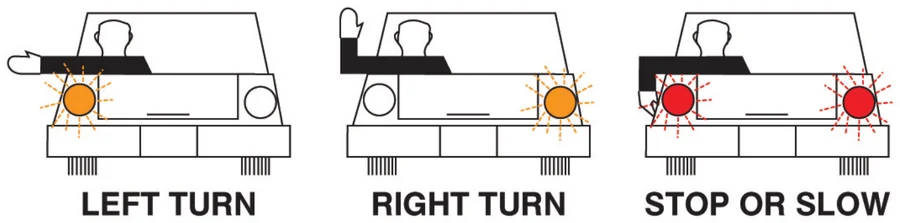
Know the rule
You must use a hand-and-arm signal, your turn signal or both continuously for at least 300 feet before turning—and signal much longer at high speed, especially when changing lanes on interstates.
Handbook p. 120 ↗Put it into practice
You plan to turn right into the second driveway, but a side street comes first. Wait until you've passed the side street to signal—otherwise a driver waiting there may think you're turning in and pull out in front of you.