roadwise.Open study app

Delaware driving lesson · Driving Skills & Safety

Basic vehicle control

A 3-minute lesson from the Delaware course. Read the rules and examples, follow the handbook page references, and check your understanding before you move on.

Read time
3 minutes
Course unit
Driving Skills & Safety
Checkpoint questions
3
Source pages
111, 112, 113

Smooth control starts before you move: parking brake on, correct gear, hands in the right place. Then accelerate gently, steer with purpose and stop early. Good drivers see events far enough ahead that they rarely need a panic stop.

Know the rule

Before starting, make sure the parking brake is on. Automatic transmission: shift to Park. Manual: not in gear (some cars also need the clutch pressed).

Handbook p. 111 ↗

Know the rule

Accelerate gradually and smoothly. Starting too fast can spin the drive wheels and make the vehicle slide, especially on slippery surfaces.

Handbook p. 111 ↗

Know the rule

Hold the wheel on opposite sides: left hand between 8 and 10 o'clock, right hand between 2 and 4 o'clock. On high-speed roads this lets you turn without taking your hands off the wheel.

Handbook p. 111 ↗

Know the rule

Use the hand-over-hand technique for sharp corners. After the turn, straighten the wheel by hand—letting it slip through your fingers can be dangerous.

Handbook p. 111 ↗

Know the rule

Look well down the road and to both sides, not just at the road right in front of you, so you can steer smoothly before you reach a situation.

Handbook p. 111 ↗

Know the rule

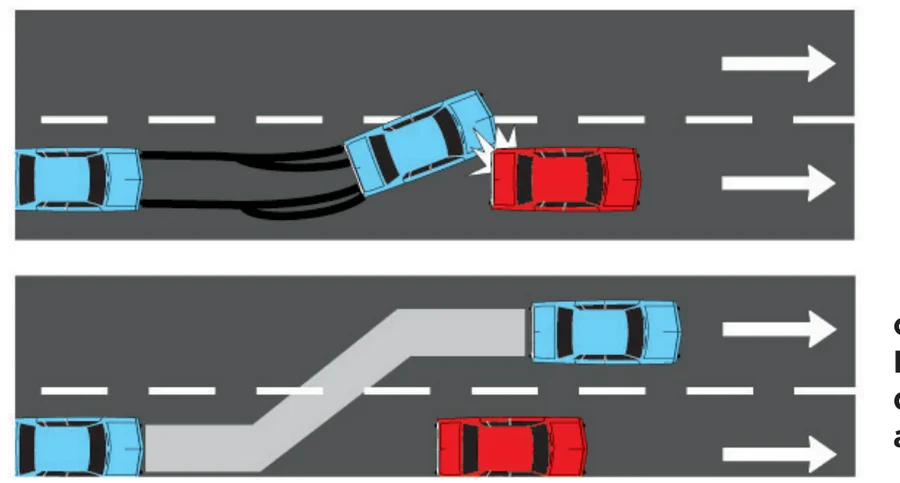
Avoid panic stops by seeing events early—slowing or changing lanes may mean you don't have to stop at all. Braking suddenly can skid you and makes it harder for drivers behind you to stop.

Handbook p. 112 ↗

Hard braking

Hard braking
VehicleWhat to do
With ABSBrake as hard as possible; steer if needed
Without ABSBrake hard without locking the wheels
Handbook p. 113 ↗
Lane change: incorrect vs correct path (composite)
Locked wheels skid and can't steer; with ABS the car stays steerable

Dealing with aggressive drivers:

  • Stay calm and don't take traffic problems personally
  • Avoid eye contact and don't challenge them
  • Stay away from erratic drivers
  • Get the tag number and report aggressive driving by calling 911
Handbook p. 113 ↗

Put it into practice

A car stops suddenly ahead of you on a slick road. If your car has ABS, press the brake as hard as you can and keep pressing while you steer around if needed. Without ABS, brake hard but stop short of locking the wheels.

Check your understanding

Read the question, decide on an answer, then open it to check the explanation. These are Roadwise study questions based on the source handbook.

Where does the handbook say to place your hands on the steering wheel?
  1. Left at 10–12 o'clock, right at 12–2 o'clock
  2. Both hands together at 12 o'clock
  3. Left at 6–8 o'clock, right at 4–6 o'clock
  4. Left between 8 and 10, right between 2 and 4 o'clock

Answer: Left between 8 and 10, right between 2 and 4 o'clock

Hands go on opposite sides: left between 8 and 10 o'clock and right between 2 and 4 o'clock.
Handbook p. 111 ↗
Before starting a vehicle with an automatic transmission, you should
  1. set the parking brake and shift to Park
  2. shift to Neutral and release the parking brake
  3. press the gas pedal twice
  4. shift to Drive with your foot on the brake

Answer: set the parking brake and shift to Park

Make sure the parking brake is on, and put an automatic transmission's shift selector in Park before starting.

Handbook p. 111 ↗
After a sharp turn, you should let the steering wheel slip through your fingers to straighten it.
  1. True
  2. False

Answer: False

Straighten the wheel by hand after a turn; letting it slip through your fingers could be dangerous.

Handbook p. 111 ↗
Take the lesson checkpoint in the app

More in Driving Skills & Safety