roadwise.Open study app

Arizona driving lesson · Safe Driving Practices

Following distance, space cushion & blind spots

A 3-minute lesson from the Arizona course. Read the rules and examples, follow the handbook page references, and check your understanding before you move on.

Read time
3 minutes
Course unit
Safe Driving Practices
Checkpoint questions
6
Source pages
25, 26

Space is your reaction time. The gap ahead of you gives you and other drivers time to respond in an emergency, and most rear-end crashes happen because someone followed too closely. Arizona teaches the 3-6 second rule.

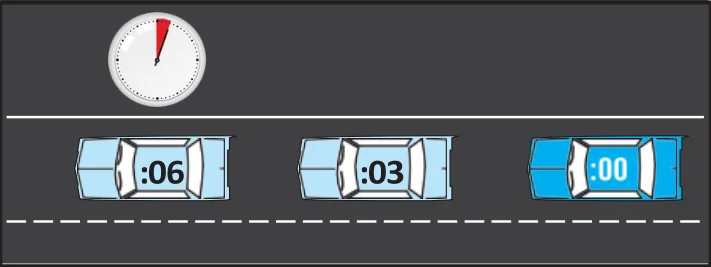
Following distance interval (clock)
Counting seconds of following distance from a fixed point

3-6 second rule

When the car ahead passes a fixed point, count "one-thousand-one…". Passing that point before you finish counting means you're following too closely.

Handbook p. 25 ↗
3–6 seconds

Following cushion; use more than 3 seconds in poor road conditions

Handbook p. 25 ↗

Know the rule

At faster speeds, leave a greater distance. At high speeds you travel farther while reacting, so your margin for error is smaller.

Handbook p. 25 ↗

Know the rule

Most rear-end crashes are caused by following too closely.

Handbook p. 25 ↗

Know the rule

Create a space cushion by staying in the middle of your lane, with enough room ahead and behind to pass or stop safely.

Handbook p. 25 ↗
3 ft

Minimum clearance when sharing a lane with a bicycle

Handbook p. 25 ↗

If someone tailgates you:

  • Gradually slow down and add extra space in front of you
  • That space lets you brake more slowly, giving the tailgater time to react
  • When safe, move to another lane to encourage the tailgater to pass
  • Help drivers behind you by keeping a constant speed and signaling early before slowing or stopping
Handbook p. 26 ↗

Blind spots

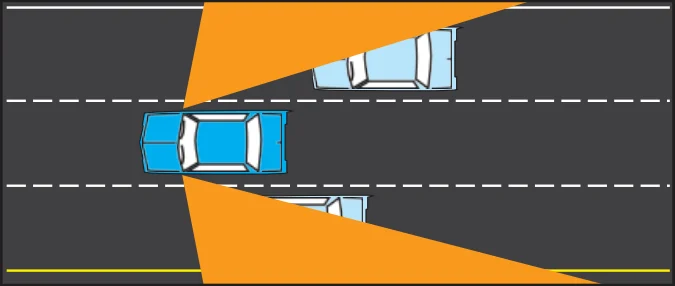
Areas on the left and right sides of your vehicle that are not visible in your mirrors.

Handbook p. 26 ↗
Vehicle sight and signal distance
Blind spots beside your vehicle

Know the rule

Never rely on mirrors alone — look over your shoulder before changing lanes. Don't linger in another driver's blind spot: speed up or drop back.

Handbook p. 26 ↗

Know the rule

If parked cars, bushes, trees or buildings block your view at an intersection, inch forward slowly until you can see clearly, then proceed when clear.

Handbook p. 26 ↗

Know the rule

Entering from a side road or private drive, stop and wait for traffic to clear. Don't trust a turn signal — wait until the other driver commits to the turn.

Handbook p. 26 ↗

Put it into practice

Rain is falling and the car ahead passes an overpass. You reach it at "one-thousand-two." That's too close for poor conditions — ease off until you have a cushion of more than 3 seconds.

Check your understanding

Read the question, decide on an answer, then open it to check the explanation. These are Roadwise study questions based on the source handbook.

What is the minimum recommended following distance for most driving situations?
  1. 3 seconds
  2. 2 seconds
  3. 1 second
  4. 5 seconds

Answer: 3 seconds

Allow at least a 3-second following distance for most driving situations.

Handbook p. 53 ↗
What is the most common cause of rear-end crashes?
  1. Failing to signal
  2. Driving with worn tires
  3. Following too closely
  4. Speeding on freeways

Answer: Following too closely

Most rear-end crashes are caused by following too closely.

Handbook p. 25 ↗
When sharing a lane with a bicycle, how much clearance must a motorist allow when passing?
  1. At least 10 feet
  2. At least 3 feet
  3. At least 1 foot
  4. At least 6 feet

Answer: At least 3 feet

Motorists must allow at least 3 feet of clearance when passing a bicyclist.

Handbook p. 25 ↗
If a driver is tailgating you, what is a recommended response?
  1. Gradually slow down to add space ahead
  2. Speed up to lose the tailgater
  3. Brake suddenly to warn them
  4. Turn on your high beams

Answer: Gradually slow down to add space ahead

If someone is following too closely, gradually slow down and give additional cushion between you and the vehicle ahead, which reduces how hard you must brake.
Handbook p. 25 ↗
You see a car ahead using its turn signal at a side road. What should you assume?
  1. That it is safe to enter the roadway right away
  2. That the signal is malfunctioning
  3. Nothing until the driver commits to the turn
  4. That the vehicle will definitely turn immediately

Answer: Nothing until the driver commits to the turn

Don't assume a vehicle using a turn signal is actually going to turn; wait until you see the driver commit to the turn.

Handbook p. 26 ↗
You should count 'one-thousand-one, one-thousand-two...' from a fixed point to help judge your following distance.
  1. True
  2. False

Answer: True

This counting method helps determine your following-distance cushion from the vehicle ahead.

Handbook p. 25 ↗
Take the lesson checkpoint in the app

More in Safe Driving Practices