roadwise.Open study app

Alaska driving lesson · Sharing the Road

Motorcycles

A 3-minute lesson from the Alaska course. Read the rules and examples, follow the handbook page references, and check your understanding before you move on.

Read time
3 minutes
Course unit
Sharing the Road
Checkpoint questions
6
Source pages
51, 52

Motorcycles are small, easy to miss, and hard to judge for speed and distance. In most motorcycle crashes the other driver is at fault, so consciously look for riders and give them a full lane.

Under 4% / 11%

Motorcycles are under 4% of U.S. motor vehicles but are involved in 11% of motor vehicle deaths

Handbook p. 51 ↗

Know the rule

Motorcyclists have the same rights and responsibilities on public roads as other drivers.

Handbook p. 51 ↗
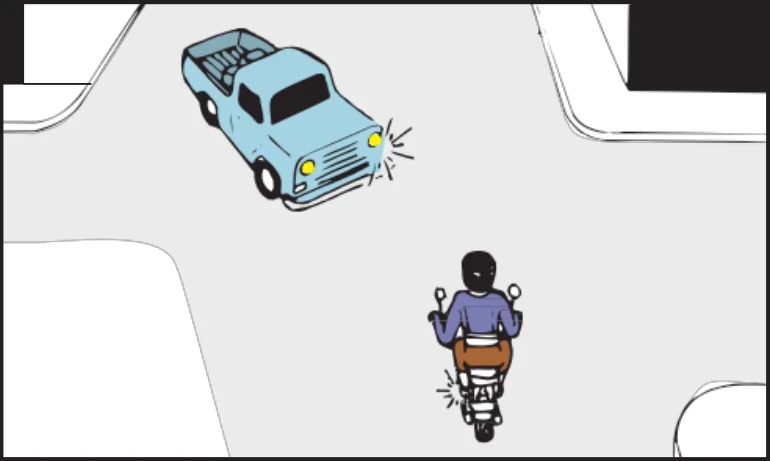
Motorcycle blind spot at intersections
A driver turning left in front of an oncoming motorcycle

Know the rule

Drivers turning left in front of oncoming motorcycles cause a large share of car/motorcycle crashes. Look once, then again, and be sure you see the motorcycle and know its speed before turning left.

Handbook p. 51 ↗

Know the rule

Most motorcycle turn signals don't turn off automatically. Before turning in front of a rider, be sure they are actually turning.

Handbook p. 52 ↗

Know the rule

Give motorcyclists the same four-second following distance as other vehicles, and more when the road is wet or slippery.

Handbook p. 52 ↗

Know the rule

A motorcycle needs a full lane. Never move into the same lane as a motorcycle, even if the lane is wide and the rider is to one side. It's illegal and extremely hazardous.

Handbook p. 52 ↗
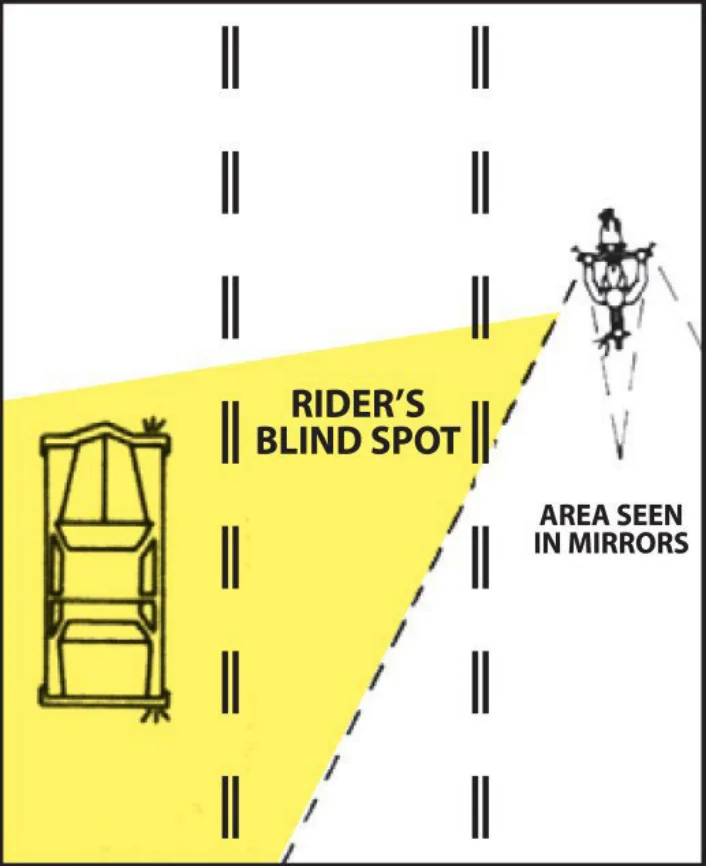
Motorcycle rider's blind spot
Rider's blind spot

Conditions that can make a rider suddenly change speed or direction:

  • Bad weather and slippery surfaces; also glare from rain and wet roads, especially at night
  • Strong crosswinds on open highways and bridges, and wind blasts from large fast trucks
  • Road hazards: gravel, debris, pavement seams, rain grooves, small animals, manhole covers
  • Railroad crossings: riders slow, rise off the seat, and may turn to cross the tracks head on
  • Metal or grated bridges: riders slow and move to the lane center; new riders may swerve
Handbook p. 52 ↗

Know the rule

Skilled motorcyclists constantly change position within their lane to see, be seen, and avoid objects.

Handbook p. 52 ↗

Put it into practice

You're waiting to turn left and see a motorcycle approaching with its left signal blinking. Don't assume it's turning. The signal may have been forgotten. Wait until you're sure the rider is turning.

Check your understanding

Read the question, decide on an answer, then open it to check the explanation. These are Roadwise study questions based on the source handbook.

According to the handbook, what share of the U.S. motor vehicle population do motorcycles make up?
  1. Less than 4 percent
  2. About 11 percent
  3. About 20 percent
  4. About 25 percent

Answer: Less than 4 percent

Motorcycles number less than 4% of U.S. motor vehicles, yet are involved in 11% of motor vehicle deaths.
Handbook p. 51 ↗
What is a common cause of car/motorcycle crashes, according to the handbook?
  1. Motorcyclists always speeding excessively
  2. Motorcyclists refusing to wear helmets
  3. Drivers turning left in front of oncoming motorcyclists
  4. Motorcyclists riding in the center of the lane

Answer: Drivers turning left in front of oncoming motorcyclists

Drivers turning left in front of oncoming motorcyclists cause a large share of these crashes.

Handbook p. 51 ↗
Why might a motorcyclist's turn signal still be blinking without them turning?
  1. It always means a mechanical failure
  2. It is illegal for a signal to stay on after a turn
  3. Motorcycles are not equipped with turn signals
  4. Most motorcycle turn signals do not turn off automatically

Answer: Most motorcycle turn signals do not turn off automatically

Most motorcycle turn signals don't self-cancel, so a blinking signal may be forgotten, not a real turn.

Handbook p. 51 ↗
Why do skilled motorcyclists often change position within a lane?
  1. To see and be seen and avoid road hazards
  2. To signal that they are about to turn
  3. To let cars share the lane with them
  4. To keep their tires warm

Answer: To see and be seen and avoid road hazards

Motorcyclists shift lane position to improve visibility and avoid hazards.

Handbook p. 51 ↗
Is it legal to share a lane side-by-side with a motorcyclist, even if the lane is wide?
  1. Yes, as long as you signal first
  2. No, it is illegal and hazardous
  3. Yes, if the motorcyclist waves you in
  4. Yes, but only below 25 mph

Answer: No, it is illegal and hazardous

Sharing a lane with a motorcycle is illegal and extremely hazardous, even if the lane looks wide enough.

Handbook p. 51 ↗
What following distance should you give a motorcyclist?
  1. Half the distance used for cars, since motorcycles are smaller
  2. No specific distance is needed
  3. The same four-second rule used for other vehicles
  4. Twice the distance required by law for cars

Answer: The same four-second rule used for other vehicles

The same four-second following distance applies to motorcyclists as to other vehicles.

Handbook p. 51 ↗
Take the lesson checkpoint in the app

More in Sharing the Road