roadwise.Open study app

Wyoming driving lesson · Defensive Driving & Conditions

Wyoming winter roads

A 3-minute lesson from the Wyoming course. Read the rules and examples, follow the handbook page references, and check your understanding before you move on.

Read time
3 minutes
Course unit
Defensive Driving & Conditions
Checkpoint questions
5
Source pages
44, 45, 46

Wyoming roads can turn slick, icy and treacherous fast when a winter storm hits. Move slowly, check the surface, and expect ice where you can't see it. Patience gets you through quicker than speed.

Know the rule

When traffic permits, test the surface: touch the brakes and see if your vehicle begins to slow down or swerve.

Handbook p. 44 ↗

Know the rule

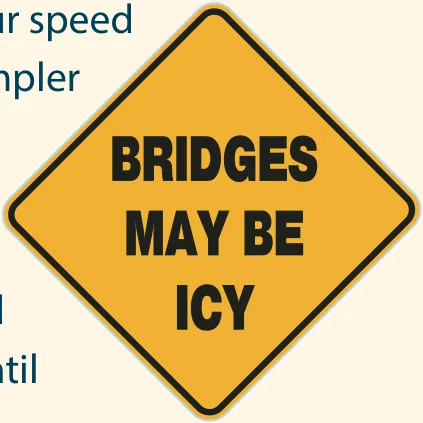
Watch for ice on bridges, overpasses and shaded areas, where it can remain even after the sun comes out.

Handbook p. 44 ↗

Black ice

Invisible, treacherous ice. Road surfaces can change suddenly from wet to extremely icy, often on bridge decks, overpasses, high fills, deep cuts and near snow fences.

Handbook p. 44 ↗

Know the rule

Thawing temperatures can leave a thin film of water over melting ice, making it even more slick.

Handbook p. 45 ↗
Watch for ice on bridge
Bridges may be icy

Know the rule

To start on snow and ice, accelerate slowly, steadily and carefully with the front wheels pointed straight ahead. Many drivers use second gear, or "drive" in an automatic.

Handbook p. 45 ↗

Know the rule

Four-wheel-drive and front-wheel-drive vehicles usually have better traction, but can skid with sudden changes in power, such as quickly releasing the accelerator. High four-wheel-drive vehicles are more likely to tip over in a skid.

Handbook p. 45 ↗

Know the rule

Increase your following distance: when the car ahead passes a landmark, count "one-thousand-one" through "one-thousand-four." If you reach the landmark first, you're following too closely.

Handbook p. 45 ↗

Braking on ice

Braking on ice
Brake typeWhat to do
ConventionalPump about once every second; jamming locks wheels
Anti-lock (ABS)Don't pump; ABS does it automatically
Handbook p. 46 ↗

Know the rule

If you begin to skid, gently turn into the skid and ease your foot off the gas until you regain control.

Handbook p. 46 ↗

In a ground blizzard over icy roads:

  • Slow down, but keep moving and don't panic
  • Make all steering, braking and speed changes SLOW
  • Lost your bearings? Roll down the window and look on the downwind side for the center stripe or road edge
  • If the vehicle ahead spins out on an icy hill, stay in line and wait for a snowplow
Handbook p. 46 ↗

Know the rule

If you stop to help someone who slid off the road, park well away from the site and be ready to get out of the way if another car loses control there.

Handbook p. 46 ↗
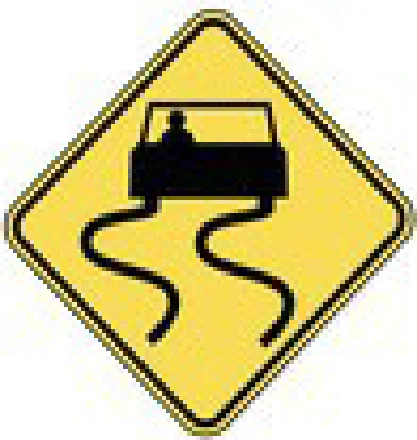
Slippery when wet
Slippery road warning sign

Put it into practice

A car ahead passes a mile marker on a snowy highway. You count "one-thousand-one" and reach the marker at "one-thousand-three." You're following too closely for these conditions. Ease off until you can count to four.

Check your understanding

Read the question, decide on an answer, then open it to check the explanation. These are Roadwise study questions based on the source handbook.

Black ice is easy to see, so you can spot it before you reach it.
  1. True
  2. False

Answer: False

Black ice is invisible and treacherous; watch for sudden changes from wet to extremely icy, especially on bridges and overpasses.
Handbook p. 44 ↗
What should a driver do if caught in a ground blizzard and losing their bearings?
  1. Speed up to get through the blizzard quickly
  2. Roll down the window and find the center stripe or road edge
  3. Turn on high beams and continue straight ahead
  4. Stop in your lane and wait for it to clear

Answer: Roll down the window and find the center stripe or road edge

If you lose your bearings in a ground blizzard, roll down the window and look on the downwind side to find the center stripe or edge of the road.

Handbook p. 46 ↗
On winter Wyoming roads, how does the handbook suggest checking the road surface when traffic permits?
  1. Accelerate hard to see if the tires spin
  2. Touch the brakes to see if you slow down or swerve
  3. Look for a shiny, wet-looking surface only
  4. Wait for your first skid to judge the road

Answer: Touch the brakes to see if you slow down or swerve

Touch the brakes to see if your vehicle begins to slow down or swerve, checking the road surface when traffic permits.

Handbook p. 44 ↗
On a snowy road, the car ahead passes a landmark. To check your following distance, how far should you be able to count before you reach it?
  1. One-thousand-two
  2. One-thousand-three
  3. One-thousand-six
  4. One-thousand-four

Answer: One-thousand-four

On winter roads, count 'one-thousand-one' through 'one-thousand-four'; if you reach the landmark first, you are following too closely.

Handbook p. 45 ↗
Your car has conventional (non-ABS) brakes and you must stop on ice. How should you brake?
  1. Press hard and hold steady pressure
  2. Pump the brakes about once every second
  3. Use only the parking brake
  4. Pump the brakes several times per second

Answer: Pump the brakes about once every second

Jamming on conventional brakes locks the wheels; pumping about once every second is a good rule of thumb. Don't pump ABS brakes.

Handbook p. 46 ↗
Take the lesson checkpoint in the app

More in Defensive Driving & Conditions