roadwise.Open study app

West Virginia driving lesson · Defensive Driving and Weather

Traffic conditions and crash situations

A 3-minute lesson from the West Virginia course. Read the rules and examples, follow the handbook page references, and check your understanding before you move on.

Read time
3 minutes
Course unit
Defensive Driving and Weather
Checkpoint questions
4
Source pages
75, 76

Traffic changes with the hour, the day, the season and the place. The handbook also describes six positions another vehicle can be in just before a crash, and how to defend against each.

When traffic is heavier

When traffic is heavier
FactorWhat to expect
Time of dayRush hour: inbound 7–9 am, outbound 4–6 pm
Industrial areasRush hours at work shift changes
Day of weekWeekdays heaviest; weekends bring longer trips
Time of yearSummer vacations and holiday weekends
Handbook p. 75 ↗

Know the rule

Holiday periods bring more tired, hurried and drunk drivers.

Handbook p. 75 ↗

Know the rule

Rural areas bring slow farm machinery, stray livestock, game animals, and faster drivers; urban areas bring more pedestrians, bicycles, intersections, and stop-and-go traffic.

Handbook p. 75 ↗

Know the rule

A defensive driver keeps track of how many heavy trucks and buses are around; they complicate passing and slow traffic on hills and grades.

Handbook p. 75 ↗
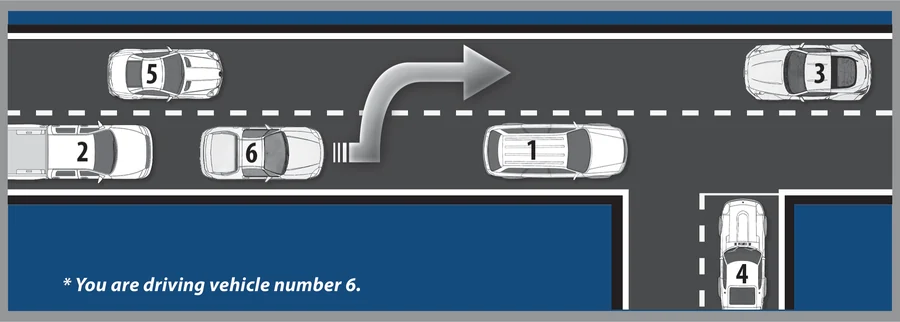
Traffic situation scenario (right-of-way test)
Traffic situations: you are vehicle 6

Six crash situations:

  • Vehicle ahead: may stop suddenly; stay alert and keep a safe following distance
  • Tailgating vehicle: signal every change in your driving pattern
  • Oncoming vehicle: may cross into your lane (asleep, drunk, distracted, passing, on a curve)
  • Vehicle at an angle: at intersections, driveways and parking lot entrances
  • Vehicle passing you: don't treat it as a challenge
  • When you pass: do it legally, smoothly and with consideration
Handbook p. 76 ↗

Know the rule

To avoid crashes with a passing vehicle, check your mirror often, slow down, and keep as far right as possible.

Handbook p. 76 ↗

Know the rule

Passing adds wear, burns fuel, and can lead to head-on, sideswipe or run-off-the-road crashes.

Handbook p. 76 ↗

Put it into practice

It's 5:15 pm on a Friday before a holiday weekend, leaving the city. Expect heavy outbound traffic, rushed and tired drivers, and possibly drunk drivers. Leave extra following distance and watch vehicles at angles from side streets.

Check your understanding

Read the question, decide on an answer, then open it to check the explanation. These are Roadwise study questions based on the source handbook.

During what hours is rush-hour traffic usually inbound to metropolitan areas?
  1. Between 4 pm and 6 pm
  2. Between 10 am and noon
  3. Between 7 am and 9 am
  4. Between 5 am and 6 am

Answer: Between 7 am and 9 am

Inbound rush-hour traffic to metro areas typically runs from 7 am to 9 am, with outbound traffic from 4 pm to 6 pm.
Handbook p. 75 ↗
What increases in traffic during summer months, according to the handbook?
  1. Only commercial truck traffic
  2. Only motorcycle traffic
  3. Only school bus traffic
  4. Vacation travel and holiday weekend traffic

Answer: Vacation travel and holiday weekend traffic

Summer months bring increased vacation travel and holiday weekend traffic volume.

Handbook p. 75 ↗
What is one way rural driving conditions differ from urban ones, per the handbook?
  1. Urban areas have fewer pedestrians and bicycles
  2. Rural areas have more stop-and-go traffic
  3. Urban areas have fewer intersections
  4. Rural areas may have slow farm machinery and stray livestock

Answer: Rural areas may have slow farm machinery and stray livestock

Rural driving may involve slow-moving farm machinery, stray livestock, and game animals as hazards.

Handbook p. 75 ↗
A faster vehicle starts to pass you on a two-lane road. What should you do?
  1. Speed up so it can't cut in
  2. Slow down and keep to the right
  3. Move toward the center line
  4. Tap your brakes to warn it off

Answer: Slow down and keep to the right

Don't treat being passed as a challenge: check your mirror, slow down, and keep as close to the right side as possible so the vehicle can pass.

Handbook p. 76 ↗
Take the lesson checkpoint in the app

More in Defensive Driving and Weather