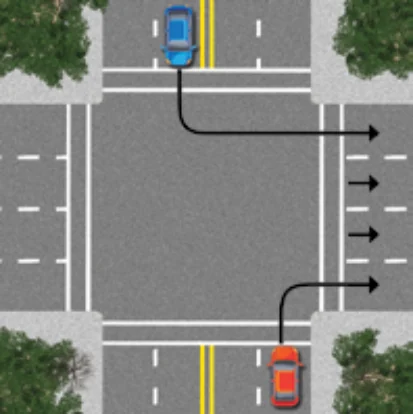
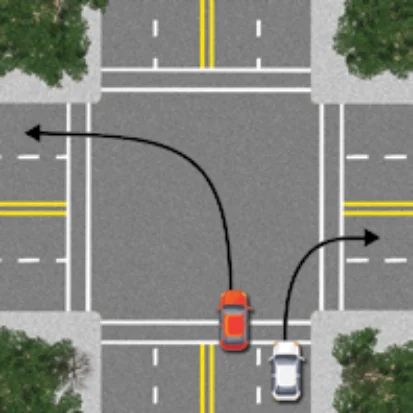
A 4-minute lesson from the Oregon course. Read the rules and examples, follow the handbook page references, and check your understanding before you move on.
Most turn mistakes come from starting in the wrong lane or ending in the wrong one. The rule of thumb: turn from the nearest lane in your direction into the nearest lane going where you want to go. One-way streets change which lane is nearest.
Know the rule
Turning rules apply everywhere you turn — driveways and alleys too, not just intersections.
Left turn on a two-way road: approach in the lane just right of the center line, look left, ahead, right and left again, and yield to oncoming traffic until safe. Turn just before the center of the intersection, ending just right of the new street's center line.
Dual left or right turn lanes: several lanes may turn the same way at once when signs or markings allow it. Follow the markings and stay in your lane through the turn.
General rule: turn from the nearest lane in your direction of travel into the nearest lane in the direction you want to go. Avoid swinging wide or changing lanes while turning.
You're on a two-way street at a red light, wanting to turn left onto a one-way street whose traffic flows left. Start in the lane just right of the center line, stop fully, yield to traffic and pedestrians, then turn into the nearest lane of the one-way street.
Check your understanding
Read the question, decide on an answer, then open it to check the explanation. These are Roadwise study questions based on the source handbook.
Before making a right turn, you should position your vehicle:
In the center of the lane
Close to the centerline
Partly in the bike lane
Close to the right curb or edge
Answer: Close to the right curb or edge
Right turns should be made close to the right curb or edge.