roadwise.Open study app

Ohio driving lesson · Before You Drive

Seat and mirror adjustments

A 3-minute lesson from the Ohio course. Read the rules and examples, follow the handbook page references, and check your understanding before you move on.

Read time
3 minutes
Course unit
Before You Drive
Checkpoint questions
6
Source pages
8, 9

A correct seat and mirror setup gives you full control, a clear view, and room for the air bag. Do it before you pull away — every time you get into a car someone else has driven.

Know the rule

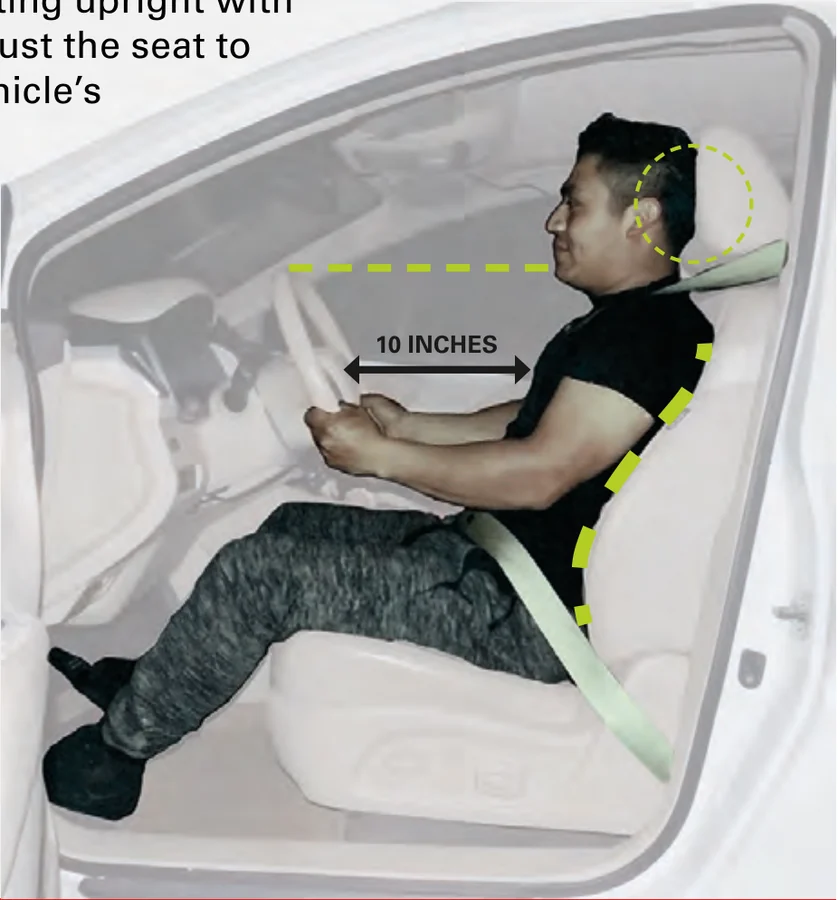
Sit upright with your back against the seat and feet on the floor. Adjust the seat for a clear view through the windshield and full control of the pedals and steering wheel.

Handbook p. 8 ↗

Your seat is adjusted properly when:

  • Your foot pivots smoothly from brake to accelerator with your heel on the floor
  • The top of the steering wheel is no higher than the top of your shoulders and below chin level
  • There are at least 10 inches between your chest and the steering wheel
  • The head restraint contacts the back of your head, not below ear level (to avoid whiplash)
Handbook p. 8 ↗
10 inches

Minimum space between your chest and the steering wheel, for air bag deployment

Handbook p. 8 ↗
Driver seating position adjustment
Good driving posture: upright, at least 10 inches from the wheel

Know the rule

The inside rear-view mirror is the primary mirror for the view to the rear. Adjust it to frame the rear window.

Handbook p. 9 ↗

Setting the outside mirrors to reduce blind spots:

  • Left mirror: rest your head against the closed driver-side window
  • Then adjust the left mirror until the vehicle's left edge is barely visible
  • Right mirror: lean right so your head is directly above the center console
  • Then adjust the right mirror until the vehicle's rear edge can barely be seen
Handbook p. 9 ↗
12–16°

Extra viewing area this mirror setting adds to each side of the vehicle

Handbook p. 9 ↗

Know the rule

With this setting, a vehicle passing you moves from the rear-view mirror into the side-view mirror, and when it leaves the side mirror it appears in your peripheral vision.

Handbook p. 9 ↗

Put it into practice

After adjusting your mirrors, you can't see the sides of your own car in them. That's correct — you've traded that view for 12 to 16 degrees of extra coverage on each side.

Check your understanding

Read the question, decide on an answer, then open it to check the explanation. These are Roadwise study questions based on the source handbook.

How much space should there be between your chest and the steering wheel for safe air bag deployment?
  1. At least 10 inches
  2. At least 6 inches
  3. At least 15 inches
  4. At least 4 inches

Answer: At least 10 inches

Ohio's handbook recommends at least 10 inches between your chest and the steering wheel to allow for air bag deployment.
Handbook p. 8 ↗
How should you adjust your left outside mirror to reduce blind spots?
  1. So half the vehicle is visible
  2. So the vehicle's left edge is barely visible in the mirror
  3. So it matches the inside mirror exactly
  4. So only the road behind is visible, with no vehicle in view

Answer: So the vehicle's left edge is barely visible in the mirror

The mirror should be adjusted so the vehicle's left edge is just barely visible, extending the viewing area outward.

Handbook p. 9 ↗
Properly adjusting your outside mirrors adds roughly how much extra viewing area to each side?
  1. 5 to 8 degrees
  2. 20 to 25 degrees
  3. 12 to 16 degrees
  4. 30 to 35 degrees

Answer: 12 to 16 degrees

Correctly adjusted outside mirrors add about 12 to 16 degrees of additional viewing area per side.

Handbook p. 9 ↗
What is the top of the steering wheel's recommended position relative to your shoulders when your seat is properly adjusted?
  1. At chin level
  2. No higher than the top of your shoulders
  3. At eye level
  4. At waist level

Answer: No higher than the top of your shoulders

A properly adjusted seat keeps the top of the wheel no higher than your shoulders and below chin level.

Handbook p. 8 ↗
Head restraints should contact the back of your head, not sit below the level of your ears.
  1. True
  2. False

Answer: True

Proper head restraint position helps avoid whiplash and should contact the back of the head, not below ear level.

Handbook p. 8 ↗
How should you position your body to adjust the right-side outside mirror correctly?
  1. Sit normally in the driver's seat
  2. Lean right so your head is above the center console
  3. Lean left toward the driver's door
  4. Lean forward toward the windshield

Answer: Lean right so your head is above the center console

For the right-side mirror, lean right so your head is directly above the center console, then adjust.

Handbook p. 9 ↗
Take the lesson checkpoint in the app

More in Before You Drive