Roadwise States Ohio Driving lessons Intersections, turns & turning on red Ohio driving lesson · Basic Vehicle Control & Intersections
Intersections, turns & turning on red A 3-minute lesson from the Ohio course. Read the rules and examples, follow the handbook page references, and check your understanding before you move on.
Read time 3 minutes
Course unit Basic Vehicle Control & Intersections
Checkpoint questions 6
Source pages 19, 20, 21 Most crashes happen at intersections. Slow down, search in a set pattern, and position your car correctly before, during and after the turn.
At every intersection, reduce speed and search for: Traffic control devices Oncoming and cross traffic, including motorcycles and bicycles — look left, right, then left again Pedestrians Roadway conditions Areas of limited visibility Handbook p. 19 ↗ When turning: Signal your intentions Search all corners for traffic controls, pedestrians and vehicles Get into the lane closest to the direction you want to go Look through the turn to the farthest point along your path Accelerate smoothly, make sure your signal cancels, and check traffic behind Handbook p. 19 ↗ 100 feet Signal at least this far before the turn — by turn signal or hand/arm signal
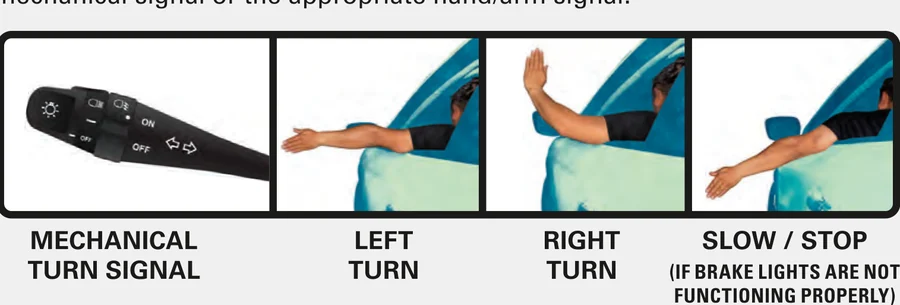
Handbook p. 20 ↗ Turn signal lever and hand signals: left, right, and slow/stop Know the rule
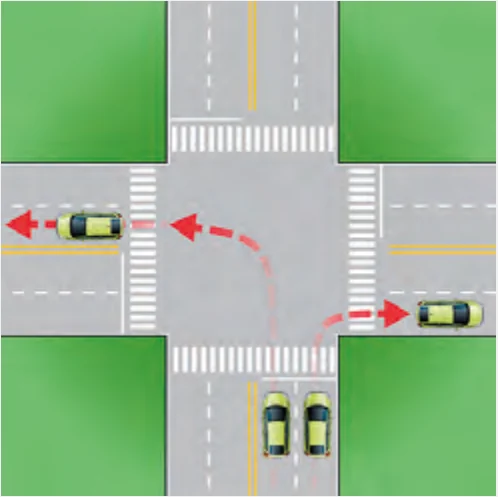
Right turns: don't swing wide to the left. Turn from the right-most part of your lane into the right-most part of the new street.
Handbook p. 20 ↗ Know the rule
Left turns: yield to oncoming traffic. Turn from the left-most part of your lane into the lane farthest left, just right of the center line — on four-lane highways too.
Handbook p. 20 ↗ Know the rule
Turning left on a green light: if traffic is heavy, position the front of your car slightly past the stop bar, yield to pedestrians and oncoming traffic, and turn when safe.
Handbook p. 20 ↗ Know the rule
Multiple turn lanes: pick the lane you'll turn from and stay in it until the turn is complete.
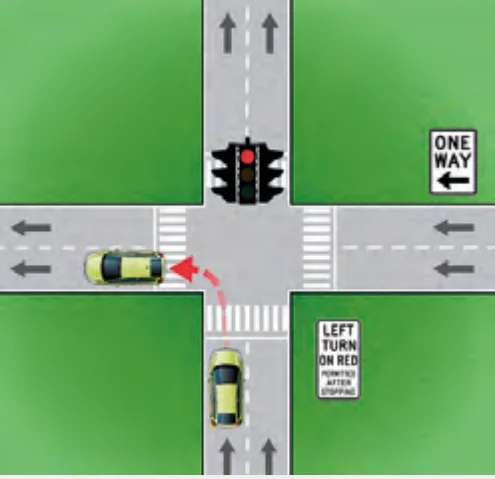
Handbook p. 20 ↗ Turn from the nearest lane into the nearest lane Left on red: from a one-way street onto another one-way street Intersection tips: An approaching car's signal doesn't prove it will turn — don't pull out without assured distance At a stop sign where you can't see crossing traffic, edge forward to check Wait for a gap big enough to cross, turn into the right lane and get up to speed Handbook p. 21 ↗ Put it into practice
You're stopped on red on a one-way street, in the far-left lane, and the cross street is also one-way to the left. After a full stop and yielding to traffic and pedestrians, you may turn left — unless a sign forbids it.
A useful reminder Left on red is legal only one-way to one-way, from the extreme left lane.
Check your understanding Read the question, decide on an answer, then open it to check the explanation. These are Roadwise study questions based on the source handbook.
Besides a mechanical turn signal, how else may you give the required signal before a turn? By flashing your headlights With the appropriate hand-and-arm signal By tapping your brakes twice By turning on your hazard lights Answer: With the appropriate hand-and-arm signal
A turn signal must be given at least 100 feet before the turn, using either a mechanical signal or the appropriate hand/arm signal.
Handbook p. 20 ↗ From which part of your lane should you make a right turn? The center of your lane The leftmost portion of your lane The rightmost portion of your lane Whichever portion has the least traffic Answer: The rightmost portion of your lane
Always turn right from the rightmost portion of your lane into the rightmost portion of the street you're entering.
Handbook p. 20 ↗ Before turning right on red, what must you do? Slow down but you don't need to stop if clear Signal only, no stop required Wait for a green arrow Come to a complete stop and yield to crossing traffic and pedestrians Answer: Come to a complete stop and yield to crossing traffic and pedestrians
You must come to a complete stop and let all crossing traffic and pedestrians clear before turning right on red.
Handbook p. 20 ↗ When is a left turn on red permitted in Ohio? Only from the far-left lane of a one-way street onto another one-way street From any lane onto any street From a two-way street onto a one-way street Never — all left turns on red are banned Answer: Only from the far-left lane of a one-way street onto another one-way street
A left turn on red is legal only from the extreme left lane of a one-way street onto another one-way street, unless prohibited.
Handbook p. 20 ↗ An oncoming vehicle has its left turn signal on as you approach an intersection. What should you assume? That it is definitely turning and you may proceed Nothing for certain — don't pull out until clear That it will stop to let you go first That it is switching lanes, not turning Answer: Nothing for certain — don't pull out until clear
Don't assume the vehicle is turning — it may turn after passing you or the driver may have forgotten to cancel the signal.
Handbook p. 21 ↗ You're on a one-way street approaching another one-way street, and a red light is showing with no sign prohibiting a turn. Can you turn left on red? Yes, from the far-left lane No, left turns on red are never allowed Yes, from any lane Only if a police officer waves you through Answer: Yes, from the far-left lane
A left turn on red is legal only from the extreme left lane of a one-way street onto another one-way street, unless prohibited.
Handbook p. 20 ↗ Previous lesson Steering & backing up Next lesson Roundabouts, lane position & changing lanes More in Basic Vehicle Control & Intersections About the source Roadwise’s Ohio course uses the driver handbook edition supplied with this study pack. This lesson cites source pages 19, 20, 21. The linked PDF is a third-party mirror of the handbook, rather than a government-hosted page.
Open the handbook source PDF · View the source edition
For current application requirements, fees, appointments, and the format that applies to your age or license type, check Ohio’s BMV. Roadwise provides study material and does not issue permits or licenses.