roadwise.Open study app

North Dakota driving lesson · Occupant Protection

Seat belts & air bags

A 3-minute lesson from the North Dakota course. Read the rules and examples, follow the handbook page references, and check your understanding before you move on.

Read time
3 minutes
Course unit
Occupant Protection
Checkpoint questions
6
Source pages
37, 38

Seat belts are one of the most effective safety devices you have. Most traffic deaths and serious injuries happen when people are thrown from the vehicle or onto the dashboard. Belts keep you in place.

Know the rule

North Dakota's seat belt law requires all occupants to wear seat belts in all seating positions.

Handbook p. 38 ↗
4 times

How much greater your chance of being killed is if you're thrown from the vehicle

Handbook p. 37 ↗

Know the rule

Crashes that cause injury are most likely at speeds under 40 mph and within 25 miles of home, so seat belts aren't just for highway driving.

Handbook p. 37 ↗

Know the rule

At 30 miles per hour, the force of a crash is like hitting the ground from the top of a three-story building.

Handbook p. 37 ↗

Know the rule

Seat belts also help you keep proper riding and driving posture, so you feel less tired after a trip.

Handbook p. 37 ↗

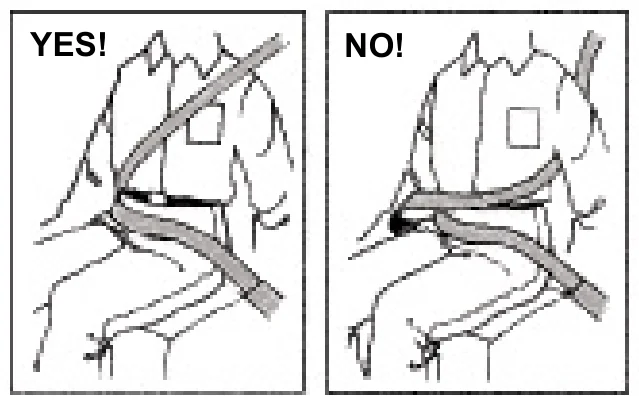
Wearing belts correctly:

  • Lap belt: snug and low across the hips, not across the abdomen
  • Shoulder belt: across the chest and over the collarbone, with minimal slack, if any
  • Automatic shoulder belts: you must still fasten the separate lap belt by hand
Handbook p. 38 ↗
Correct vs incorrect child car seat use
Correct (YES!) and incorrect (NO!) seat belt positions

Know the rule

Air bags give supplemental protection to belted front-seat occupants in a frontal crash. Lap/shoulder belts must always be used with them to protect you in side-impact and roll-over crashes.

Handbook p. 38 ↗

Know the rule

Air bags work best when everyone is buckled and children, especially those 12 and younger, are properly restrained in the back seat.

Handbook p. 38 ↗

Put it into practice

You're driving two miles across town at 30 mph. Buckle up anyway, and make sure every passenger does too. Injury crashes are most likely under 40 mph and within 25 miles of home.

Check your understanding

Read the question, decide on an answer, then open it to check the explanation. These are Roadwise study questions based on the source handbook.

How much more likely are you to be killed in a crash if you are thrown from the vehicle?
  1. Ten times more likely
  2. Two times more likely
  3. Four times more likely
  4. Equally likely either way

Answer: Four times more likely

Your chances of being killed are four times greater if you are thrown from the vehicle.
Handbook p. 37 ↗
How should a lap belt be worn?
  1. Snug and low across the hips
  2. However is most comfortable
  3. Loose and high across the stomach
  4. Across the chest only

Answer: Snug and low across the hips

Lap belts should lie snug and low across the hips, not across the abdomen.

Handbook p. 38 ↗
At 30 miles per hour, a crash's force is compared to what?
  1. Falling off a three-story building
  2. Being tapped from behind at 5 mph
  3. Falling from a one-story building
  4. Falling from a ten-story building

Answer: Falling off a three-story building

At 30 mph, the force of a crash is like hitting the ground from the top of a three-story building.

Handbook p. 37 ↗
What are air bags designed to do?
  1. Replace the need for seat belts entirely
  2. Deploy only in side-impact crashes
  3. Provide supplemental protection for belted front-seat occupants in a frontal crash
  4. Protect only rear-seat passengers

Answer: Provide supplemental protection for belted front-seat occupants in a frontal crash

Air bags are designed to provide supplemental protection for belted front-seat occupants in a frontal crash, and must be used with lap/shoulder belts.

Handbook p. 38 ↗
What does North Dakota's seat belt law require?
  1. Only the driver must wear a seat belt
  2. Only front-seat occupants must wear seat belts
  3. All occupants, in every seating position
  4. Seat belts are optional for adults

Answer: All occupants, in every seating position

North Dakota's seat belt law requires all occupants to wear seat belts in all seating positions.

Handbook p. 38 ↗
Where are traffic-related injury crashes most likely to occur, according to the handbook?
  1. Under 40 mph, within 25 miles of home
  2. Only in construction zones
  3. Exclusively in bad weather
  4. Only on the Interstate

Answer: Under 40 mph, within 25 miles of home

Crashes causing injury are most likely to occur at speeds less than 40 mph and within 25 miles of home.

Handbook p. 37 ↗
Take the lesson checkpoint in the app

More in Occupant Protection