roadwise.Open study app

North Dakota driving lesson · Points & Teen Driving

Aggressive driving & finding your blind spots

A 3-minute lesson from the North Dakota course. Read the rules and examples, follow the handbook page references, and check your understanding before you move on.

Read time
3 minutes
Course unit
Points & Teen Driving
Checkpoint questions
4
Source pages
47, 48

Aggressive drivers speed, run red lights and stop signs, tailgate, and ignore other people's safety. That behavior can quickly become road rage. Learn to spot it, in others and in yourself, and how to get away from it safely.

Road rage

What aggressive driving can easily escalate into. Motorists have killed or injured other drivers for seemingly trivial reasons.

Handbook p. 47 ↗

Signs that driving is aggressive, not just inexperienced:

  • Constant rushing, lane jumping, and the need to get ahead
  • Ignoring road signs and regulations
  • Constantly ridiculing and criticizing other drivers
  • Denying entry into your lane or preventing passing
  • Speeding past another car, revving the engine
  • Tailgating a driver to make them go faster or get out of the way
  • Honking, yelling, or making visible insulting gestures
Handbook p. 47 ↗

When confronted by an aggressive driver:

  • First and foremost, try to get out of their way
  • Put your pride in the back seat; don't speed up or hold your lane to challenge them
  • Wear your seat belt
  • Avoid eye contact
  • Ignore gestures and refuse to return them
  • Report them: vehicle description, license number, location and direction of travel
  • If you have a cell phone and can do it safely, call 911
Handbook p. 47 ↗
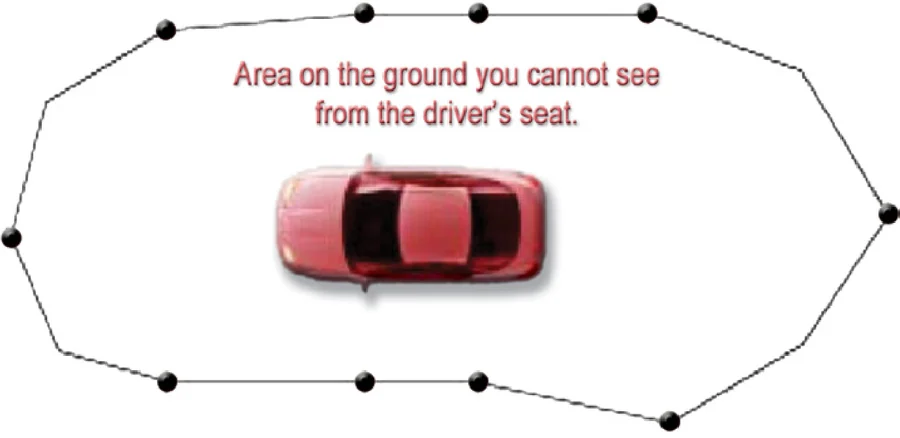
Ground area not visible from driver's seat
The area on the ground you cannot see from the driver's seat

Blind-spot exercise (engine off):

  • A helper stands close to the front bumper, facing the driver, and steps backward
  • The teen taps the horn when they can see the helper's feet; mark the spot with a cone or cup
  • Repeat behind the vehicle, using the inside mirror or looking over the right shoulder
  • Walk backward from the left and right passenger doors, marking the areas the driver can see
  • Have the teen measure these distances and record them
Handbook p. 48 ↗

Know the rule

The marked area in front shows the pavement you can't see through the windshield from the driver's seat.

Handbook p. 48 ↗

Put it into practice

A driver tailgates you, honking and flashing lights. Don't speed up or brake to teach them a lesson. When it's safe, move over and let them pass, avoid eye contact, and if you can do it safely, call 911 with their plate and direction.

Check your understanding

Read the question, decide on an answer, then open it to check the explanation. These are Roadwise study questions based on the source handbook.

When confronted by an aggressive driver, what is recommended?
  1. Make every attempt to get out of their way and avoid eye contact
  2. Brake suddenly to make them pass
  3. Speed up to maintain your position in the lane
  4. Flash your headlights and return any gestures

Answer: Make every attempt to get out of their way and avoid eye contact

When confronted by an aggressive driver, get out of their way, avoid eye contact, and do not challenge them by speeding up.
Handbook p. 47 ↗
Which behavior indicates aggressive driving rather than simple inexperience?
  1. Signaling every lane change in advance
  2. Checking mirrors every 6-8 seconds
  3. Driving at or below the posted speed limit
  4. Tailgating a driver to force them to go faster or get out of the way

Answer: Tailgating a driver to force them to go faster or get out of the way

Tailgating to intimidate another driver into speeding up or moving over is listed as a sign of aggressive driving.

Handbook p. 47 ↗
In the blind-spot exercise, when does the teen in the driver's seat tap the horn?
  1. When the helper reaches the rear bumper
  2. When the helper is 10 feet away
  3. When they can see the helper's feet
  4. When they lose sight of the helper's head

Answer: When they can see the helper's feet

The helper steps backward from the front bumper and the teen taps the horn when they can see the helper's feet, marking the area they can't see.

Handbook p. 48 ↗
When reporting an aggressive driver, what information should you provide?
  1. Only a description of the driver's face
  2. Vehicle, plate, location and direction of travel
  3. Your own name, license number and insurance company
  4. The make of the car and the time of day

Answer: Vehicle, plate, location and direction of travel

Report aggressive drivers with a vehicle description, license number, location, and if possible direction of travel.

Handbook p. 47 ↗
Take the lesson checkpoint in the app

More in Points & Teen Driving