roadwise.Open study app

North Carolina driving lesson · Basic Driving Skills & Rules

Railroad crossings

A 4-minute lesson from the North Carolina course. Read the rules and examples, follow the handbook page references, and check your understanding before you move on.

Read time
4 minutes
Course unit
Basic Driving Skills & Rules
Checkpoint questions
6
Source pages
32, 33

A train at 55 mph can take more than a mile to stop, and a train hitting a 4,000-lb car is like your car running over a soda can. The train always has the right of way, even over police, fire and ambulance vehicles.

15–50 feet

Required stop: within 50 feet but not less than 15 feet from the nearest rail

Handbook p. 32 ↗

You must stop at a crossing when:

  • An electric or mechanical signal warns a train is coming
  • A crossing gate is lowered or a flagger signals a train
  • A train within about 1500 feet sounds a signal and is an immediate hazard
  • An approaching train is plainly visible and in hazardous proximity
Handbook p. 32 ↗

Know the rule

Never drive through, around or under a crossing gate while it's closed, opening or closing. Pedestrians may not pass it either.

Handbook p. 32 ↗

Know the rule

When stopped at a crossing, keep as far right as possible, and don't form two lanes unless the road is marked for four or more lanes. Violations are infractions.

Handbook p. 32 ↗
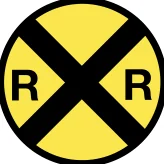
Railroad crossing ahead
Railroad advance warning sign
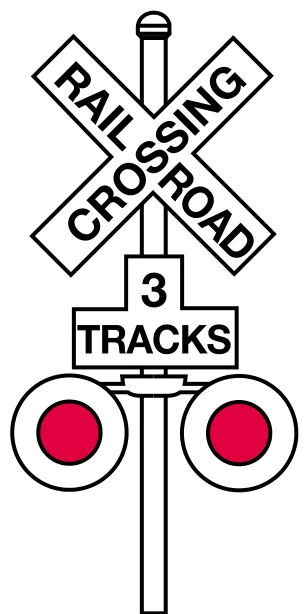
Railroad crossbuck (number of tracks)
Crossbuck with number-of-tracks sign and flashing lights

Crossing rules:

  • Yield to trains even at crossings with only a crossbuck and no lights or gates
  • Flashing red lights at a crossing mean stop, as for any flashing red signal
  • Don't go right after a train passes; another may come from either direction
  • Wait until the red lights stop flashing before moving
  • Never stop on train tracks for any reason; cross tracks only at designated crossings
  • Expect school buses, passenger and placarded hazmat vehicles to stop at crossings
Handbook p. 32 ↗

As you approach a crossing:

  • Slow your speed
  • Look both ways
  • Listen for the train
  • Keep alert
  • Watch for the crossing signal
Handbook p. 32 ↗

Know the rule

If lights start flashing or gates come down while you're crossing, keep moving; don't stop or back up. If the far gate comes down, drive through it: it's flexible and won't trap you.

Handbook p. 33 ↗

Know the rule

Make sure traffic ahead won't stop and trap you on the tracks before you start across.

Handbook p. 33 ↗
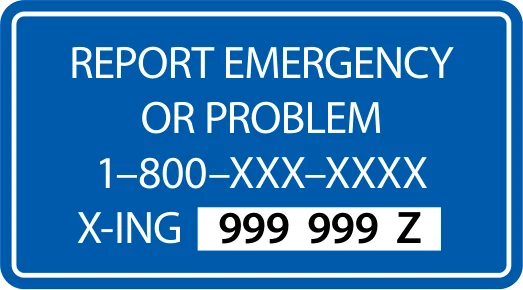
Railroad crossing emergency notification sign
Emergency Notification System (Blue) sign

Know the rule

Every NC crossing has a Blue Sign in each direction listing the crossing ID number, railroad name and emergency phone number.

Handbook p. 33 ↗

If your vehicle stalls on the tracks:

  • Get out immediately
  • Walk quickly away from the vehicle and tracks along the roadway
  • Once safe, call the number on the Blue Sign
  • Damaged or missing signs: USDOT FRA at 1-800-232-0144
Handbook p. 33 ↗

Put it into practice

Your car dies on the tracks and no train is in sight. Get everyone out right away and move away from the tracks. Then call the railroad's emergency number on the Blue Sign so it can stop trains.

Check your understanding

Read the question, decide on an answer, then open it to check the explanation. These are Roadwise study questions based on the source handbook.

When required to stop at a railroad crossing, where must you stop?
  1. Within 10 feet of the nearest rail
  2. Anywhere before the crossbuck sign
  3. 15–50 feet from the nearest rail
  4. At least 100 feet back

Answer: 15–50 feet from the nearest rail

The driver shall stop within 50 feet but not less than 15 feet from the nearest rail of the railroad.
Handbook p. 32 ↗
What should you never do at a railroad crossing?
  1. Slow down as you approach
  2. Look both ways before proceeding
  3. Listen for an approaching train
  4. Stop on the tracks for any reason

Answer: Stop on the tracks for any reason

Never stop on train tracks for any reason.

Handbook p. 32 ↗
At a crossing marked only with a crossbuck sign and no lights or gates, what must you do?
  1. Yield to any approaching train
  2. Proceed, since there are no lights
  3. Stop only if you hear a horn
  4. Stop only if a flagger is present

Answer: Yield to any approaching train

Vehicles must always yield to a train even when the crossing only has a crossbuck and no lights or gates.

Handbook p. 32 ↗
If you are already crossing the tracks when warning lights begin flashing, what should you do?
  1. Stop immediately on the tracks
  2. Keep moving — do not stop or back up
  3. Back up off the tracks
  4. Stop and wait for the lights to stop

Answer: Keep moving — do not stop or back up

If crossing when the lights begin flashing, do not stop or back up — keep moving, since the signal allows time to clear the crossing.

Handbook p. 32 ↗
If your vehicle stalls on or near railroad tracks, what should you do first?
  1. Try to restart the engine while staying inside
  2. Wait inside the vehicle for help
  3. Get out and move away from the car and tracks
  4. Push the vehicle off the tracks first

Answer: Get out and move away from the car and tracks

If your vehicle stalls on or near the tracks, get out immediately and move away from the vehicle and the tracks.

Handbook p. 33 ↗
What is the purpose of the Blue Sign (Emergency Notification System sign) at railroad crossings?
  1. It shows the speed limit through the crossing
  2. It gives the railroad's emergency phone number
  3. It shows the train schedule
  4. It marks a nearby fire hydrant

Answer: It gives the railroad's emergency phone number

The Blue Sign contains the railroad crossing ID, railroad company name, and an emergency phone number.

Handbook p. 33 ↗
Take the lesson checkpoint in the app

More in Basic Driving Skills & Rules